By Deborah Danan
Gilbert Meñoza spent decades as a Christian pastor in the Philippines before his study of the Hebrew Bible led him to reject the New Testament and embrace the “Noahide” faith.
Last week, Meñoza joined dozens of fellow Noahides from around the world in Israel, part of a movement of non-Jews who follow seven basic Jewish religious teachings without converting to Judaism.
The gathering, billed as the First International Congress of Noahides, was organized by Brit Olam, or Noahide World Center, a Jerusalem-based organization that claims thousands of followers in more than 70 countries.
Many study online or belong to small local communities, often with limited contact with other Noahides.
The five-day visit by more than 60 delegates from 22 countries included tours of biblical sites in the West Bank, a meeting with President Isaac Herzog and, in a nod to Theodor Herzl’s First Zionist Congress, the signing of a founding scroll of their own.
Unlike converts to Judaism, Noahides retain their non-Jewish identities while accepting the Hebrew Bible as a source of religious and moral guidance.
Known in Hebrew as B’nai Noah, they subscribe to the biblical account of G-d’s covenant with Noah following the flood. In Jewish tradition, that covenant established seven universal obligations — “the Seven Laws of Noah” — including the creation of a justice system and bans on murder, theft, idolatry, blasphemy, sexual immorality and consuming flesh taken from a living animal.
Many, like Meñoza, come from Christian backgrounds, although others have arrived at their beliefs through independent religious study.
Meñoza began studying with rabbis online years ago, eventually completing a three-year religious leadership course alongside more than 20 members of his community.
He now reaches a wider audience through radio and television broadcasts.
The congress sought to bring those communities together under a formal global structure.
At a ceremony attended by Jerusalem Mayor Moshe Lion, delegates signed a Scroll of the Noahide Covenant, a Hebrew declaration of their commitment to the people of Israel and the Torah.
Organizers also established an international court of rabbis from Brit Olam offering religious guidance to Noahide communities worldwide, and said in a statement that the congress “carries the blessings of Israel’s chief rabbis.”
For centuries, the Seven Laws of Noah remained largely a matter of Jewish religious teaching rather than an organized effort to reach non-Jews.
Rabbi Oury Cherki, president of Brit Olam, believes Israel’s establishment spurred the delivery of those teachings to a wider international audience.
Cherki hopes the Jerusalem congress will do for Noahides what Herzl’s 1897 gathering in Basel did for Zionism: transform a shared set of beliefs and aspirations into an organized international movement.
“Zionism achieved the material liberation of the Jewish people,” Cherki said, arguing that the next frontier must include building “a healthy connection with the outside world.”
Steven Lee Rachel, from Montreal, said he didn’t come from a “hardcore” Christian background and that his family and friends have been overwhelmingly supportive of his decision to become a Noahide.
“Becoming a Noahide has changed my everyday life for the better in almost every way, in terms of my spiritual life, my personal life, career as well, in terms of how I’ve been able to use that identity to build relationships in different industries,” he said.
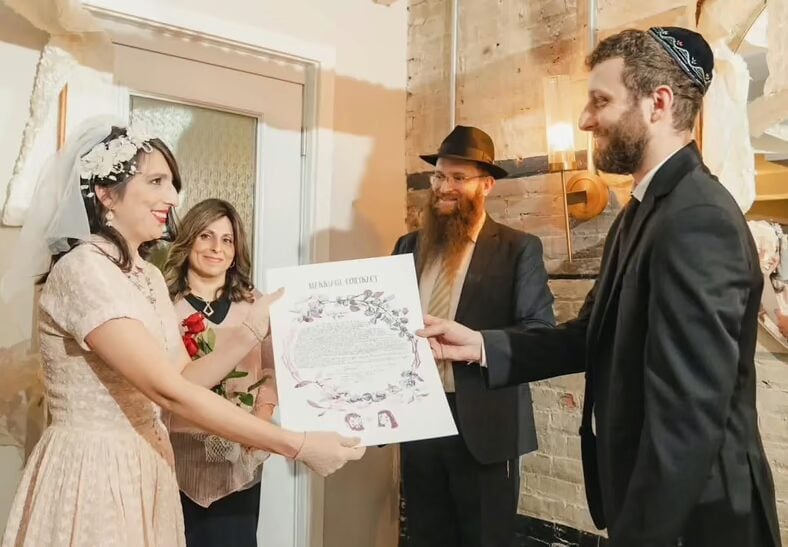
Three years ago, Rachel married fellow Noahide Camila Henriquez in a ceremony in Montreal co-officiated by Rabbi Yisroel Bernath, director of the local Chabad, and Aleeza Ben Shalom, the matchmaker featured in Netflix’s “Jewish Matchmaking.”
The couple exchanged vows beneath a chuppah, or wedding canopy, pledging to build their home according to the Seven Laws of Noah. They also signed a marriage contract and broke a glass.
The overwhelming majority of guests were not Jewish.
Bernath described the ceremony as highly unusual, saying he was unaware of any precedent for a rabbi officiating at a Noahide wedding.
Eliezer Vicente Yarid, a Cuban who now lives in the US, spent years helping others reconnect with their Jewish ancestry in a country where religious life had long been restricted, but ultimately chose not to convert to Judaism himself.
Yarid said he was 11 when his grandfather first told him their family descended from “Bnei Anusim,” Jews who had been forced to convert to Christianity during the Spanish and Portuguese Inquisitions.
“I didn’t understand what he was saying to me,” he said.
By his mid-teens, his family had begun observing Jewish religious practices at home.
In 2000, he and his parents established a “Bnei Anusim” community to help others reconnect with their Jewish heritage. Yarid initially sought to convert himself and later helped arrange visits by a rabbinical court to Cuba, where some community members underwent conversion.
But when an opportunity to convert arose after his move to the US, Yarid decided against it, saying he felt it was unfair to push his family into it.
He now follows the Seven Laws of Noah with his wife and son, while continuing to maintain ties with communities in Cuba, where he said he had also taught Noahide principles to people who had not converted.
The congress offered delegates practical guidance on building Noahide communities and strengthening their ties with Israeli rabbis.
“Israel is the focus of the world’s attention, for better or worse,” Rabbi Chaim Goldberg, chief executive of Brit Olam, says. “Noahides see the children of Israel, the people of the Bible, coming back to life in the modern age.”
Meñoza hopes to establish permanent institutions and overcome challenges facing Noahides back home in the Philippines.
His community, for example, is raising money to purchase land for a cemetery because local burial procedures have made it difficult to avoid embalming, which conflicts with Torah practices.
“We want the Noahide community in every city where we work to have its own land, its own building, and its own fellowship center, with a beit midrash where they can learn together,” he said, using the Hebrew term for a religious study hall.