While Colorado’s lack of snowfall this past winter was devastating for the state’s ski industry, it will be challenging for Colorado homeowners and groundskeepers who cherish their green lawns and gardens.
Roughly 83% of the water that Coloradans use for drinking, agriculture and recreation comes from snowpack and spring runoff. Most of the major river systems in the state — including the Colorado, Rio Grande Arkansas and Platte Rivers — derive roughly 60%-80% of their annual streamflow from snowmelt.
In 2026, Colorado experienced its worst snowpack year in recorded history, with snow water equivalent levels dropping to just 22% of the historic median, well below previous low years like 2012.
As a result, on March 25, Denver Water declared a Stage 1 drought, mandating twice-a-week watering restrictions to reduce consumption by 20% — and delaying watering altogether for most of this past spring — until May 15.
Beyond Denver, the following Front Range jurisdictions are also imposing watering restrictions: Aurora, Arvada, Brighton, Edgewater, Golden, Northglenn and Thornton.
These cities have voluntary watering restrictions: Broomfield, Boulder, Erie, Evergreen and Longmont.
Under Denver’s restrictions, lawns can only be watered twice a week, and no watering is allowed between 10 a.m. and 6 p.m. to mitigate evaporation of water during the heat of the day.
People with even-number addresses will water Sunday and Thursday; odd addresses, Wednesday and Saturday.
Multi-family buildings and HOA properties may be watered Tuesday and Friday.
Hand-watering of trees, shrubs and gardens is allowed any day, but not between 10 a.m. and 6 p.m.
Other rules:
• Do not water during rain or high winds and avoid spray on paved surfaces.
• Fix broken or leaking sprinklers with 10 days.
• For car-washing, use a nozzle with a shut-off valve.
First violations of these regulations result in warnings, with subsequent fines of $250 and $500 for the second and third infractions.
Another issue posed by the drought is its effect on agriculture. Approximately 70% to 80% of the Colorado River’s water is used for agriculture, according to the Lincoln Institute of Land Policy.
Studies indicate that roughly 52% of the total water is directly consumed by crops, irrigating about 5.5 million acres.
A significant portion of this water — about 32% to 62% of agricultural usage — is dedicated to growing cattle feed, such as alfalfa and hay.
That means if water is in short supply and water prices go up, so does the cost of food.
The challenge for Front Range homeowners in 2026 to provide enough water to lawns to keep them green while using less water than in previous years, when most people watered three times a week. Watering efficiency is key.
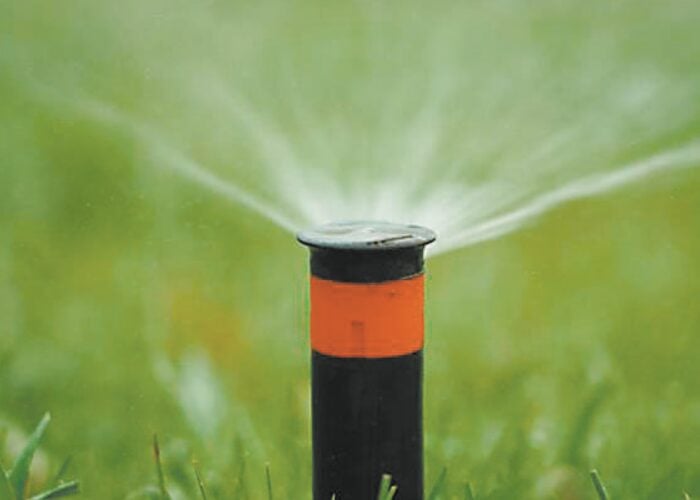
Denver Water says that irrigation technology has led to the widespread installation of in-ground home sprinkler systems, although it should be noted that hand-setting sprinklers attached to garden hoses has been shown to be equally or more efficient than watering landscapes with in-ground systems.
“Cycle-and-soak” is a simple lawn watering technique than can greatly improve the health of your grass without using more water — and possibly using less, according to Jay Adams, a content producer for Denver Water.
The technique involves splitting the total amount of time you run your run sprinkler system zones on a watering day into two or three cycles, instead of running the zone all at once.
Cycle-and-soak is useful because the soil at many homes in Denver Water’s service area has a high clay content, which means the soil can only absorb so much water at a time.
Once the soil is saturated, additional water from the sprinkler will simply start puddling, or run off and go down the sidewalk and onto the street.
Cycle-and-soak is also a great technique if your grass is on a slope or a hill.
Lyle Fair, a landscape professional with the Associated Landscape Contractors of Colorado, says cycle-and-soak is a tried-and-true technique to maximize water use during irrigation season.
“If you are running a sprinkler zone for 14 minutes, the ground likely can’t absorb all that water at once, so the last couple of minutes of that run time is a waste of water,” Fair said.
“Splitting up the sprinkler zone run times on a watering day puts the same amount of water down — or possibly less. But does it in a more efficient manner.”
To maximize efficiency, split up each zone’s overall watering time into multiple sessions.
For example, a zone’s 14-minute run time may be divided into two, seven-minute watering sessions. Or if you are running a zone for 18 minutes, you could split that into three, six-minute cycles.
After the zone has run, go to the rest of the zones. This will give the lawn covered by the first zone time to absorb the water. Try to wait about one hour in between run times.
Once all the zones have run, then have a second start time programmed to irrigate for the remaining seven minutes to achieve the total 14-minute run time for each zone.
Fair said that when you first try the cycle-and-soak technique, make sure to watch each zone. Check it to make sure water isn’t puddling or running onto the sidewalk. If that happens, reduce the run time on the zone.
It’s also important to adjust the times throughout the watering season as lawns need less water in May and September than in July and August.
For clay soils, Colorado State University Extension recommends sprinklers with spray heads be run no more than eight minutes at a time and having at least 30 minutes between cycles to allow water to soak into the ground.
“Outdoor water use accounts for roughly 40% of Denver Water’s overall water consumption, so it’s critical that our customers use water wisely,” said Austin Krcmarik, water demand and efficiency planner at Denver Water.
“Using the cycle-and-soak watering technique and fixing problems with your irrigation system can make a big difference in helping protect our water resources.”
© IJN 2026