


By Penny Schwartz
Most people spend their later years looking back. Harold Grinspoon has spent his reinventing himself. The billionaire businessman became a philanthropist. The philanthropist discovered Jewish children’s books and created PJ Library. In his late 80s, he became a sculptor after a cherry tree fell in his yard.
Now, as he turns 97, Grinspoon is reflecting on the unexpected pivots that have defined both his life and his approach to Jewish giving.
Known for PJ Library — designed to engage young Jewish families with monthly deliveries of age-appropriate children’s books and music — Grinspoon and his eponymous foundation have focused on programs that, in the spirit of the real estate business that made his fortune, build Jewish habits, institutions and relationships that he hopes will outlast him.
“I was 10 years old in 1939 when the Holocaust began. The horrific news of what was occurring to the Jews in Europe over the ensuing years made a deep impression on me,” he recalled in a recent interview.
“I have spent my life reflecting on the inhumanity of the Holocaust and what small part I could play in helping to rebuild the Jewish community.”
That help is also coming from JCamp 180, a program that now supports over 175 Jewish day and overnight camps, and Life and Legacy.
With Life and Legacy’s assistance, $350 million has been placed into organizational endowments, and over $2.2 billion has been committed for the future of Jewish communities.
Visitors to the foundation headquarters in Western Massachusetts find a philanthropy looking for answers to out-of-the-box questions in the Jewish world.
How can art be used to promote Jewish values?
What’s the best way to help local farmers?
What do lay-led congregations known as havurot need to thrive?
Many of these questions are posed by Grinspoon himself.
“Harold shows up, asks questions, listens, and follows through,” Jamie Simon, CEO of the Foundation for Jewish Camp, says.
Simon first met Grinspoon when she headed up Camp Towanga, a Jewish overnight camp near Yosemite National Park. She remembers how on a visit, he laced up his hiking boots for the steep hike down to the river, eager for an up-close look.
Adrian Dion, COO of the Harold Grinspoon Foundation says that Grinspoon likes to take his early morning work meetings during his daily 4-mile walk. Once, they encountered a flooded road.
“We took off our socks and shoes and walked through, then jumped in the back of a pickup to get back. That’s Harold. Roll with the punches but keep the work going,” she wrote about the avid outdoorsman.
In his interview, Grinspoon reflected on his turning points, philanthropy, world travels and discovering a new life as an artist.
“I always knew that if I made money, that I would give it back to the Jewish people,” Grinspoon says.
If” became “when” in 1991, when he and his wife, Diane Troderman, founded HGF. He had made his money as founder of Aspen Square Management, a property development company in Agawam, Massachusetts, near where the couple live.
In his mid-70s, Grinspoon, a cancer survivor and grandfather, was introduced to the world of Jewish children’s books by his daughter-in-law, Winnie Sandler Grindspoon. He was concerned by research showing that young Jewish families were increasingly opting out of synagogues and other legacy Jewish institutions.
Grinspoon had no idea that there were beautifully illustrated Jewish-themed books that his grandkids were eager to read. The challenge — and opportunity — was getting them into the hands of Jewish parents.
He launched PJ Library in 2005, inspired by Dolly Parton’s Imagination Library, a national literacy program he supported in his area.
Today, the HGF’s signature program is a global, multi-lingual organization with more than 670,000 subscribers in 40 countries, across five continents.
A sister program in Israel, Sifriyat Pijama, reaches 350,000 children, while Maktabat-al-Fanoos provides books in Arabic to Arab-speaking school children.
Grinspoon marvels about the endurance of PJ Library, whose name is a nod to family bedtime reading. According to Naomi Firestone-Teeter, CEO of the Jewish Book Council:
“PJ Library has helped create a strong, reliable audience for Jewish children’s books.
“We’ve seen that influence reflected in the revival of out-of-print titles and the introduction of new voices and books that speak to the diversity and richness of Jewish life.”
The year before PJ Library began, HGF established JCamp 180.
The foundation committed up to $10 million to a matching fund to help the overnight camps weather the pandemic crisis, when they had to cancel an entire summer session.
The foundation, with assets reported at just over $1 billion as of 2025, along with its philanthropic partners, has invested more than $700 million in Jewish programming and communities in Israel, the US, and around the world.
In 2012, the foundation launched Life and Legacy, aimed at strengthening management at Jewish institutions across the country.
Sandler Grinspoon is the current president of the Harold Grinspoon Foundation but will soon retire from the role and remain as a board chair.
Through a second foundation, the Harold Grinspoon Charitable Foundation, her father-in-law supports numerous non-Jewish civic causes, including awards programs for local farmers and educators.
Grinspoon’s wealth and optimism belie his early years. Born in 1929, Grinspoon was raised in a poor family in Newton, a suburb of Boston. One of five kids, he attended elementary school in Auburndale, one of the city’s neighborhoods with few Jewish residents.
Dyslexic and bullied because he was Jewish, Grinspoon attended Newton’s vocational high school, where he was one of the few Jewish students.
To earn money when he attended Marlboro College in Vermont, Grinspoon sold ice cream in the summer, so successfully that he left school to manage a fleet of ice cream trucks.
After serving in the US Navy, Grinspoon bought a two-family home in West Springfield, Mass. He renovated homes in need of repair and rented them as affordable housing.
Over the decades, his real estate enterprise expanded across the country.
A decade after launching PJ Library, the ever-ebullient Grinspoon, then approaching 90, had another “aha” moment that once again transformed his life.
When a large cherry tree fell in the yard of his home, Grinspoon didn’t feel right having it carted away. Instead, he set to work creating a large sculpture from the distressed wood.
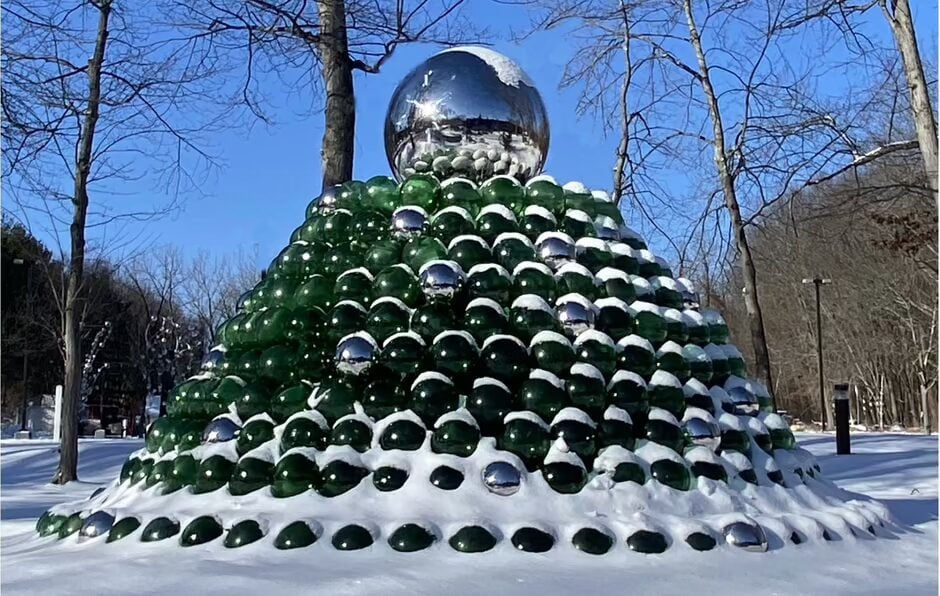
many of which are on display in the Berkshire Mountains of Western Massachusetts.
This led him into the life of a sculptor. Working with an artistic partner for the past seven years, he’s created more than 140 large-scale, modern, abstract sculptures, many on display in the Berkshire Mountains of Western Massachusetts, where he supports a Jewish and local institutions.
He works with distressed wood and recently, with modern media, including found objects. Among his works is “Cosmic Dreidel” and “Floating,” a towering piece of 550 12-inch glass and stainless steel balls (see left).
Grinspoon acknowledges the distressing rise in anti-Semitism. “My mind flashes back to when I was a young kid and anti-Semitism was rampant. This is the second time it has happened in my lifetime,” he says.
Post Oct. 7, 2023, his foundation continues its investment in programs that connect Jews around the world with Israel.
“This is a moment in time to double down on our flagship programs — PJ Library, Life and Legacy and JCamp 180,” Adrian Dior, the foundation’s COO, wrote. “We will continue to grow and evolve as we have for the last 30 years,” and continue to look for new partners.
“I believe in helping others. Being generous. Being grateful. We try to be good citizens,” he says.
In celebration of his 95th birthday, Springfield Mayor Domenic J. Sarno presented Grinspoon with the key to the city, the largest in Western Massachusetts.
Grinspoon says one of his greatest sources of optimism is Maktabat al-Fanoos, the Arabic-language children’s literacy program his foundation supports in Israel.
It builds on family connections in service of creating civic and communal connections.
“It gives me hope,” he wrote. “I hope all Israeli citizens can be great neighbors.”


