By Andrew Lapin
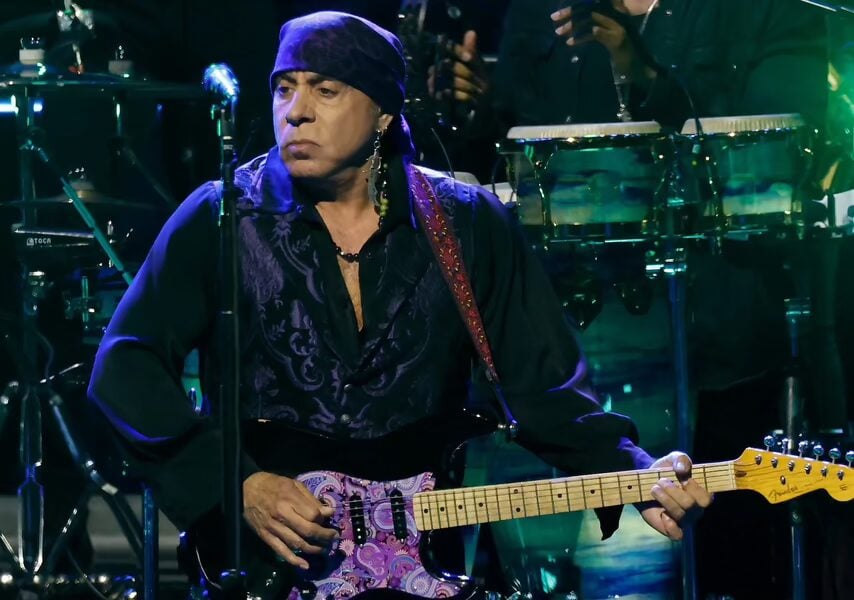
Steven Van Zandt is worried about the Jews. “There is that pre-Holocaust vibe,” the Rock and Roll Hall of Famer says about what he sees on social media, where he is a prolific user.
“They spread lies around year after year after year, and if you say something often enough, people start to believe it.
“That’s what happened that led to the Holocaust in the first place, and that’s what’s going on now.”
For a man equally beloved for his longtime work with Bruce Springsteen in the E Street Band and his role on HBO’s “The Sopranos,” such a detour might be unusual.
But Van Zandt is looking to make his own mark in the world of Holocaust education, via his education initiative TeachRock, which since 2013 has provided K-12 lesson plans built around popular music.
Titled “Jewish Heritage and the Holocaust: Exploring an Enduring Culture Through Music,” the initiative’s four-day lesson plan, launched this week, includes the onset of anti-Semitism in pre-WW II Europe, survivor testimony and Jewish values.
Anchoring the lessons are rock songs from the likes of KISS, the glam metal band, Jewish folk singer Leonard Cohen and contemporary New York pop band Lawrence, which is fronted by two Jewish siblings.
It’s a departure from the somber tone of most Holocaust education programs.
For Van Zandt, the lessons aren’t just teaching about the Holocaust, but also about highlighting positive Jewish influence in the world of popular culture. He rattled off a list of Jewish artists he admires, including Bob Dylan and the pop songwriting team Lieber and Stoller.
“Show business doesn’t exist without the Jewish contributions,” he says
The guitarist founded TeachRock in 2013 alongside other big names from the world of music and the arts, including Springsteen, U2 frontman Bono, Jackson Browne and the director Martin Scorsese.
On Nov. 12, the organization piloted its new Holocaust education lesson plan to 50 high school students at the Florida Holocaust Museum in St. Petersburg, timed to the state’s Holocaust Education Week.
Florida’s Holocaust education task force is promoting the material to districts across the state.
Michael Igel, a contributing author on the TeachRock lesson plan who also chairs the statewide task force, is a descendant of survivors.
He’s planning future courses that incorporate food and theater.
“It’s still standards-based Holocaust education. But it’s being delivered to students in these different portals,” he said.
It was through Igel’s promotion of such nontraditional methods that he was approached by a member of TeachRock’s leadership council a year ago.
TeachRock had been looking to offer lessons on Jewish heritage, and saw an opportunity to broach the subject of the Holocaust through Igel.
A huge E Street Band fan, Igel laughed as he recalled how the council member asked him if he had ever heard of Van Zandt.
The first of the curriculum’s four days opens with students listening to “Rock and Roll All Nite,” the 1975 hit by rock band KISS, before segueing into Jewish life in pre-WW II war Europe and the rise of anti-Semitism.
Igel noted the unique nature of the lesson. “When Gene Simmons with his tongue out is the first thing you see, you’re wondering, ‘What the heck happened to Holocaust education?’” he said.
Gradually the link becomes clear: The lesson explains that KISS frontman Gene Simmons is the son of a Holocaust survivor.
Students are asked to contemplate how Simmons’ family background informed his outré stage persona. Such concepts, he said, expand the idea of a Holocaust lesson beyond Jews as “victims in a snapshot of time.”
In teacher training sessions, educators have responded well to the musical framing and discussed which songs they would want to pass down to future generations — a positive sign for Igel, who hopes to convince teachers to use the curriculum even outside of the state-mandated Holocaust education lessons.
While Van Zandt, who is not Jewish, doesn’t craft the curriculum himself, he is friends with Simmons and the two have spoken before about wanting to use music to teach Jewish history.
Max Weinberg, the E Street Band’s longtime drummer, is Jewish.
The initiative comes at a moment when the world of popular music, like many other cultural sectors, has become engulfed in controversy over Israel.
A recent dustup involved Ed Sheeran and Macklemore, in which Jewish venue owner Robert Kraft pressured Sheeran to drop the rapper from his tour over his onstage anti-Israel activism. That prompted other artists to support Macklemore, including Jewish actor Ilana Glazer.
Several leading musicians, including Lorde, Paramore and Björk, have also signed pledges to boycott Israel, while others including Pink and Boy George have taken opposite tracks.
All of this discourages Van Zandt, who famously led an international artist boycott of the South African resort venue Sun City in 1985 to protest apartheid. Artists now backing the BDS movement targeting Israel have cited the Sun City protests as a direct inspiration.
Sun City itself was founded by Sol Kerzner, the son of Jewish Russian immigrants.
But Van Zandt says the two causes are different.
“Yes, I am known as the boycott king of the world,” he said. “It’s not the same situation. Trying to deny weapons for Israel to defend itself is obscene. It’s ridiculous. It’s terrible.”
He has feuded with Roger Waters, the Pink Floyd co-founder, over BDS.
“I wrote him a very nice, detailed letter saying that it was misconceived, it’s a mistake, it’s not going to accomplish anything,” Van Zandt recalled.
“I was very nice to him. Very diplomatic, very respectful. And then he starts just calling me names in the press.” Waters has directed expletives at Van Zandt and other contemporaries who disagree with him about Israel.
Igel, too, is thinking about how TeachRock’s lessons can address contemporary discourse over Israel, a subject that many Holocaust educators often are reluctant to bring up in the classroom even when students press the topic.
His curriculum defines what a genocide is — “for a generation that needs to know what that word means, and what it doesn’t mean,” he said.
Following this week’s pilot program, both Igel and Van Zandt hope states beyond Florida will take an interest in their lessons. The rock star has ambitious goals for the initiative: to try to change the national conversation around Jews and Israel that has filled his social media feeds, which he describes as “lies on top of lies.”
“Eventually there’s got to be a national public conversation about this, which is not taking place,” he said. “So eventually it’s going to have to be. At that point, all bets are off.”