

By Joseph Strauss
If AIPAC has any regrets about pouring more than $2 million into opposing a Democratic candidate who calls himself pro-Israel — and who conceded to an outright anti-Israel opponent — it isn’t saying so.
“We are going to have a focus on stopping candidates who are detractors of Israel or who want to put conditions on aid,” Patrick Dorton, a spokesperson, said.
The anti-Israel candidate whom AIPAC did not oppose — Analilia Mejia, a progressive organizer — won in a primary for an upcoming special election.
The special election decides only which candidate will fill a congressional seat until the end of 2026. The election is for the seat vacated by New Jersey Gov. Mikie Sherrill.
A second primary, held in June 2026, will decide the Democratic nominee for the regular November election.
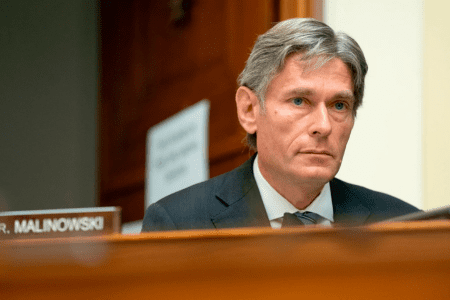
The target of the AIPAC’s recent spending in the special ection was Tom Malinowski, a former congressman who was the frontrunner bebefore AIPAC targeted him.
Malinowski, who was endorsed by J Street, has said he would be open to placing some conditions on US aid to Israel.
He opponent, who won, and who was endorsed by Sen. Bernie Sanders, has called Israel’s war in Gaza a genocide.
AIPAC pummeled Malinowski with $2.3 million in negative ads — but not about Israel. Instead, the ads tarred him from a progressive angle — one emphasized his vote on a 2019 bill that included increased funding for ICE.
Conceding, Malinowski congratulated Mejia, and credited her for “running a positive campaign and inspiring so many voters on Election Day.
“But the outcome of this race cannot be understood without also taking into account the massive flood of dark money that AIPAC spent on dishonest ads during the last three weeks,” Malinowski wrote.
“I met several voters in the final days of the campaign who had seen the ads and asked me, sincerely, ‘Are you MAGA? Are you for ICE?’”
AIPAC’s move appears to have backfired by throwing open the door for Mejia, a progressive grassroots organization leader very critical of Israel.
Mejia was the national political director for Bernie Sanders’ 2020 presidential campaign. Tahesha Way, the former lieutenant governor of New Jersey who is thought to have been AIPAC’s preferred candidate, finished in a distant third.
Critics, including AIPAC supporters, have slammed AIPAC’s strategy in the race [see adjacent opinion].
“They could not have gotten a worse result than what they got,” said Alan Steinberg, a journalist in New Jersey who was an EPA administrator under George Bush.
“I’m a very pro-AIPAC person, but this is one of the worst strategic errors that they could’ve ever made.”
AIPAC got into the race because of Malinowski’s comments on US aid to Israel when many Democrats, and some Republicans, expressed openness to attaching conditions to the aid as they sought to press Israel’s Prime Minister Benjamin Netanyahu to end the war in Gaza.
As to conditioning or suspending aid to Israel, Malinowski told Jewish Insider that he “would make case-by-case judgments given what’s happening on the ground.”
“We had very serious concerns about Tom Malinowski, who clearly was open to conditioning aid to Israel,” said AIPAC spokesperson Dorton. “He knew that he had moved to what is not a pro-Israel position.
“Adding conditions to aid to Israel, and undermining the US relationship, is a top priority for us in assessing candidates,” he said.
In New Jersey, the electoral result could be elevating a politician whose stance on Israel is much harsher.
• Analilia Mejia has accused Israel of committing a genocide in Gaza.
• Mejia has pledged not to take any AIPAC-funded trips to Israel.
• Meija called for a ceasefire in Gaza within weeks of Hamas’ Oct. 7, 2023, attack on Israel.
• Mejia tweeted on Oct. 10, 2023:
“Every fiber of my being is horrified beyond words at what is furthering in Gaza. Yet again we see how oppression & dehumanization leads to despair & unthinkable destruction.”
In addition to Sanders, Mejia was also endorsed by Alexandria Ocasio-Cortez and Ro Khanna.
Journalist Alan Steinberg thinks that AIPAC “never took seriously the possibility of her winning in this primary,” and that Malinowski would be far more aligned with AIPAC on Israel.
Malinowski wrote that his “support for Israel as a Jewish and democratic state” would not waver “because of who supports or opposes me.
“But our Democratic Party should have nothing to do with a pro-Trump-billionaire-funded organization that demands absolute fealty to positions that are outside the mainstream of the American pro-Israel community, and then smear those who don’t fall into line.”
AIPAC’s Dorton downplayed the impact of a Mejia primary victory because the upcoming special election decides only which candidate fills the seat until the end of 2026.
Others view her primary win as a larger victory for pro-Palestinians.
“Analilia Mejia for New Jersey just set a new precedent in NJ and beyond,” wrote pro-Palestinian activist Linda Sarsour in a Facebook post featuring a photo of Mejia raising her hand as the lone candidate indicating that she believed Israel committed genocide, at a forum hosted by the Council on American-Islamic Relations.
“She’s teaching us that it’s OK to stand alone so as [sic] long as you are on the right side of history.”
Mejia will face Joe Hathaway, the Republican mayor of Randolph, NJ, in the special election April 16.
Mejia is the favorite in the Democratic-leaning 11th Congressional District.
Hathaway said that he would highlight Mejia’s position on Israel in an attempt to flip the district.
“At a forum with all of her Democrat opponents, she was the only one to raise her hand when asked if you agree with the concept that Israel is committing genocide in Gaza,” he said. “She was the only one.”
“This is not, you know, mainstream Democrat Party. This is fringe, radical socialism, and I think that our Jewish residents and everyday people in this district need to reject that brand of their party.”
Surrounded by supporters on Feb. 10, Mejia celebrated her victory while taking a shot at AIPAC.
“AIPAC did all of the voters in New Jersey a very incredible favor because they told us who they are,” she said. “They told us what they’re willing to do, and that is to subvert democracy and silence even their friends.”
Malinowski endorsed Mejia, as did Sherrill and other Democrats.
In an email to supporters, Malinowski said that the AIPAC spending certainly made a difference.
“The huge difference between the early vote, which we were winning comfortably, and the Election Day vote, suggests that it had a major effect,” he wrote.
“At the end of the day, those AIPAC attacking Malinowski on his ICE vote did him in,” veteran New Jersey pollster Patrick Murray said.
“It was a colossal backfire on AIPAC’s part, and part of it was because AIPAC — like a lot of political observers and a lot of the Democratic leadership — didn’t fully comprehend the mood of the Democratic electorate,” he said.
“They had this perception that this being a moderate district means the Democratic electorate would be more moderate than it really is.”
What happened was Democratic voters came to the polls looking for someone to take on US President Donald Trump.
But the AIPAC ads, instead of driving voters to more moderate candidates, such as former New Jersey Lt. Gov. Tahesha Way, convinced them that Mejia, rather than Malinowski would be a stronger voice against Trump, Murray said.
“If there’s a consolidation of the many center-left Democratic candidates, the primary in June for the next full term will be much more competitive and may have a very different result,” said Izzy Klein, the political chair of the Jewish Democratic Council of America.
But pollster Murray said Mejia and Malinowski positioned themselves as anti-Trump fighters, and between them captured nearly 60% of the vote.
“These are people who want the Democratic Party to take a much stronger stand against Donald Trump.”
Adam Green, co-founder of the Progressive Change Campaign Committee, believes that Mejia’s victory is a “table-setter for the entire 2026 election year.”
“This victory signals to voters in countless upcoming primaries that it’s OK to be inspired again — that being inspired and winning are the same, and that electing real organizers like Analilia is key to getting people to the polls and building a durable coalition,” he said.
As for AIPAC and its super PAC, it enters the year with $124 million in the bank to spend on midterms.
“The outcome in NJ-11 was an anticipated possibility, and our focus remains on who will serve the next full term in Congress,” AIPAC said.
AIPAC added that it “will be closely monitoring dozens of primary races, including the June NJ-11 primary, to help ensure pro-Israel candidates are elected to Congress.”
Malinowski stated that the Democratic Party should have nothing to do with AIPAC, and said he would oppose any candidate in the June primary with AIPAC support and urged “my supporters to do so as well.”
AIPAC’s affiliate has spent millions on congressional races to mixed results since AIPAC began directly funding candidates in 2021.
In 2024, it spent at least $14.5 million against the incumbent “Squad” member Jamaal Bowman in New York, and more than $8 million to take down Cori Bush in Missouri; both incumbents lost their primaries.
But the $4.5 million it spent was not enough to beat Dave Min for Katie Porter’s House seat in California.
The upcoming midterms will likely serve as a test of AIPAC’s strength as more lawmakers and voters distance themselves from Israel and its advocates.
Dorton said he is not concerned about shifting sentiment toward Israel and AIPAC. He is looking ahead to the June midterm primaries and will “continue to run ads that move the needle” in primary races about issues that mostly don’t involve Israel, he said.
“There is a strong bipartisan pro-Israel majority in Congress,” Dorton said. “And we intend to keep it that way.”
Jonathan D. Salant, JNS, contributed to this story.


