

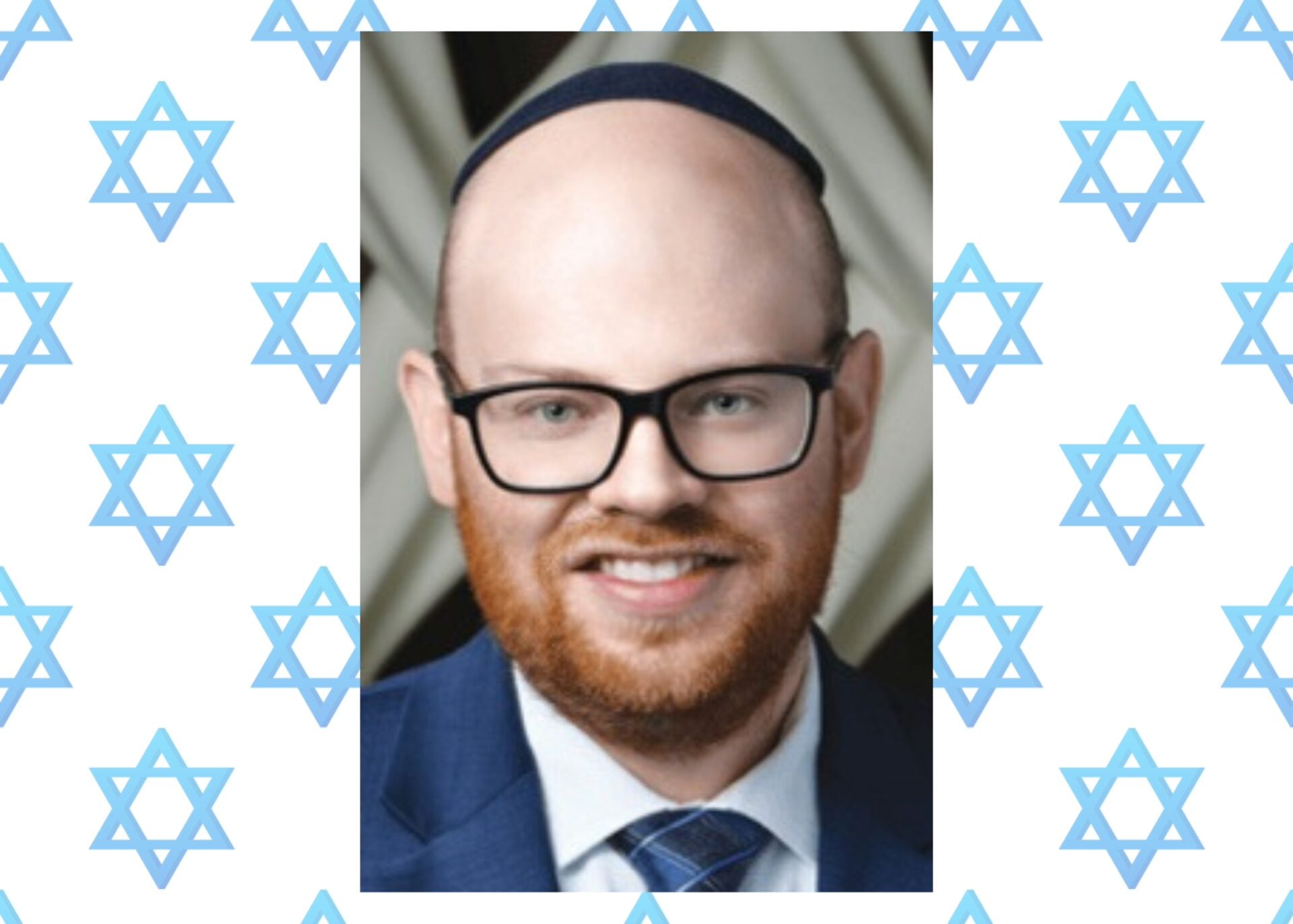
Some people return to the places that shaped them simply to reminisce. Rabbi Jordan Shaner is returning to help shape the next generation.
Years after sitting in the classrooms of Temple Sinai as a child, he has come home as the congregation’s new rabbinic director of Jewish learning, bringing his journey full circle.
That journey began as grandson of well-known Jewish Denverites, the late Meyer “Timmy” and Evelyn Shaner and the late Fred and Miriam Hoffman. His parents are Mark and Hanna Shaner.
Jordan’s family started out going to Beth Joseph when they lived in Denver. His parents moved to the south suburbs and they became involved with Temple Sinai, where he attended religious school and became a Bar Mitzvah under the aegis of Rabbi Raymond Zwerin.
For early elementary school, Shaner went to Herzl Jewish Day School. After graduating Cherry Creek High School, he received a scholarship for his singing and went to DU for a BA in music. From there, he applied to Hebrew Union College to train to be a cantor.
“A little more than halfway through my training in that program, I was working at a hospital during a summer internship in clinical pastoral education, which is the way you learn to take care of people spiritually and emotionally.
“A lot of people — including Rabbi [Rick] Rheins — asked me, ‘Are you sure you don’t want to be a rabbi?’
“I talked to my wife and we decided that I’d stick around a few more years in rabbinical school and go that route.”
Shaner was ordained as a cantor in 2017 before his rabbinical ordination two years later.
He landed at another congregation called Temple Sinai in Toronto, where he served as associate rabbi under the mentorship of Rabbi Michael Dolgin, whom he admires as a “tremendous Zionist and lover of the Jewish people.”
As much as he enjoyed his work at Toronto’s Temple Sinai, he seized the opportunity to return to his hometown and work at his childhood synagogue, Denver’s Temple Sinai.
He and his wife Kate are the parents of five-year-old Meir, and they relished the idea of Meir being around his grandparents and extended family.
Meir will start kindergarten at Denver Jewish Day School in a couple of weeks, sitting on the very floor in the very classroom as his father did nearly three decades ago.
A major part of Shaner’s position as rabbinic director of Jewish learning is running Temple Sinai’s religious school of some 250 students, grades K-10. There are the administrative duties, but perhaps more important are the educational innovations Shaner is introducing.
“I think a lot of what we have been teaching kids in supplemental Jewish education is focused on getting them through their B’nai Mitzvah. Those skills are critical and important, but I really want to start to shift the focus to Hebrew instruction — seeing Hebrew as a living language.
“It’s not just a bunch of letters you need to learn to decode to read from the Torah scroll on your big day, but it’s the passport to Jewish belonging and a key to Jewish identity.”
To that end, Shaner is working with the JEWISHcolorado shinshinim —Israeli teen emissaries — and their supervisor Michelle Ruby (who was his own Hebrew school teacher) to plan Hebrew enrichment activities to give kids practice speaking.
They will also work with teachers in the school to refer to everyday objects in the classroom with Hebrew words instead of English.
“I’m developing an app with GPT as an-house version of Duolingo so the students can work on conversational Hebrew as well as the material we want them to know for the siddur, Torah and reading skills.”
Temple Sinai will be one of the first congregations piloting the B’nai Mitzvah curriculum developed by the Tell Institute, headed by Dara Horn.
Horn describes the curriculum as eight lesson plans designed for B’nai Mitzvah-age students “to learn the world-defining story about Am Yisrael — the Jewish people — a tiny countercultural minority that has always refused to bow down to tyrants or conform to dominant societies, and how people seeking domination have responded to that challenge.”
Shaner says, “It’s really focused on making sure that our kids know who we are as a people, what’s our story and how do we counter the libels that all of us have been facing over the past few years, if not more. And not in a way that’s based on a sense of victimhood or persecution, but in a way that points out that the Jewish people have something important to offer society.”
Shaner acknowledges the challenge of making religious school, Sunday school, Hebrew school — whatever it’s called — more palatable and impactful on children whose attention is divided among many other activities and interests.
“The other piece of this is there are lots of families in our community who, for whatever reason, are not able to access a full-time day school education, and this is our shot.
“We’re trying to make it a place where they’re going to be engaged, they’re going to learn and they’re going to build community with one another.
“For me, it can’t be just training for this one service that you have as a 13-year-old. They should come out with the feeling of connection that they want to continue to learn the rest of their Jewish lives.
“They don’t need to know everything, but they have to have a strong enough basis that when they go to Hillel, or when they go to summer camp or when they go to the synagogue, or when they are starting their own families, they feel that they can participate. They can make new friends and become part of the Jewish people is a real and serious way.”
Adult education is also part of Shaner’s portfolio at Temple Sinai, This, too is challenged by the competition for people’s time and attention, and he has some ideas for that as well.
“We want to continue having great lectures on Shabbat and during the week. Jewish learning can have a lot of different flavors, though. It can look like . . . learning to make shakshuka . . . sitting in on a klezmer session . . . a lot of things.”
Shaner says he wants to provide opportunities for people who might not find their way into shul for lectures and classes, to come in and find their place in the Jewish community.
“Really, the point is being together and spending time as a community and learning to love one another.
“Rabbi Dolgin in Toronto a few months ago, in one of the best sermons I ever heard him give, noted that it says in the Torah that you should love the stranger 36 times. Fine — that’s the easy part.
“The hard part is learning to love your fellow Jews.
“That’s the mitzvah of mitzvahs.”
© IJN 2026

