

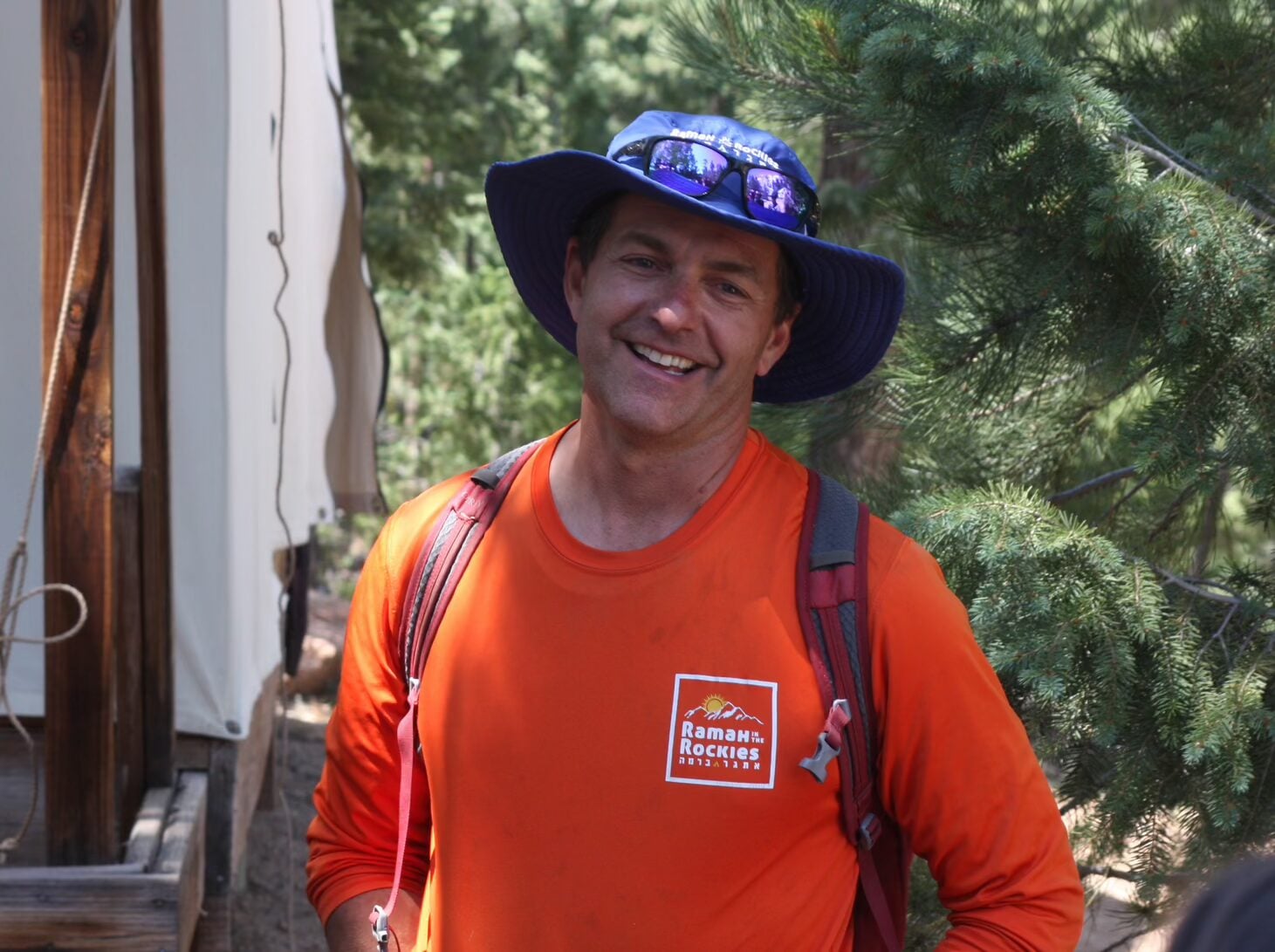
DECKERS, Colo. — It is lunchtime at Ramah in the Rockies, which is considered a sacred time for its camp director. Only a phone call from the supplier of a commercial vacuum cleaner can tear Rabbi Eliav Bock away from his campers.
“We just got it, and it’s not the right thing,” says Bock.
At a camp, where dirt and dust prevail, this is not a small thing.
“I was trying to arrange to have it brought back quickly.”
The call ends, and it is back to lunch with the campers.
Bock, an ordained rabbi and camp director since 2009, is used to interruptions, which are part of the job description. The walkie-talkie attached to his hip is always on, better to connect with any of his 200 camp staffers that walk through Ramah during a summer.
Like at most any camp, Bock wears a lot of hats — architect, water treatment engineer, counselor, fund raiser and spiritual leader.
“You have to know a little bit about everything,” says Bock, “and you have to know when you do know and when you don’t know.”
A Boston native and Columbia University graduate, Bock, 49, was a Wall Street equity trader. The income was great, but Bock always found a gravitational pull elsewhere.
“I did tutoring and taught Hebrew school on the side,” says Bock. “I got so much enjoyment from that.”
Bock had spent 11 summers working in Ramah camps and found himself on numerous nationwide committees. When the events of September 11, 2001, unfolded, Bock had a reckoning.
“I was downtown and saw a lot on September 11th,” says Bock. “I was outside when the second plane hit and felt everything that was going on. Oh my G-d.
“I promised myself after that summer, I’d find a way to go back to camp.”
His love of tutoring eventually led him to rabbinic school at the Jewish Theological Seminary while still working on Wall Street.
In 2008, Bock was on the search committee for a camp director at the soon-to-exist Ramah in the Rockies. Bock was enamored by the vision of one of the camp’s co-founders, Donald Skupsky, and threw his hat in the ring to be under consideration for the directorship.
“In my fifth year at rabbinical school, I started this camp and finished school at the same time,” says Bock. “The outdoors is always where I’m most at home.”
Thanks to his Wall Street background, Bock had the financial acumen to oversee an enterprise with a $3 million annual budget. He knows when to turn up the business lingo when fundraising visits occur. Ramah of the Rockies is a nonprofit camp and provides financial aid for 25 to 30% of campers.
“That means that about 20-ish percent of our campers get help from outside sources,” says Bock. “Running camps is phenomenally expensive.
“For example, in 2019, it cost us about $95,000 to insure our camp. This year our bill is at around $280,000. That’s just for insurance.
“Before we put a single camper on our property, and before we pay a single salary, our number is $550,000, just to maintain the property.
“Our water system alone is an $85,000 commitment, because we have to maintain a municipal grade waste water treatment plant for 12 months a year, even though we only use it three months a year.
“We’ve been able to survive, based on good enrollment, and then philanthropy. Without robust fundraising, Jewish camps would not survive.”
Ramah in the Rockies attracts 470 campers during the summer. Bock gazes to the other side of a long recreation hall, where about 10 counselors are huddled. Those staff members are a key reason Bock loves his job.
“I believe that Jewish camp is as much, if not more so, about the staff, than the campers,” says Bock. “You need to have campers in order for the staff to have a leadership training opportunity.
“How do we keep our post-college kids engaged in Jewish community? We actually have something that has worked now for 70 years. It’s called Jewish camp.
“I can keep people involved in camp through their early 20s and not say goodbye to them at age 19. It’s going to be a lot cheaper to reengage them than after they start families in their late 20s and early 30s. That’s for sure.”
When camp ends, Bock heads to Binghamton, NY, which is his family’s home base. It is where his wife of 20 years, Dina Danon, is a professor of Jewish studies at Binghamton University.
Their three kids, Matan, 16, Yuval, 11 and Sivan, 7, spend summers with their dad at camp.
During the camp’s off-season, Bock handles Ramah in the Rockies duties remotely from New York, and returns to Colorado about once a month until the next camp session.
Many camp directors stay in their position for life. Bock, 49, has no designs on leaving Ramah in the Rockies, but like anyone else, ponders the future. The bond trader who made a U-turn to summer camps has a tangent of a fantasy.
“I love real estate and projects, and I could totally imagine myself one day doing project management, being a developer for a developer,” says Bock. “Totally. I’m always tinkering.
“I think it’s one of the things why I enjoy managing the ranch so much here.”
An hour or so after lunch, Bock heads across the 360-acre site to unveil his latest project, two newly-built tents for upcoming 11th graders. With a guitar accompaniment, they recited the shehecheyanu before moving into the new summer dwellings. The water started working earlier that day.
The only item in the way were some rather large rocks that blocked the path to the tents. Bock and several others combine to haul them out of the way.
Bock is now dirty and full of sweat, and is no doubt due for a clothing change, which usually happens two or three times a day. For the ivy school graduate who made it to Wall Street, only to pivot to rabbinical ordination and a career of providing foundational values to Jewish youth, Bock is proof that change can happen, with a simple set of rules.
“You cannot burn the candle on both ends,” says Bock. “This is my 17th summer. I tell my staff that the miracle drugs are sleep and water. Sleep and drink, and you’ll be fine.”
More from “Professionally Speaking”:
- Steven Levine, HEA
- Jay Siegel, Mount Nebo
- Ilene Rosen, BMH-BJ
- Susan Rona, Mountain States ADL
© IJN 2026


