

By Toby Axelrod
How do you stop neo-Nazis from meeting up at Adolf Hitler’s birthplace? Station officers there around the clock.
That is just what the small town of Braunau in Austria has done — but the officers are not providing surveillance. Instead, they are on site as part of their regular duties because Hitler’s first home has become a police station.
After years of discussion, planning and construction, the new police station on a corner near Braunau’s town square opened July 22, in the house where Hitler was born in 1889 and spent the first few months of his life.
The use of the building — and even whether to keep it standing — had been a source of controversy. Austria and Braunau’s city fathers think it is positive to turn the building into a police station. Others sharply disagree
The city’s aim is “to prevent any association with Adolf Hitler, so as to strip it of that mystique,” the head of the Austrian interior ministry’s history department, Stephan Mlczoch, told reporters.
At the July 22 opening ceremony, Austrian Interior Minister Gerhard Karner emphasized that today’s police are “the exact opposite of the symbolism tied to this place. Our police stand . . . for democracy and the rule of law,” AP reported.
Some 50 local and district police officers will be stationed there. There will also be a police training program on human rights.
“They will probably also do anti-Semitism training. And I think that’s a good thing,” says Hannah Lessing, who was on the expert commission to decide what should be done with the property.
Lessing co-chairs the Austrian delegation to the International Holocaust Remembrance Alliance.
She was opposed to tearing down the building:
“I don’t like historical cancellation. But we should use it for something,” she said. “A museum was for me not a good idea, because it would attract automatically people who are probably Hitler fans.”
Thomas Ulmer is a retired officer with the Stuttgart police who fought to turn a former Gestapo headquarters in his German city into a place of remembrance. He says:
“It’s very important to convey the memory and the history to young people, to young police trainees.”
Ulmer brings police recruits to the Hotel Silber Memorial and Learning Center, where they learn how police were co-opted into the Nazi machine.
He helped design an exhibit in another former Hitler dwelling that became a police station: a nine-room apartment on Prinzregentenplatz in Munich.
The exhibit, which spanned 100 years of history, included the years in which Hitler’s popularity grew after the Beer Hall Putsch, his attempted coup in 1923.
The Munich station’s head, Andreas Franken, doesn’t hide the building’s history.
Back in Braunau, the new police station “will continue to be known as ‘Hitler’s birthplace’ and will attract visitors accordingly,” laments Austrian filmmaker Günter Schwaiger, who opposed the plan back in 2023.
“It used to be a modest house, but now the Austrian government has turned it into a monument,” he says.
Also disappointed is California attorney Cary Lowe, who was born in Braunau to Holocaust survivors.
He favored turning the site into a “House of Responsibility.” That plan is still alive, with another local site in mind.
The city did “their best to come up with a result that’s acceptable to everybody,” he said. “And now it’s a done deal, so I think we just have to move on.”
The building where Hitler was born dates back to the early to mid-19th century and sits, along with some other structures, on about three quarters of an acre. It has been privately owned, and over the years has housed a school and a branch of a disability support organization.
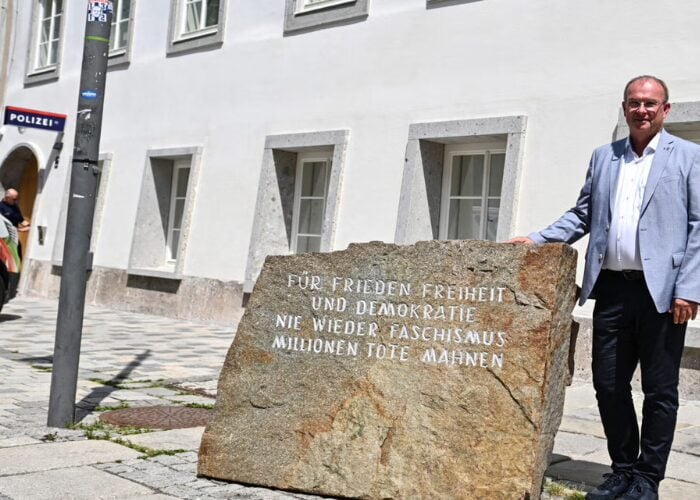
In 1989, a memorial stone taken from the quarry at the Mauthausen concentration camp was erected in front of the house, and inscribed with a warning “Never again fascism.”
Noticeable visits by neo-Nazis declined since then, Cary Lowe said.
“Yes, they still get the occasional individual that wants to carry out a pilgrimage or do a photo op or something in front of the house,” he said. “But it’s on a much smaller scale.”
In 2017, the city of Braunau expropriated the vacant property and organized an expert commission to debate possible uses, or even demolition. Suggestions ranged from a museum to the wild: An Austrian artist collective called Total Refusal suggested that a statue of Vienna’s wartime mayor Karl Luegers, a devoted anti-Semite, be picked up by helicopter and dropped over Hitler’s birth house.
The idea that Hitler fanatics might seek relics led the city to grind down all the construction rubble and bury it in a secret location.
“We didn’t need another museum,” Lessing says. “We have Mauthausen for that.”


