

CHANUKAH 5786 Sec. A, P20
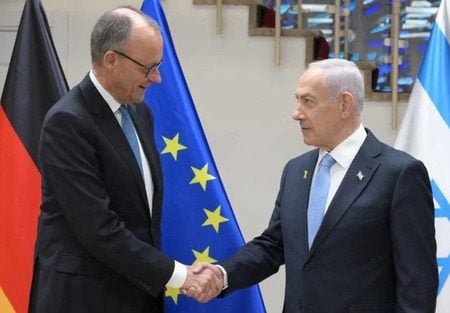
German Chancellor Friedrich Merz met with Israeli Prime Minister Benjamin Netanyahu at his office in Jerusalem on Dec. 7 after arriving in Israel the previous evening for his first visit to Israel since taking office in May.
The expanded bilateral talks included senior Israeli defense and foreign policy officials, as well as German Ambassador to Israel Steffen Seibert.
Last week, an Israeli Arrow battery for defense against ballistic missiles was deployed in Germany for the first time.
Thanking Merz for his visit at a joint press conference following their meeting, Netanyahu noted how remarkable the shared defense cooperation of the two countries is 80 years after the Holocaust, and said he had discussed with the chancellor ways to continue this security partnership.
The premier touted the technological alliance of the two advanced nations.
“I think that working together we can not only better the lives of citizens in Israel and Germany, I think we can better the world and our immediate neighborhood, the Middle East.”
The pair also discussed peace opportunities, ending Hamas rule in Gaza and deradicalizing Gaza’s population, said Netanyahu.
They disagreed with regard to Palestinian statehood, said the Israeli leader, adding that the purpose of such statehood “is to destroy the one and only Jewish state.”
Jerusalem, said Netanyahu, believes in a “path to advance peace with the Arab states and a path also to establish a workable peace with our Palestinian neighbors. But we’re not going to create a state that will be committed to our destruction at our doorstep.”
Following their meeting, Merz posted to X: “I wish for the Israeli people that, after years of terror and war, a better time will dawn. That decisions will be made that lead to peace and good neighborly relations. Germany will stand by your side in friendship.”
“After the traumas of war, we must lay the foundation for a new order. It requires the goal of a new Middle East, in which the State of Israel is also recognized as part of itself.”
On Dec. 7, Merz visited Yad Vashem, Israel’s memorial institution to the victims of the Holocaust.
“I bow before the six million men, women and children from all across Europe who were murdered by Germans because they were Jews,” he said.
Israeli President Isaac Herzog hosted Merz on Dec. 6 at his official residence in the Israeli capital. After the meeting, Herzog called the two countries “true friends” and strategic allies.
“During our meeting this evening, we discussed the importance of implementing President Trump’s plan, approved by the UN Security Council, and emphasized that Hamas must be removed from Gaza and disarmed,” Herzog stated.
“In addition, Hamas must uphold the agreement and release the last remaining Israeli hostage still being held in Gaza, Ran Gvili.”
Writing on X in Hebrew, Merz said:
“I come here with deep faith and as a friend of Israel, @Isaac_Herzog. We will always stand by your side. The very fact that our countries established diplomatic relations within such a short time after the Holocaust remains a miracle, as does the fact that the friendship between us has deepened so profoundly.”
Israeli Foreign Minister Gideon Sa’ar met the 70-year-old leader of the Christian Democratic Union on the Ben Gurion International Airport tarmac when he landed after a brief stop in Jordan.
He called the chancellor a “friend,” describing Germany as an “important partner” and saying bilateral relations between Berlin and Jerusalem were “on an upward trend.
“This trend is reflected in the removal of the partial [arms] embargo, Germany’s clear opposition to all types of boycotts against Israel, and its abstention at the UN from supporting the extension of UNRWA’s mandate,” said Sa’ar, referring to the UN Relief and Works Agency for Palestine Refugees in the Near East.
“Last week, an Israeli Arrow battery for defense against ballistic missiles was deployed in Germany for the first time.
“Germany is an important friend, and I am convinced that the Chancellor’s visit will contribute to the strengthening of the special relations between the countries.”
Merz wrote on X Saturday night, Dec. 6, that “the ceasefire in Gaza is stabilizing. Now we must successfully move into the second phase.
“This means permanently removing the basis for Hamas’s terror and ensuring that the precarious humanitarian situation of Gaza’s civilian population improves quickly and noticeably.”
Hours before taking off for Israel, Merz spoke by phone on December 6 with Palestinian Authority head Mahmoud Abbas and urged him to implement “urgently necessary reforms” in the PA, AFP reported.
Merz expressed support for the Trump administration’s peace plan for the Mideast, welcoming what the German leader called the PA’s “cooperative attitude,” AFP reported.
Merz spoke with Netanyahu on Nov. 16, shortly after declaring in a speech that Berlin must “stand with Israel” as part of a renewed “Western alliance.”
A day earlier, Merz referenced Israel in a speech to the Junge Union Deutschlands — the youth wing of his Christian Democratic Union party — in Rust, near Stuttgart in western Germany.
“The position of the Federal Republic of Germany must be clear, where we stand. In the Western alliance, at Israel’s side, dear friends, I have not forgotten that,” to thunderous applause.
Successive German governments have described a commitment to Israel’s security as a core principle of their foreign policy, rooted in the legacy of the Nazi regime’s near annihilation of European Jewry.
At the same time, Berlin has funneled millions of dollars to Palestinian and other organizations that work to undermine Israel’s legitimacy and oppose Jewish statehood.
Germany’s government has adopted a friendlier posture toward Israel than many other European countries since Hamas’ Oct. 7, 2023, massacre.
However, there have been tensions, as exemplified by Merz announcing a ban on exporting “offensive” weapons to the Jewish state on Aug. 8, hours after Netanyahu’s Cabinet voted to expand IDF operations against the Hamas terror group.
On Dec. 3, Israeli Defense Ministry officials handed over the first operational Arrow 3 missile defense system to the German Army at a ceremony at a German Air Force base near Berlin.
The development “marks a significant step in implementing the defense export contract signed between the two nations approximately two years ago, and is considered the largest defense export deal in Israel’s history,” according to a Defense Ministry statement.

