

A banner over the front gate of a small Jewish building in the heart of Cracow, Poland, four years ago next week, became a symbol of timeless Jewish chesed — lovingkindness — of direct involvement in a refugee crisis.
“Early, early” on Feb. 24, 2022, Jonathan Ornstein, executive director Cracow’s JCC, learned on the internet and from friends’ text messages that the Russian Army had invaded neighboring Ukraine for the second time in eight years.
Russian troops poured south over the border, overwhelming Ukrainian troops in the Donbas region. Fearful Ukrainians headed toward safety in many European countries.
Including Poland.
Within hours of hearing the news, Ornstein, a native of Queens who has served at the JCC since its founding in 2008, had a hand-painted, blue-and-yellow (the colors of the Ukrainian flag) 15-foot-wide “Welcome” banner posted in Ukrainian.
He foresaw, correctly, that many refugees would reach Cracow.
“We didn’t know what would happen, but I wanted the refugees to feel that the Jewish community in Cracow was welcoming them,” Ornstein remembered in a telephone interview last week.
“As they began to come, we began to buy them a toothbrush or a sweater or some food.”
The refugees kept showing up. About 13 million of them in Poland since early 2022, of whom an estimated one million have remained in Poland with temporary protection status.
“The line in front of the building grew,” Ornstein said.
“Local Poles saw what we were doing, and began to drop off clothes and food.
“The line grew longer and we started to publish our work on social media and we began to raise money to do more work.”
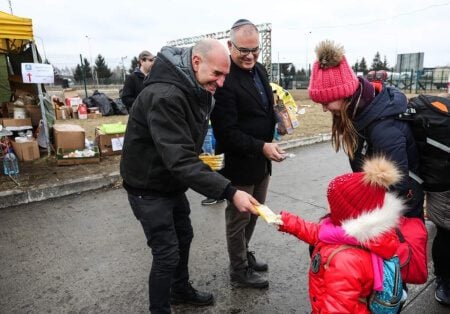
Even now, a line forms outside the JCC, where the women and children, who constitute most of the refugee population receive free food and clothing and other supplies at a “shop” near the front entrance.
“There is a line every morning,” Ornstein said. “They’re still coming.” At the beginning, the crisis was “acute. “It’s more stable now.”
The JCC began offering a wide-range of humanitarian, temporary-resettlement aid, much of it provided at various sites around the city. The JCC:
• rented apartments for the refugees;
• provided university scholarships to 250 students;
• opened daycare facilities for the families;
• offered lessons in the Polish and English;
• sponsored job training;
• hired Russian and Ukrainian-speaking psychologists;
• employed refugees to assist in the relief effort;
• fed more than 1,000 people a week;
• set up a Ukrainian-language hotline for legal and psychological advice;
• distributed 530 tons of “essential supplies,” including toys, hygiene products, blankets and medicine.
• sent supplies to Ukraine and border areas for further distribution.
The Cracow — the second-oldest in once-communist Eastern Europe — has aided nearly 500,000 refugees — “99% of whom are non-Jews.”
Why does the JCC show all this kindness to strangers?
“We have a responsibility,” said Ornstein.
“Eighty years ago the Jews were the victims and the world remained mostly silent.
“Now, 80 years after the Holocaust, our community has been reborn and we can look at these poor refugees and say, ‘The world didn’t help us so we don’t need to help.’ Or we can say, ‘The world didn’t help us so we know what it feels like to be forsaken, and that gives us a special responsibility to try to prevent the suffering of others — especially here in the place where we were killed.
“Being Jewish does not mean being a victim.”
The refugees “understand that they are being helped by Jews.”
The JCC, now the country’s largest Jewish organization, is located 43 miles from Auschwitz. The memory of the Nazis’ killing center is never far from the minds of the city’s Jewish and non-Jewish residents.
This massive outreach effort has raised some $16 million, more than four times the JCC’s earlier annual budget, “all raised in the United States from American Jewry.” Initial funding also came from the New York-based Joint Distribution Committee.
“Here in Cracow, from the ashes of the Holocaust, the Jewish community has been reborn,” Britain’s King Charles said last month during a Holocaust commemoration day at the JCC. As Prince of Wales, Charles was the founding patron of the JCC.
“In a post-Holocaust world, projects such as this Centre are how we recover our faith in humanity,” he said.
Ornstein said the JCC has downsized the scope of its activities for the refugees. “At the peak,” he said, “we had about 30 full time employees working on Ukraine. That number is down to around seven, but we have had thousands of volunteers from across the world who have helped.”
The refugees, and their plight, are a constant presence in the JCC’s four-story, 9,100-square-foot building in the center of the Kazimierz neighborhood, where Cracow’s wartime Jewish ghetto was located.
Have the Jewish members of the JCC supported the JCC effort?
“Our community has been and remains incredibly supportive,” Ornstein said. “We even have Holocaust survivors that volunteer packing food for the refugees.”
The welcome banner is still posted at the JCC.
Nobody keeps an exact count of the number of refugees whom the JCC has aided, Ornstein said — the figure just keeps mounting each day.
The fourth anniversary of the start of the Russian-Ukrainian war, and of the JCC’s efforts on behalf of the refugees, was this week, Feb. 22.
The JCC mark planned a small commemoration,” Ornstein said, “but most importantly we plan to feed as many refugees as we can on that day.”


