

A numerical rundown of Chris Leppek’s career at the Intermountain Jewish News: 47 years; 2,394 weekly newspaper editions; 95 magazines; 3,272 bylines; 56 Rockower Awards for Excellence in Jewish Journalism; at least eight Colorado Press Assn. Awards; countless hours of informative and entertaining reading for IJN readers.
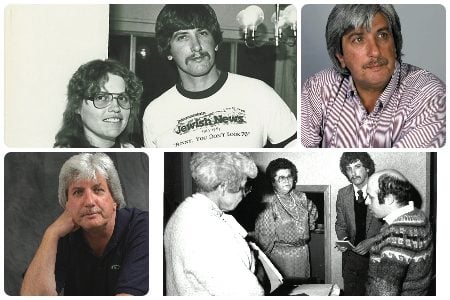
The numbers are impressive, but what truly stands out in Leppek’s journalistic career is his uncanny ability to interview, investigate, verify and deftly write news and feature stories on the widest range of subjects and developments in the Jewish world. And, on top of that, Leppek is not Jewish.
An era in the IJN’s 111-year history will end when IJN Assistant Editor Chris Leppek retires on Nov. 15.
Leppek recently sat down for one more interview, but this time, he was on the receiving end of the questions.
First, a review of Leppek’s life, pre-IJN:
Leppek was born in Saginaw, Mich., Oct. 3, 1954 to Robert and Liesel Leppek. The close-knit family grew to include four sons and a daughter. The Leppek family moved to Denver when Chris was seven.
“By the third grade I was writing hokey little articles for a paper. Then at Ranum High School, near Westminster, I ended up becoming the editor of a high school paper, and some of the people I worked with on that little staff are still friends of mine,”he says.
That’s when Leppek decided to make a career of journalism.
“When I finished high school, I joined the Navy. I got a guarantee from the Navy that they would train me as a Navy journalist.”
In addition to his military duties in the Navy Seabees, Leppek officially learned at the Defense Information School in Indianapolis, which included all branches of the service journalists.
After that, he served for eight months each in Diego Garcia (a tiny island in the middle of the Indian Ocean), Guam and Spain.
“Guam was very important to my journalism training because it was 1975, right when the Vietnam War ended and Saigon fell to the North Vietnamese. All those refugees went to Guam, and the Seabees were the first people to deal with that.
“We built a city of tents that housed 10,000 Vietnamese refugees in one week. We got national publicity out of that, both with the stuff that we wrote and by handling national news outlets such as AP, The New York Times and CBS.
“That was a real important part of learning how to handle a big and complicated story.”
Leppek and his colleagues received a Peacetime Medal of Honor for their work in effectively disseminating that information.
After his discharge from the Navy, Leppek went to work for the Lyons Recorder, a small-town paper in Boulder County, but due to the lack of local housing in and around Lyons, he needed to find a job closer to his Denver home, leading him to the Intermountain Jewish News.
IJN: Describe your first encounter with the IJN.
Chris Leppek: I ended up interviewing in December, 1977, with the IJN. [Editor and Publisher] Miriam Goldberg and [Managing Editor] Doris Sky were my interviewers.
Miriam asked me, “How much do you know about Judaism?” and my response was, “Nothing at all, but I’m a quick learner.”
That turned out to be an understatement. I needed to learn a great deal to be fluent in the Jewish world, and eventually I ended up becoming conversant enough to do the job.
My early elementary school was Catholic, and then I continued with catechism, which in the Jewish world would be like Hebrew school. I think that gave me an inherent interest in Judaism because I’ve always been interested in religion although I’ve never been religious.
I knew one Jewish guy in the Navy, a Reform Jew. We spent time in a foxhole together during war games. He brought out his blue velvet yarmulke bag to say a prayer. We talked about it and he gave me my first introduction to modern Judaism. He was literally the only Jewish person I knew until I came to the Jewish News.
I think I made some big mistakes in the beginning. My first couple of interviews, I did not know anything about the Middle East political situation. I knew something about the Six Day War but I didn’t really know the dynamics of it. I asked a stupid question of a rabbi from Israel, from the West Bank, who was working on an Israel-Palestinian peace project. I remember the expression on his face.
He didn’t shoot me down, though. He had to correct me, and I learned right then and there I’d better know what I’m talking about before I talked to people, so I did start reading up.
I learned about the Middle East political history and the then-current situation. It was also about Judaism as a religion, Jewish history and modern Jewish culture. It took a while but, within a year, I could sit down with pretty much anybody from an Orthodox rabbi to a progressive Reconstructionist person and talk to them intelligently.
During your first year at the IJN, the Camp David Accords, which resulted in a peace treaty between Israel and Egypt, were the big news.
That was a very hopeful time in the Jewish world because [Israel Prime Minister] Menachem Begin and [Egypt President] Anwar Sadat were talking and President Jimmy Carter was trying to facilitate something. The Camp David agreement came in 1978 and was a beginning of what was would be a new era of peace. I think that general attitude lasted until the time of the Second Intifada, 2000-2005.
That was close to half of my time at time [with the IJN], and then the second half of my time, it’s been all downhill. It culminated last year on Oct. 7, when there is no hope at this point for Middle East peace. It’s been not “bittersweet,” but “sweet bitter.” It was sweet then and now it’s bitter. Kind of a sad time to be leaving.
Describe those early days at the IJN.
Number one, it was a lot of old-school, lovable and eccentric people who worked here.
Al Robison was a WW II veteran, a loud, very funny and very politically incorrect guy, and just a very nice guy. Lottie Simmons, an escapee from the Holocaust from Germany, spent the war in London dodging the Blitz. Rosalie Rosenthal, who used to write and recite poetry in the middle of the newsroom.
Of course, there were Miriam and Doris. They were all just warm, accepting and lovely people.
We had younger people as well, like Kathy Peterman, now Kathy Jahnke, who worked in the business side; Beth Levin, now Beth Samuelson, who worked in advertising, and Patti Thorn, who was a writer for us and went on to the Rocky Mountain News. There was a whole cast of characters who became good friends.
In more recent years, Andrea Jacobs [whose tenure at the IJN was 1991-2021] is one of my dearest friends ever. Bob Weinberg and Shari Valenta were photographers, both still friends of mine, both wonderful people.
The technology when I started was the IBM Selectric typewriters with the ball, which was a step above the manual typewriters I used in the Navy.
There was the Telex on which Joe Polakoff and Hillel Goldberg would routinely send in their copy, from Washington, DC, and Israel, respectively. There was a lot of wax and rubber cement to make pages — and the cumbersome carbon paper!
As soon as the late 1980s, when we went to computers, I said I never want to touch a typewriter again.
The one thing I missed, though, was the sound of typewriters, which had this active, busy, newsy sound. But I don’t miss the actual production part of it, where you would have to start a story, realize you weren’t doing it right, crumple of the paper, throw it out and start again. With word processors, you could just go in there and delete it — much easier and smoother.
You met your wife at the IJN.
In 1978, we did our production at the Littleton Independent, the weekly paper in Littleton. This is where I met Lisa, who was a typesetter there. I had seen here and admired her and talked to her a few times. But it wasn’t until I went to a Bob Dylan concert in Denver with my two brothers and I happened to be looking at the crowd with a pair of binoculars, and I spotted her across McNichols Arena, sitting with a blonde-haired girl and a blonde-haired boy, obviously her siblings.
I thought if she’s at a Bob Dylan concert with her siblings, she must not have a boyfriend, so I think I’ll ask her out. We were married within two years, in 1980.
What have been the most interested stories you have covered?
I’m not sure what the most interesting stories are, but I can tell you what were the most intense stories. There were three: Columbine, 9/11 and Oct. 7. They were those historic moments like we remember JFK’s assassination.
The most difficult stories were the Holocaust stories, which I did a lot of. Mostly survivors, but also liberators and a couple of people who were involved with the Nuremberg Trials.
I considered it an honor and also an obligation.
My mother was from Germany. She lived in Nazi Gemany during her youth and teenage years. Her brother fought for the German Wehrmacht and was killed fighting on the eastern front. I always felt that conferred upon me a certain responsibility, since members of my family had been involved, however directly or indirectly, with the Holocaust, that I should help pay it forward by being in support of the Jewish community. That gave me a sense of being able to pay back a little for that ancestral connection.
Those Holocaust stories were very emotionally difficult. A lot of these survivors were people who had told these stories to their loved ones, and at some point, mostly in the 80s and 90s, they felt this need to tell their stories before they passed away.
For them, it was extremely traumatic in some cases. They would tell me things that, frankly I wish I had never heard. I wouldn’t put those things in my stories because they were just too horrible. After many dozens of these interviews and several of these emotional breakdowns that I had to go through with them, I asked Hillel to take me off the Holocaust stories because it was just too hard. I did eventually go back and do a few more.
The most challenging, most fun stories for me were the history stories. I love history; I probably should have been a historian or archaeologist. Every time I got to work on stories of Colorado or Rocky Mountain Jewish history, I just had a great time.
Of those historical pieces, here are some of the stand outs:
• “The Lavender Hill Mob” [May 14, 1990] about Denver men who smuggled arms illegally to Israel in 1948. It was a fascinating story, kept untold all those years until we did it. It was fun to talk to Bernie Springer, who had a great story and was a great person.
• “The Rise and Fall of the House of Elsner” [Sept. 22, 1995], a prominent, early Denver Jewish family with a lot of interesting historical highlights and a few dark shadows that were lurking.
• “Tales of the Tatterdemalion Poet” [Sept. 26, 1997] about Naftali Herz Imber, who wrote Hatkiva and spent some time in Denver, a ececentric and fascinating individual.
• “Once They Flourished,” [Sept. 14, 1990] — one of my favorites — a story I did with photographer Bob Weinberg on former Denver synagogue buildings, exploring all the old, sometimes disused buildings and finding traces of their Jewish heritage in or on them.
I’ve had these interesting moments with famous people, like Zsa Zsa Gabor, and meeting her poodle. That was the only time in my life that I’ve had caviar.
I remember riding from Five Points to downtown with Bill Clinton in his limo, and interviewing him and being so impressed by his knowledge of the Middle East. He was governor of Arkansas at that time. We almost had a major accident coming into downtown. It didn’t faze him for a second; he just kept talking about the Middle East.
I interviewed Shimon Peres. He was the most political politician I every ever seen in my life. He was very articulate, but he was sitting next to our governor, Bill Owens. I thought, “Owens is a politician, but Peres just leaves him in the dust.”
I interviewed [Jerusalem Mayor] Teddy Kollek It was a night interview at the Brown Palace, and he got a call in the middle of the interview from Israel, telling him that Israel had just invaded Lebanon. We had to cut the interview short because he had to deal with the ramifications of that. That was one of those moments.
You have enjoyed hobbies and a fiction writing career outside of the IJN.
I’ve writing fiction since the ‘80s. I had several books published. Mani Isler and I wrote a couple of books together, one of which became a horror movie. We just saw it on Peacock.
I am going to continue writing fiction. I’m in the midst of a new novel now which I’m really starting to enjoy. However, all these novels have been written in the evenings after exhausting my brain at the paper. Now I’m going to see what it’s actually like to have some energy while I’m writing.
I like to collect things. I collect bottle caps and I remember someone once saying, “That’s the stupidest thing I ever heard,” but it does give me a sense of relaxation.
I’m a huge book collector — I love books. And I like to garden and putter around the house.
And that leads to your plans for retirement.
I guess there will be more of the above. I am going to continue writing, but probably not journalism.
The most important thing I have to learn is how to relax. I don’t think I’ve managed to relax in 50 years and I need to figure out how to do that.
When you first knocked on Miriam Goldberg’s door in 1977, did you have any idea this could develop into a 47-year career?
My first thought was this was a stepping stone. My goal was to go to a daily newspaper. I did not have a college degree, which sort of closed those doors to me.
I remember at some point realizing that I have an interesting job in journalism and I think I will stick it out here. I realized that working on a daily wasn’t what it was cracked up to be. Most of the people I knew who were working there ended up getting stuck in very limited beats — police, community, politics or Sunday features. At the IJN, I got to do it all.
I ended up enjoying the fact that I could do political coverage, historical coverage and religious coverage. I got to cover all kinds of stories and it was never repetitive.
Also, somewhere after the millennium, things started shrinking in the daily world. People were getting laid off, papers were closing. The paradigm shift was happening in the media, and I consider myself very fortunate that I was able to work in the journalism field.
I think all of us in our generation in journalism were influenced by Carl Bernstein and Bob Woodward and Watergate. We saw the importance of journalism to a free democracy, and that’s never left me. I still feel that’s extremely important.
To give the Navy credit, their training included that dimension of journalism. They taught us the basics of civilian journalism and the importance of accuracy, fairness and balance.
Chris and Lisa Leppek are the parents of adult sons Noah and Adam, and they enjoy a close bond with their extended family of siblings, nieces and nephews. Lisa retired a couple of years ago after a long career in graphic design and pre-press production, going back to her days as a typesetter at the Littleton Independent where she and Chris met.
The Leppeks developed a reputation for hosting epic family holiday get-togethers as well their every-five-year Halloween parties for their many friends and family members. Chris and his brothers have taken many interesting road trips together.
To Chris Leppek, family means everything, and he extends that sentiment to his IJN family with whom he has shared many memories and some unforgettable moments.
“I remember meeting Hillel and Elaine Goldberg for the first time in the 1980s in Jerusalem, along with their children Tehilla, Mimi, Mattis, Shana and Riki. They were all these little Hebrew-speaking kids.
Hillel and Elaine came to my hotel to pick me up and take me to dinner. Elaine inadvertently left her purse on the counter at the hotel. The hotel called the cops because it was an abandoned bag. So, my first meeting with Hillel and Elaine, the Israeli police were grilling them. They did return the purse to Elaine at some point.
“I have a very fond memory of that first meeting.”
It’s those kinds of memories that will undoubtedly randomly pop up in Leppek’s mind as he reinvents his daily life after a challenging, demanding and fulfilling career that has spanned his entire adult life.
© IJN 2024


