She will never meet a survivor of Auschwitz.”
On a recent visit to Denver with my one-year old daughter, I hoped to bring her to meet Cantor Zachary Kutner. A few months back, his son advised me to be in touch upon arriving in Denver. When I did so, he responded, “Dad has taken ill recently and unfortunately, we can’t have visitors now. Please G-d we will schedule with you next time.”
Not a couple weeks later, I was shocked to hear that Cantor Kutner had passed away. I was devastated. That evening, I said to my wife, “I don’t know if anyone keeps track of this, but Cantor Kutner must literally be one of the last Auschwitz survivors.”
Eerily, the next evening, my wife saw that a history organization put up a Facebook post, “The Last Survivor of Auschwitz,” about a British survivor who recently passed away. This doesn’t appear to be factually correct, but the basic point remains. Hardly any living survivors have numbers on their arms.
But Cantor Kutner was much, much more than a survivor. He was the embodiment of life, as the IJN editorial last week so poetically described. Others have written eloquently and shared many stories which illuminate Cantor Kutner’s joyful passion, commitment to tradition, and embrace of his role as living testimony to the horrors of the Holocaust. I add just a few brief thoughts.
So much of Cantor Kutner’s legacy and impact is bound together with the soulful, joyful prayers and tunes that were always dancing on his lips. A few years ago, his son Sam graciously facilitated a phone call with me in which I informally recorded his unique tune for Mizmor l’David (customarily sung at the third meal on Shabbat afternoon).
I learned that this tune was imprinted in Cantor Kutner’s memory from when his father sang it six or seven times each week at their pre-Holocaust Shabbat table.
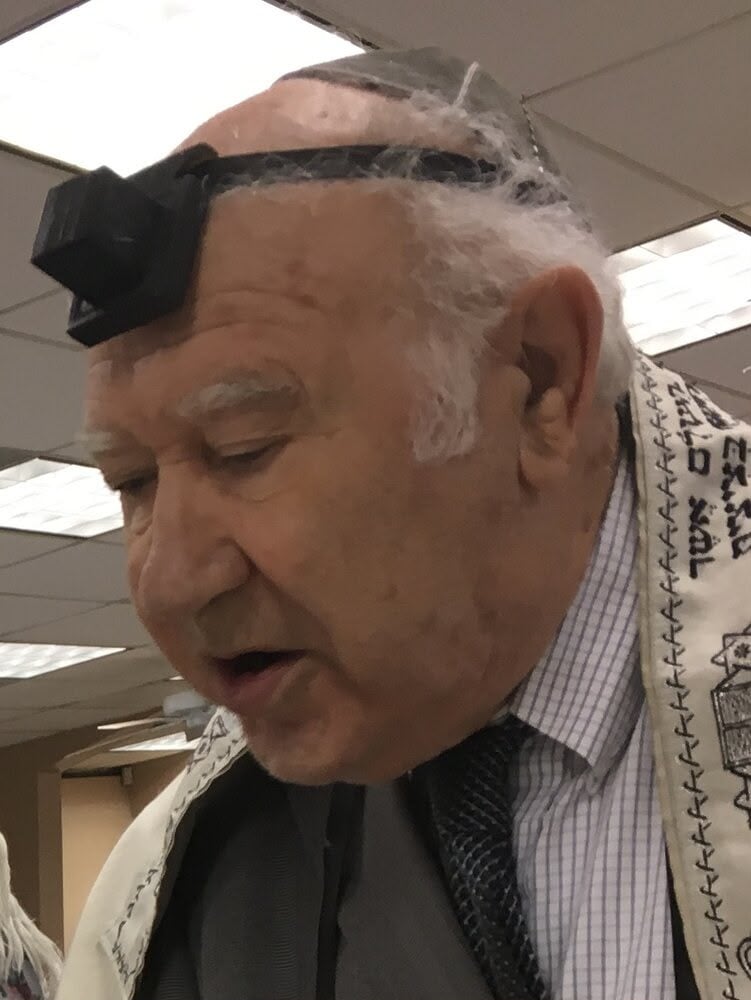
Credit: Avi Mehler
Last year, when I was lucky enough to visit Cantor Kutner with our oldest son, I also informally recorded his tunes from parts of the High Holiday liturgy. In fact, he led multi-hour, High Holiday services as recently as age 98!
Anyone who is interested in these recordings is welcome to contact me via email.
As a child roaming the halls in BMH-BJ, I loved him, as did my friends. When he wasn’t singing, he was frequently humming, with a twinkle in his eye, or, sharing some short Yiddish quip. We often didn’t understand those, but we sure understood his cheerful smile.
I frequently played ball outside, but when my mother motioned for me to come in because Cantor Kutner was praying, I was quite happy to come.
For a number of years when my father was rabbi at the BMH-BJ mechitza minyan, I was lucky enough to daven Shabbat morning in BMH-BJ and then Shabbat afternoon at EDOS. Cantor Kutner was a regular at both places. For the Shabbat afternoon prayers he graced us with his Torah reading, wonderful Shabbat songs and his famous cantorial performance of “Na’ar hayiti” at the conclusion of the Grace after Meals, bentchen, at the conclusion of which the crowd said, “Play Ball!” (You had to be there; you had to see him in action.)
Cantor Kutner left many indelible impressions on me that I will carry forever. I will share one:
The Tachanun prayer said on Monday and Thursday mornings contains the following line:
“Peer down from the heavens and observe that we have become but a laughingstock and object of scorn among the nations; we have been regarded as sheep herded to the slaughter, to be killed and obliterated in disgrace.”
Cantor Kutner recited this in the Hebrew and, trembling, he shared: “This was us. The Nazis yemach shemam (may their names be blotted out) treated us like sheep. They took us to slaughter, they made fun of us. We lived this!” Then, his voice rising, he turned to the next line in the prayer and emphatically declared: “Despite all this, we have not forgotten Your name; please! Do not forget us!”
He then commented to this effect: “When something bad is happening, I say to G-d, we did not forget you in the hell of Auschwitz. You cannot forget us!”
Nearly every week since then, I think of Cantor Kutner when saying this prayer. It has girded me with strength and faithful resolve as I encountered difficult times, which, needless to say, are not even worthy of mention in relation to Auschwitz.
Now, most of my memories of Cantor Kutner are of the tunes I heard him sing repeatedly, such as his Shabbat songs, the “E-l Moleh Rachamim” or the High Holiday liturgy. But this commentary? I heard it one time, only once, as a teenager. Yet it was seared into my consciousness forever.
Cantor Kutner is not gone. His memory is not confined to Holocaust archival sites and video recordings, as critical as these are. His eyewitness Auschwitz testimony, his soulful prayers, his penetrating insights and his zest for life are embedded in the souls of so many in our community.
We will pass those on to the next generation not out of a sense of duty, but from a place of love.
Just this past week, I started a new custom at our Shabbat table’s third meal, and that is to sing Cantor Kutner’s tune for Mizmor l’David and finish off the bentchen Grace after Meals with his inimitable “Na’ar hayiti.”
And so, my one-year old daughter may never get the chance to meet Cantor Kutner, but she will certainly know who he was.
© IJN 2026