

Harvard University’s president has apologized for the campus climate over the last year-and-a-half, asa report from a university task force on anti-Semitism and anti-Israel bias was unveiled.
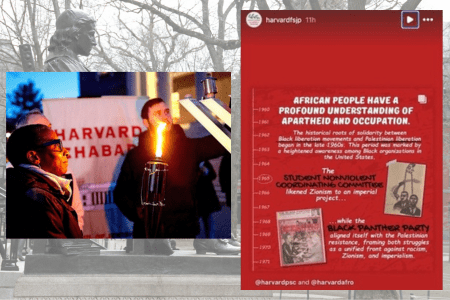
Then Harvard President Claudine Gay attends a Chanukah menorah lighting ceremony, Dec. 13, 2023 (left); a February, 2024 Instagram repost by Harvard Faculty and Staff for Justice in Palestine, since deleted, showing a cartoon with anti-Semitic imagery (right). (Getty Images via JTA)
The task force found that Jewish and Israeli students at Harvard experienced pervasive “shunning” and were targeted for their identities by both peers and faculty after Hamas’ Oct. 7, 2023, attack on Israel, according to the report, released April 29.
“I am sorry for the moments when we failed to meet the high expectations we rightfully set for our community,” wrote President Alan Garber, who convened the task force. He continued, “Harvard cannot — and will not — abide bigotry.”
The 311-page report lands 16 months after the committee first formed — and days after the Trump administration publicly called for its release.
The school also published a parallel report, authored by a task force Garber convened on Islamophobia and anti-Palestinian bias.
The two groups jointly collected nearly 2,300 responses to a campus climate survey, with the anti-Semitism task force also conducting listening sessions with around 500 Jews on campus.
The Ivy League school is locked in a fierce legal battle with the White House, which has pulled billions of dollars in federal funding to the university, citing its failure to manage anti-Semitism, and threatening its tax exempt status.
Harvard has sued the administration.
Garber praised both reports’ release in an accompanying letter to the campus community, in which he promised to establish “a research project on anti-Semitism” as well as “support a comprehensive historical analysis of Muslims, Arabs, and Palestinians at Harvard.”
He also pledged to review school disciplinary policies and find new ways to promote “viewpoint diversity.”
The anti-Semitism and anti-Israel task force report paints a sobering portrait of the campus climate for Jewish and Israeli students.
“No other group was constantly told that their history was a sham, that they or their co-religionists or co-ethnics were supremacists and oppressors, and that they had no right to the protections offered by anti-bias norms,” reads one section.
“Many Jewish students told us they feel like objects of suspicion.”
The task force focuses only on the 2023-24 school year. Its authors — Harvard faculty, students and staff, as well as the director of Harvard Hillel for most of the period — urge the university to go further than similar task force recommendations at other universities.
Those include more rigorous oversight of school centers, programs and courses on subjects such as the Israeli-Palestinian conflict to avoid “politicized instruction”; revamping admissions to prioritize students willing to do “bridge-building” and face “diverging viewpoints”; and expanding the school’s roster of classes on anti-Semitism, Judaism and the Israeli-Palestinian conflict.
The report opens with an anecdote of a Jewish student who was told by peers that they could not present their grandparents’ Holocaust survival narrative at a student forum, because the family had emigrated to Israel.
“They told me my family history was inherently one-sided because it does not acknowledge the displacements of Palestinian populations,” the student recalled.
The task force depicts the post-Oct. 7 climate at Harvard as one that frequently sought to lay the blame for Israel’s actions in Gaza at the feet of the school’s Jewish and, especially, Israeli students.
Jewish Harvard students were twice as likely as non-Jewish, non-Muslim peers to feel “unwelcome and unsafe” (though Muslim students reported “greater negative experiences” on campus than Jewish students).
Amid what the authors described as increased polarization and aggressive campus protests, “Harvard lacks relevant courses and programming to address the campus climate and discuss events in Israel/Palestine in a constructive, informed, and non-threatening way.”
One section of the report is devoted to the failures of staff and faculty at Harvard schools to foster a welcoming environment for Jewish and Israeli students, including criticism of “politicized instruction that mainstreamed and normalized what many Jewish and Israeli students experience as anti-Semitism and anti-Israel bias.”
“We urge the university and its schools to take on the mantle of moral leadership in the fight against anti-Semitism and anti-Israel bias,” the report reads at one point.
“We are deeply concerned that these forms of bigotry are becoming increasingly normalized in academia.”
The report spends many pages setting up a broader historical context for the presence of Jews, anti-Semitism, and pro-Palestinian organizing on Harvard’s campus. The authors note the experiences of Harvard’s Jewish students following the end of its anti-Jewish quotas.
They also document a shift over the last few decades from a brand of on-campus pro-Palestinian protest that sometimes sought to break bread with pro-Israel students, to one that focused on “shunning” them from public spaces and “appears to view bridge-building activities as a form of betrayal.”
A small number of anti-Zionist Jewish students told the task force they felt discriminated against at Jewish organizations serving the campus, including Hillel and Chabad, due to their views on Israel.
The parallel Islamophobia task force’s report includes testimony from pro-Palestinian Jewish students. One who identifies as “a Jew with an Israeli parent” chastises Harvard for “bend[ing] over backwards to represent the views of the Zionist members of your community at the expense of those Jews in the diaspora who oppose the colonial project.”
The latter report also criticizes Harvard for not doing more to protect students from doxxing, including the presence of pro-Israel “doxxing trucks” that drove through campus projecting images of students the truck called “Harvard’s Leading Anti-Semites.”
Survey respondents for the Islamophobia report also said they felt “apprehension” when Harvard adopted the International Holocaust Remembrance Alliance’s definition of anti-Semitism, which includes some forms of Israel criticism.
Side by side, the two reports reflect a gulf in how their respective communities viewed both the current and historic campus climate. The Islamophobia report criticized Harvard for cancelling pro-Palestinian campus events, while the anti-Semitism report said that, historically, the school has prioritized pro-Palestinian voices and de-emphasized pro-Israel ones when programming events around the conflict.
Yet they also advocated a “Pluralism Subcommittee” issuing joint recommendations to address both problems, including one to establish an “institutional anchor for practices of pluralism on campus.”


