

NEW YORK — Under liberal Zionism, support for Israel was based on a commitment to Jewish self-determination anchored in democracy, and animated by the promise of peace with the Palestinians.
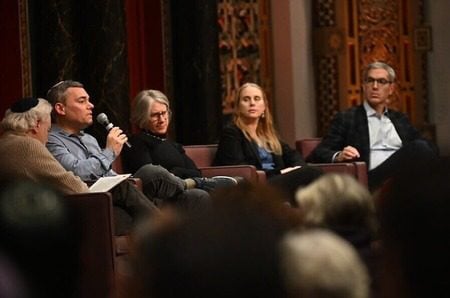
On Jan. 6 in Manhattan, rabbis and Jewish thinkers gathered to ask whether liberal Zionism is collapsing.
The conversation, held at B’nai Jeshurun on the Upper West Side, centered on what panelists described as a profound crisis accelerated by Hamas’ Oct. 7 attack and the war that followed, but rooted in the rightward political drift in Israel and growing estrangement between American and Israeli Jews.
The panel included:
Rabbi Jill Jacobs, CEO of the rabbinic human rights organization T’ruah; Rabbi Elliot Cosgrove of Manhattan’s Park Avenue Synagogue; Peter Beinart, a writer; and Esther Sperber, an Israeli-American architect and Orthodox activist.
Representatives of the Zionist right were not invited to sit on the panel, said moderator Rabbi Irwin Kula, because “that’s [not] where the crisis is.”
“We are living through the collapse of a paradigm,” said Kula.
He said: The question was no longer how big the Jewish tent should be, but whether it had already been “shredded.”
Kula pressed panelists to articulate the fears and “nightmares” driving their positions — a strategy meant to surface “vulnerability” rather than certainty.
For the most part, the audience — over 400 in the sanctuary, and another 882 online — held its applause and jeers, as Kula requested.
Cosgrove warned that American Jews were increasingly turning one another into enemies, and said that the role of pulpit rabbis like him is to make room in their congregations for disagreement.
“When the Jewish people don’t lack for external enemies, we are making internal enemies,” he said.
“And I believe that the role of rabbinic leadership and all of leadership right now must be that we restrain ourselves from this need to call the other a ‘self-hating Jew’ or ‘self-hating Zionist,’ or whatever label you want to put on one side, and a colonial oppressor on the other side.”
Jacobs, whose organization condemns Israeli policies in Gaza and the West Bank, said that for years major Jewish “legacy” organizations told American Jews that supporting Israel meant defending its government, ignoring “occupation” and silencing Palestinian voices. As Israel has moved further away from liberal democracy, that model has alienated young Jews.
“You have a young generation who’s never known Israel without Netanyahu in the helm, or almost never known the possibility of peace for both Israelis and Palestinians,” Jacobs said.
“Unsurprisingly,” that generation says, “I want no part of that.’”
In March, a Pew Research survey found that while a substantial share of young Jews still affirms the importance of Israel and the two-state idea, they also are less supportive of Israeli policy and more questioning of traditional Zionist approaches than older generations.
Sperber brought the crisis into the realm of family and faith. Speaking as an Israeli with relatives across the political spectrum, she described conversations that have become nearly impossible, even among her siblings in Israel who share religious language and deep attachment to the land.
She said her own activism as a founder of Smol Emuni, or the “faithful left,” grew out of alarm at what she called the celebration of power, vengeance and dehumanization in Israel discourse in her community of Orthodox and otherwise observant Jews.
Their uncritical support of the current Israeli government and its hawkish policies is often justified, she said, through distorted readings of Jewish tradition.
“We hear a kind of admiration of power and vengeance and brutality that is using our Jewish tradition as its justification,” said Sperber. “People talking about the Palestinians as Amalek, a kind of mythical nation that is supposed to be destroyed.
“Our Judaism has been leached away from us, and we need to find a way to bring it back into a place that’s morally grounded in our Torah and in our kind of democratic and liberal” values, she said.
What is needed is not only broader inclusion but teshuvah — moral self-examination and repentance — a core Jewish response to catastrophe.
Beinart now calls for one state, and this has placed him outside the liberal Zionist camp.
He described his own position as emerging from years of listening to Palestinians, including people in Gaza. He spoke of specific conversations that left him haunted by the scale of civilian suffering and fearful of being judged by future generations for silence or complicity.
“The most constructive role I could play is to nudge people a little bit to listen to Palestinians,” he said.
Such conversations force Jews to confront how “ethnonationalism in Israel-Palestine” contradicts their own ideals as Americans. The liberal Zionist promise — that one could affirm Jewish safety, democracy and equality simultaneously — has failed under the weight of reality, he believes.
Beinart — recently criticized after his appearance at Tel Aviv University — acknowledged the cost of rejecting the Zionist idea of exclusive Jewish sovereignty: estrangement from the Jewish communities he once felt at home in, and anxiety about what that alienation means for his children.
“My nightmare is that I will continue to lose those relationships because I can’t find a way to communicate effectively with people who profoundly disagree with the positions I’ve taken, and that I do it out of love for our people and then other people,”said Beinart.
Cosgrove suggested that Beinart’s views have become so toxic in many parts of the Jewish community that it was a risk for a prominent pulpit rabbi like him to share the stage.
“I’m concerned, because this is a public forum, that me sitting here quietly would signal my assent with anything that’s being said here,” Cosgrove said at one point, earning scattered applause.
Cosgrove agreed with the notion that American Jews could learn from Palestinian voices, but also said that critics of Israel should speak with Israeli soldiers and others “risking life and limb to make sure the atrocities of Oct. 7 never happen again.”
Even panelists critical of Israeli policy rejected the idea of disengagement.
“We can’t try to create a Jewish community that has nothing to do with half of the [world’s] Jews,” Jacobs said. At the same time, she urged American Jews to stop using Israel as a proxy for Jewish identity and invest more deeply in Jewish life at home.
By the evening’s end, no roadmap had emerged for saving liberal Zionism — or replacing it.

