

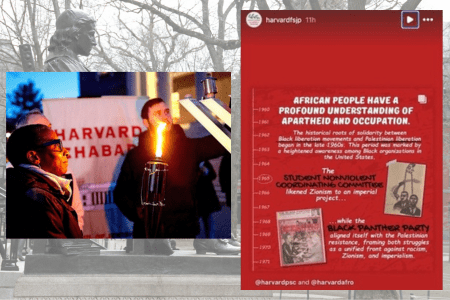
A federal judge threw out the Trump administration’s lawsuit that accused Harvard University of having “turned a blind eye” to Jewish and Israeli students.
The judge, Richard Stearns, ruled Aug. 13that the government’s evidence for Harvard having committed Title VI civil rights violations were “too isolated and episodic to support a plausible inference that any institutionalized noncompliance with Title VI persists at Harvard to this day.”
US Assistant Attorney General Harmeet Dhillon said the government disagrees with the ruling and is “assessing next steps.”
Trump’s suit, first filed in March, was a cornerstone of his administration’s aggressive and contentious fight against campus anti-Semitism.
At Harvard, Jewish students were targets as “Zionists,” in the aftermath of the Oct. 7, 2023, Hamas attacks in Israel.
The school settled cases with some Jewish students and put forward its own plans to fight anti-Semitism.
Yet unlike some other schools, Harvard resisted the government’s efforts to make concessions and pay a fine in order to resolve Title VI cases. The school also fought the Trump administration’s 2025 freezing of more than $2 billion in federal funds to Harvard, which the government argued was punishment for failing to address campus anti-Semitism.
Judge Sterns wrote that the government’s case in the Title VI suit was flawed because it relied on incidents almost entirely from the 2023-24 school year and couldn’t be considered “ongoing.”
He also criticized the Trump administration’s practice of withholding funds from schools accused of Title VI violations, writing, “Congress’s intent was not to penalize a wayward funding recipient but instead to incentivize it to bring itself into compliance with TItle VI.”
Title VI is the section of the Civil Rights Act requiring institutions that receive federal funds not to discriminate on the basis of race, color or national origin.
Shabbos Kestenbaum, a Harvard alum who has become a prominent conservative voice on antiSemitism issues since Oct. 7, said:
“Harvard insists on violating the civil rights of American Jewish students while holding the American people hostage in paying for it.”
Kestenbaum encouraged the government not to issue any further grants to the university.
The case has been seen as a barometer of academia’s ability to fight the Trump administration in court over federal enforcement efforts, many of which the administration cited campus anti-Semitism to justify.
The day before the suit’s dismissal, three dozen universities — including fellow Ivy League schools Brown, Columbia and Cornell, all of whom had signed agreements with the Trump administration in exchange for dropping anti-Semitism charges — filed an amicus brief supporting Harvard in a separate case that had restored the school’s federal funding by court order.
The legal controversey divided Jewish groups.
Weeks before the judge’s ruling, Hillel International filed, then immediately withdrew, its own amicus brief supporting Harvard in the separate case.
Hillel’s brief argued the school was already adequately addressing anti-Semitism and that the government’s actions “do not help Jewish students.”
Hillel withdrew the brief hours later, after activists including Kestenbaum criticized the organization on social media and urged donors to withhold funding.
Hillel International declined to comment. A request for comment to Harvard Hillel, which operates independently of the parent organization, also did not comment. Nor did Harvard Chabad.
A March open letter signed by 120 Jewish Harvard faculty and staff after the lawsuit’s initial filing said the government “cynically exploits concerns about anti-Semitism to justify what can only be described as an authoritarian assault on institutions of higher education.”
In contrast, a July open letter signed by 170 Jewish and non-Jewish Harvard faculty and staff said that “challenges remain” on campus, while acknowledging “the situation has improved to some extent recently.”
“We understand why colleagues question the merits and motives of the Title VI lawsuit,” the second letter states. “But one should not turn a blind eye to the fact that many Jewish and Israeli students have suffered harassment and discrimination over the last few years, degrading their Harvard experience.”


