

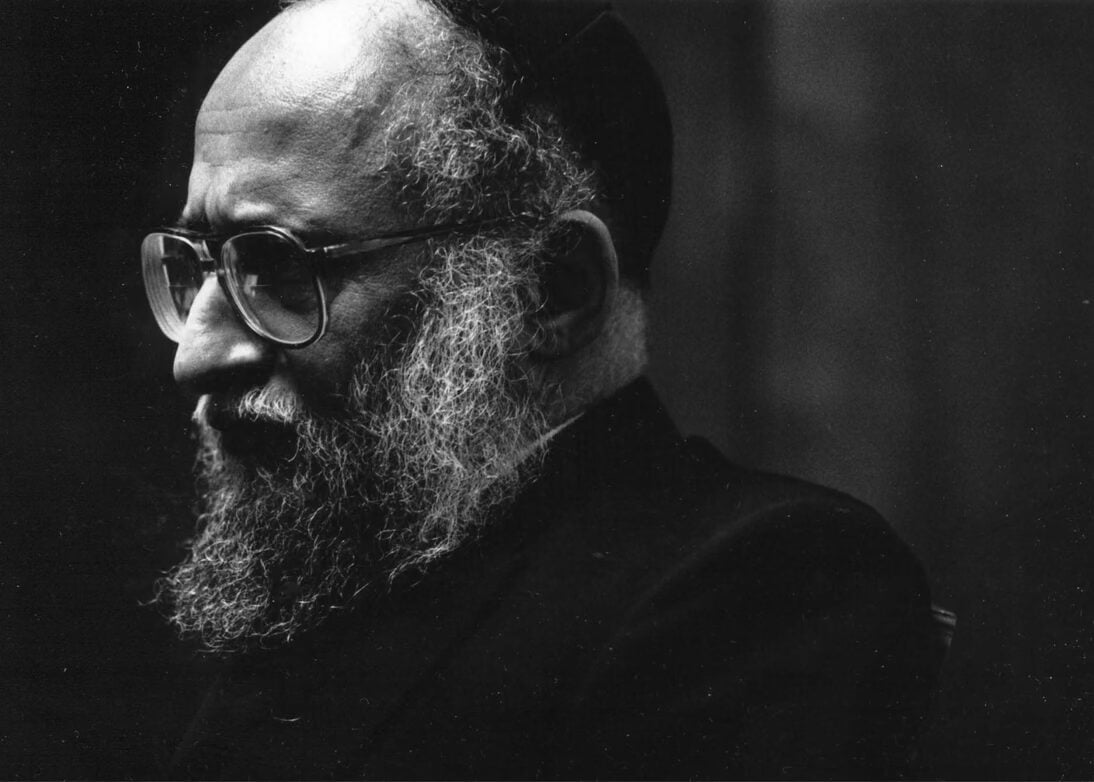
Lodestar.
Like his namesake.
The universally respected and beloved sage of European Jewry before the Holocaust was Rabbi Israel Meir Hakohen Kagan, who died in 1934.
Universal.
Not a light term. But a true one. No matter one’s circle, no one was held in such universal esteem and reverence as the sage known as “Chofetz Chaim,” after the name of the sacred tome he wrote on proscribed speech (slander and talebearing).
Denver’s Rabbi Kagan Israel Meir Hakohen Kagan — the dean, rosh yeshiva of Yeshiva Toras Chaim, whose soul ascended upward this week — bore the precise name of the Chofetz Chaim. And he was held in that same esteem in our community. Respected and beloved — universally.
Rabbi Kagan — our Rabbi Kagan — was the final word in the traditional community in greater Denver. He didn’t impose it. Didn’t demand it. Didn’t enforce it. No one bestowed this status upon him. It was just who he was. It was his polymathic knowledge of Torah and Talmud — and his humility. With him in Denver, the traditional community was not riven by competing allegiances — something so taken for granted that its rarity might be perceived only after his passing.
Rabbi Israel Meir Hakohen Kagan was Denver’s lodestar.
He was the leading Talmud scholar in our region, and that superior knowledge surely contributed to his stature, but only partly. Rabbi Kagan lived and breathed the study of Torah. It is written, “Because they (words of Torah) are our life and the length of our days, and we will meditate about them day and night.” Meditate. An internally driven process. An all enveloping process. A total personality. A high level of spiritual existence.
In Yeshiva Toras Chaim’s former home at 1400 Quitman Street, Rabbi Kagan sat and studied Torah, preparing his Talmudic lectures while leaning back in his chair as his head rested on the wall. His practice and posture were so steady that over the three decades the outline of his head was imprinted on the wall he leaned back on.
Body and soul and imprint — Rabbi Kagan’s impact on this world — radiated outward from that outline on the wall of Yeshiva Toras Chaim to thousands of students who built their own Jewish lives in Denver and around the world.
Not only students. He was interwoven into the fabric of the Denver Jewish community. For a word of personal advice. For counsel on a communal matter. For participation in a Beth Din. Last but not least, not to be omitted in any accounting of this universally respected and beloved sage — his wit, irony, humor and smile.
Not only students and not only a community — but a family. No accounting of Rabbi Kagan is possible without reference to his late wife Leah Kagan, beloved in her own right, a softspoken paragon of outreaching friendship — and without reference to the many generations of loyal Jews and Torah scholars that Rabbi and Mrs. Kagan leave behind.
The mourning is deep because the loss is not only of a leader, a scholar, an institutional head. The mourning is deep because it is also personal. It is not only Rabbi Kagan the rosh yeshiva, it is Rabbi Kagan the friend and role model whom we have lost.
Meditate. “Uvahem nehegeh — and we will medidate about them.” Rabbi Kagan did not leave behind a book named “Chofetz Chaim” — literally, “He who desires life” —but he left behind a gently, steadily, pulsating image of a person who loved life, and who did so because he loved the primary source of an elevated life, the Torah and the study of Torah.
Rabbi Kagan was one of the last living disciples of Rabbi Aaron Kotler, who primarily disseminated in the United States the idea of Torah study as a spiritual pursuit worthy in and of itself. No accounting of Rabbi Kagan is possible without reference to his fellow disciple of Rabbi Kotler, his esteemed partner of 60-years standing, Rabbi Isaac Wasserman, who blessedly is still with us. Few partnerships last 60 years. The Wasserman-Kagan partnership in Yeshiva Toras Chaim brought this idea of Torah study for its own sake to the Rockies, an unlikely place for the planting of such an idea. Their idea has taken deep root here.
Who would have expected 60 years ago that there would have emerged among its many flowers one who became a lodestar?
Rabbi Kagan — scholar, patriarch, molder of men, friend, amazingly accessible — is missed, we suspect, far more than he ever could have guessed. Denver has lost its Chofetz Chaim.
© IJN 2026

