


When the Jewish Federation of Greater Philadelphia first got wind of a planned “boycott bike ride” of six Jewish- and Israeli-owned restaurants scheduled for Sunday, Nov. 8, its CEO wondered if the result would be “a small pebble” or “a big boulder.”
It became a big boulder.
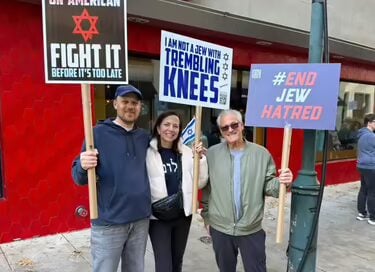
The protest ultimately drew some 300 bikers, but thanks to communal organizing among dozens of Jewish, pro-Israel and interfaith groups, it was met with an estimated 200 counter-protesters and hundreds more who waited in hours-long lines, to patronize the affected businesses.
“I honestly had a hard time hearing what the boycotters were saying,” Michael Balaban, the federation head, said. They were drowned out by counter-demonstrators singing Israeli songs.
The restaurants all sold out their inventory.
At one shop, the mac-and-cheese kiosk Mac Mart, a visitor offered to buy the open box of baking soda its proprietor kept to eliminate pantry odors.
“What was supposed to be a boycott of Jewish businesses turned into a food festival of Jewish businesses,” Balaban said.
“I had several people say, ‘I feel safe walking as a Jew today’.”
A group called Philly Bike On Your Left organized the event. Its flyer proclaimed, “No business for Zionists!” with the names of six local Jewish-owned restaurants listed with red “No” signs drawn through them.
The planned date fell just before the 88th anniversary of Kristallnacht, the “Night of Broken Glass” targeting Jewish businesses and homes in Nazi-occupied Europe.
What made a Philly business “Zionist,” fit to be targeted?
Some of the business owners had donated to United Hatzalah, the Israeli first responder organization. Others had simply posted online that they were Zionists.
Allan Domb, the owner of Schlesinger’s Deli, told the local CBS affiliate that he believed his business was on the list because he had donated to the local federation after the Oct. 7, 2023, Hamas attacks in Israel.
In its rhetoric and conflation of Jewish- and Israeli-owned businesses with Israel, the bike boycott seemed like a perfect storm for pro-Palestinian protests. Yet the boycott — focused only on Jewish busineses — spurred a broad show of force from Jews and their allies to fight back.
“A real line was crossed here,” Balaban said. “You want to boycott something going on in Israel . . . go to an embassy, go to a consulate. But to think that someone selling tahini milkshakes or macaroni and cheese has a red phone to the prime minister, that’s just silliness.”
Three people were arrested and two police officers suffered minor injuries.
Local elected officials spoke out strongly against the ride, including Philadelphia District Attorney Larry Krasner, a favorite of the progressive movement.
“There is widespread perception that this action is anti-Semitic,” Krasner said in a video he filmed from his car prior to the event. “That perception is real.”
He cited the timing, the targets and the rhetoric around.
Krasner and Lori Shapiro, Pennsylvania’s first lady and wife of Jewish Democratic Gov. Josh Shapiro, joined state lawmakers who attended a “solidarity lunch” with some of the targeted businesses days prior to the boycott. The Philadelphia JCRC organized the event.
Gov. Shapiro called the boycott “blatant anti-Semitic targeting of Jewish-owned restaurants on the anniversary of Kristallnacht,” and said local support of the businesses “prove once again that hate has no place in our Commonwealth.”
Pennsylvania Sens. John Fetterman, a pro-Israel Democrat, and Dave McCormick, a Republican, also condemned the ride.
Among the groups supporting the ride were Faculty for Justice in Palestine chapters at Temple University and the University of Pennsylvania; the local Students for Justice in Palestine chapter; a pro-Palestinian group of Temple law students; and Writers Against the War on Gaza.
The local Democratic Socialists of America chapter initially promoted the event, but then said it “does not endorse the bike ride.” But the Philly DSA’s statement accused accuse the event’s critics of “political repression of anti-Zionism” orchestrated by “organized Zionist lobbying groups.”
The Prayers for Peace Alliance, an interfaith pro-Palestinian group in Philadelphia that includes Jews, said: “The decision to target only Jewish-owned businesses threatens to undermine trust within this broad, intersectional movement, which includes many American Jews.”
Early on, the federation wondered if they should avoid giving the protests much oxygen. It changed its minds after last week’s midterm elections, which Democrats dominated and which, to Balaban, elevated candidates who “use ‘Zionist’ as a code word.
“Seeing individuals who use anti-Israel and anti-Jewish as part of their platform come into the fold, it was time for us to let loose and push back,” he said.
Philly Bike On Your Left is planning a follow-up bike protest.
Balaban says he’s ready.
“We know that they’ll be out again, and we’ll be out again.”


