By Yael Buechler, Kveller via JTA
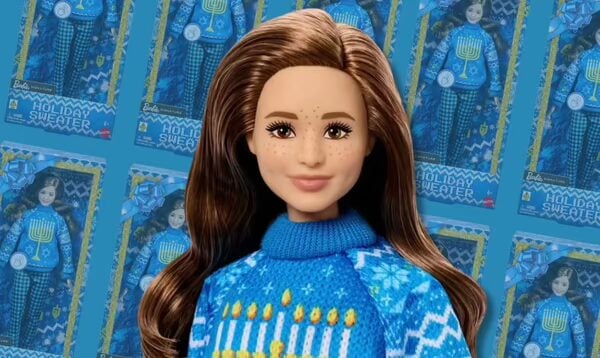
Mattel would like us to call her “Holiday Sweater Barbie.” Respectfully, no. This is Chanukah Barbie.
She is dressed in the blue-and-yellow color palette that retailers have apparently decided belongs exclusively to Chanukah.
Her sweater is covered in Jewish stars and dreidels, with a light-up chanukiah built right into the front.
She also dons blue-and-white gingham pants and tan shearling boots, because Chanukah Barbie understands comfort.
Naturally, I bought her immediately.
Unboxing her involved approximately 613 tiny plastic ties, but once I finally freed her, I was even more delighted than I expected. I have spent an unreasonable amount of my adult life thinking about Chanukah merchandise, and holding an actual Chanukah Barbie feels slightly surreal.
As Denverites well know, Barbie was created by Ruth Handler, the daughter of Jewish immigrants, who co-founded Mattel and introduced Barbie in 1959.
It feels almost bashert that a doll created by a Jewish woman is finally celebrating a Jewish holiday — more than six decades after her debut!
I’m not sure Handler ever imagined this particular outfit, but I like to think she would have loved it.
Judging by the frenzy around her, plenty of people seem to agree.
She has repeatedly sold out at major retailers, sometimes within hours of appearing online.
I understand the impulse.
There are few shopping instincts stronger than a Jewish person unexpectedly encountering genuinely good Chanukah merchandise. You see it. You buy it.
Which is why I was particularly disappointed when some other outlets decided that the big Chanukah Barbie story was apparently her nose.
Had Mattel intentionally given its Jewish Barbie a larger nose? Chanukah Barbie had barely arrived and somehow the conversation had already turned to one of the most tired stereotypes about Jewish appearance.
So, for reasons I absolutely did not anticipate when I ordered this doll, I have now become familiar with Barbie face sculpts.
The Barbie face many of us picture is known as the Millie sculpt. Another face sculpt, Violet, dates to 2018 and has pronounced dimples, fuller cheeks and a somewhat more prominent nose.
To my eye, Chanukah Barbie’s face looks like an iteration of Violet, but not exactly the same. Next to a Barbie with the Violet sculpt, Chanukah Barbie’s face looks more petite. And while Violet dolls are marked “2018” on the backs of their heads, the back of Chanukah Barbie’s keppe reads “2026.”
That doesn’t tell us exactly what changed, or why. But based on my own side-by-side comparison, I see similarities to a face already used on other Barbies, not evidence that Chanukah Barbie was designed around a stereotypically Jewish nose.
If we’re going to scrutinize the choices Mattel made with Chanukah Barbie, I’d rather focus on the ones the company got right.
The Hebrew letters on the dreidels are accurate. Her chanukiah has the correct number of branches. The sweater lights up. Technically, the illumination reads more like three glowing sections than nine individually blazing candles, but I’m willing to give Barbie a pass for imperfect light-up-sweater technology.
Those details may seem small, but Mattel itself knows how quickly one mistake can become the story. In 2023, packaging for its Barbie honoring the Cherokee Nation’s first woman principal chief famously contained an error in the Cherokee text that turned “Cherokee Nation” into “Chicken Nation.” This time, Mattel did its homework.
One more pressing question for Mattel: When are we getting the Chanukah Dreamhouse?