

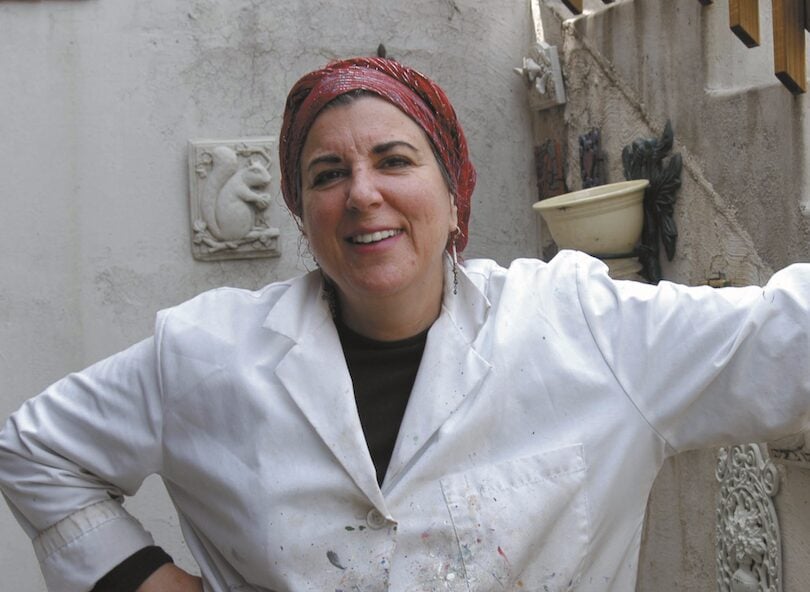
Who would have thought that a voice message could be a work of art?
If you called Arel Rachel Mishory and she couldn’t pick up, you were treated to a serious message lightened as a clever ditty. How I wish I would have transcribed these messages. They made you listen longer than you expected to, when all you wanted to do was to leave your name and number, but they weren’t annoying. They were engaging.
Arel’s phone messages were one more medium for her artistic bent. I have in my office one of Arel’s prints, about 5” x 5”, a “Mizrach” — an eastward sign to help orient one for prayer. All that a “Mizrach” or “East” needs to say is the word itself, and that is all that many “Mizrach” signs do say. But in Arel’s beautiful handiwork, on top of the “Mizrach” are man and a women’s interlocking hands under the Hebrew words, “Shalom Bayit, Peace in the home.” Then, underneath the Mizrach is a lit menorah. Surrounding it are the Hebrew words for “on this side, the spirit of life,” with doves holding branches of peace above it all.
Does the print sound busy and cluttered? It isn’t. Each item is perfectly proportioned and the colors and design naturally enhance the message. Next to her signature at the bottom is “Shalom Bayit Mizrach.”
One more thing: This was a gift to my wife Elaine and me. I strongly suspect that the number of people who received similar gifts of artwork from Arel is beyond count. Even so, she made a business out of her art, “The Hand Work,” which played out not just in prints but in canvas, fabric, tin and porcelain.
Who would have thought that all this gentle artwork could constitute only one piece of a life?
Arel was my student, my teacher, my friend, my community support, my role model, all with such ease and deftness of touch. There were so many pieces to her life, which I first discerned when she called me from Santa Fe 43 years ago out of the blue. She was looking for kosher wine and figured a Jewish newspaper would know how to direct her. Little did I know that with this phone call a lifetime of friendship, always interwoven with Jewish practice and faith, began.
If Arel needed to ask something in Torah, she called me. If I needed someone to explain a point in Torah to someone else, I called her. Even in the most delicate of halachic topics, the laws of family purity, when it needed to be taught in theory or practice, I never had an issue. All I needed to do was to call Arel. She was never too busy. I knew she would bring her customary ease that combined clarity and compassion to the questioner — and to make a friend to boot.
Art. Torah. Teaching. And many other sides to Arel, too. She was a community builder. Often the builders don’t know how to be “support staff” — the leaders don’t know how to be followers — and the “support staff” doesn’t know how to be builders. Arel was both. In Torah Bamidbar in Santa Fe. In the Southeast Center for Judaism in Denver. And, I take it, in Baltimore, too.
In the early 1990s I organized a Shabbaton in Salt Lake City together with the Walton family there. There was a need for teachers who could communicate the layers of Torah to people who had but the barest of exposure to them. I asked Arel and Mordechai to come to Salt Lake, to be those teachers. They did. They needed no briefing, no training. All they needed to do was to be themselves and speak out of their own faith and love of the life prescribed by the Torah. They were perfect.
Decades ago the Mishorys fashioned a challah board out of beautiful wood. It stands on small legs an inch high, and is shaped like an altar. The Mishorys gave this to us as token of friendship. We use it every Shabbos, and every Shabbos it brings our friendship with Mishorys into our lives.
The Mishorys brought their presence and wisdom mainly to Santa Fe, Denver and Baltimore. Hardly least, Arel was a wife and a mother, and relished both roles, and both are complicated roles. Somehow, the ease reflected in her art and in her way with people incorporated itself naturally into her family life. If ever there were a couple who mirrored each other’s virtues, it was Arel and Mordechai.
I can no longer access Arel’s voice messages. But I do have the message that she and Mordechai sent for their Rosh Hashanah Greeting in the IJN. So much, in so few words: “May we all gain clarity from the messages that Hashem has been sending us in this historic moment.”
Yes, through her gentle, clear touch in all her roles and messages, Arel came through as a person of faith. Faith is often taken to be something needed in order to relieve a burden. Goodness knows, Arel had her share of physical challenges. But for Arel, faith was not primarily a burden-reliever. It was a buoyancy. It lifted her up. It lifted up others alongside her. To be alongside Arel Mishory was a feast of faith.
With all of these qualities of Arel, we still have not gotten to the heart of the matter, the essence of this beloved person who left us on Nisan 5, 5786. Many people have many fine qualities. With Arel, it was more — she integrated them. She embodied the musar ideal of adam ha-shalem, “the whole person.” Rabbi Israel Salanter, the founder of modern musar, observed that if one has two very large challahs, and one of them is missing a piece, even a little piece, but one also has two small challahs, and they are whole, then one may recite the “Hamotzi” blessing only over the small challahs, not over the large ones. The goal in life is wholeness, with each piece of life perfectly proportioned, with the designs and colors of life perfectly in sync. The goal is not to project a dramatic accomplishment or trait, but to integrate all the pieces of one’s life.
It is a very high bar. A very high ideal. It is rarely reached.
Arel Mishory reached it.
Her memory places us eternally in her debt for that.
It was a privilege for all who knew Arel Mishory to walk alongside her. She wasn’t above you. She wasn’t beneath you. She was alongside you, gently and artistically drawing out the faith inside you.
• • •
Arel Rachel Mishory is survived by her husband, Dr. Mordechai Mishory; son Elie (Dassi) Mishory; siblings Patricia, David and Sue (Kevin); and seven grandchildren.
Contributions may be made to the Torah charity of one’s choice.
© IJN 2026


