

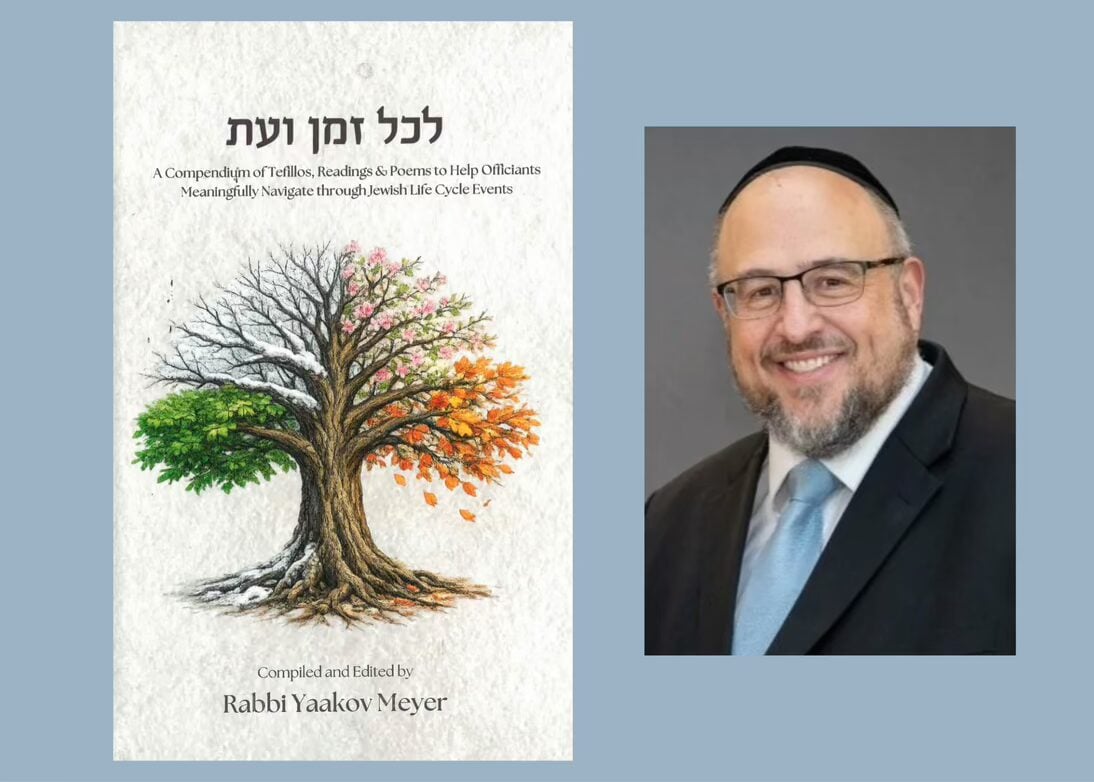
There are endless teachings in the Talmud. So many more than the 613 commandments. For every one of the “staples,” like kiddush, Shema Yisrael and Mi She’beirach, there are the lesser-known prayers, like the Prayer Before an Operation (“Bless me with bodily vigor”), the Prayer for Inner Peace at Night (“Keep us this night from the anxieties and tensions of darkness”) or the Prayer for Divine Assistance (“Give us strength of body and health of mind”).
To assist his rabbinical colleagues with a quick reference of prayers, mainstream or obscure, Aish of the Rockies Rabbi Yaakov Meyer has published a guidebook, For Every Time and Place: Compendium of Tefillos, Readings & Poems to Help Officiants Meaningfully Navigate through Jewish Life Cycle Events.
In the book, Rabbi Meyer has examples of prayers the likes of the Prayer to Find a Lost Object (“May I find [item] which is lost”), or the Prayer for Perseverance in the Face of Adversity (“Guard us from imaginary fears and illusory perils”).
Prayer for a Lost Object? Who knew?
“The idea is that in the Torah portion when Hagar takes her son, Ishmael, out to the desert, when Sarah tells Hagar to send the child away,” says Rabbi Meyer, “there comes a well of water and all of a sudden it says
G-d opens her eyes and she sees the well of water.
“The well of water was there,” so the Talmud says, yes, it was there, but she didn’t see it.
“There are a lot of times, and I noticed it in my life. Well, it’s there and you don’t see it.”
Situations of that sort motivated the rabbi to the prayer compilation.
“What led me to put it all together,” Meyer says, “is that as a young rabbi I started to do funerals, there was very much a standard text and a lot of Hebrew with translation that I didn’t find all that exciting, but more so, depending on who I was doing the funeral for, I felt that there needed to be certain things that would touch people emotionally or that they would relate to at a funeral that would be meaningful to them.
“Just to read the Psalms, of course, that’s who we are, but only to read Psalms or certain prayers in Hebrew or even translated, people wouldn’t relate to it. You want people to feel a sense of mourning and sometimes even connection to the deceased at a funeral.
“I didn’t think that was out there for most Orthodox rabbis, so I decided to compile prayers from all over. They were from different prayer books, from different things that I heard, from things that I read having nothing to do with death and mourning.
“Every single one of them, I think, has changed and adapted an outlook on life that would be mine or more tradition-based. Hopefully, this would make it more meaningful for, not necessarily clergy, but Torah-observant officiants, at funerals or other lifecycle events.”
In his tidy 109 pages, Rabbi Meyer includes the Blessing for Synagogue Boards, a Prayer for Personal Times of Distress, and even the Prayer Against Loneliness.
“Grant me the awareness to sense the nearness of Your Presence so that I may never feel the dread of being alone,” the prayer reads.
Meyer has also come out with a 28-page paperback companion, When the Heart Seeks Prayer, for members of the community.
“This one is not meant for officials,” says Meyer, “but specifically meant for the individual when they go to a grave site and they don’t know what to say, or when a friend of theirs is sick, just a whole bunch of different things that relate not just to the officiant, but also to the individual.”
So many little-known prayers exist in this compendium, that it seems Rabbi Meyer has collated everything but a Prayer for the Denver Broncos.
“That’s a prayer for loneliness,” Meyer says, laughing: “When they don’t win, they’re very lonely.”
© IJN 2026

