

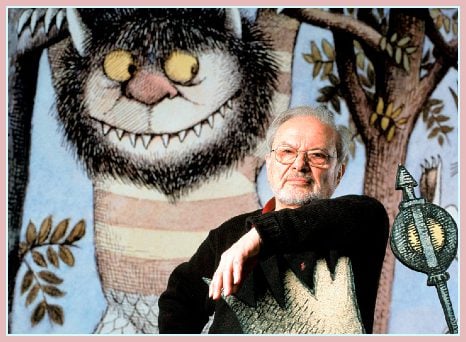
By Yael Ingel, National Library of Israel
[quote]And when he came to the place where the wild things are
they roared their terrible roars and gnashed their terrible teeth
and rolled their terrible eyes and showed their terrible claws
till Max said ‘BE STILL!’
and tamed them with the magic trick
of staring into all their yellow eyes without blinking once and they were frightened and called him the most wild thing of all and made him king of all wild things.
— Where the Wild Things Are[/quote]
Scary.” “Gloomy.” “Not suitable for children.” “High potential for nightmares.” These were some of the criticisms used to describe Maurice Sendak’s books.
In Where the Wild Things Are, young Max encounters terrifying creatures with pointed teeth and sharp horns after being sent to his room without supper. In In the Night Kitchen (1970), a boy barely escapes drowning in a pot of cake batter. In Outside Over There (1981), yet another boy is kidnapped by goblins.
But despite the dark themes (or maybe because of them?) Maurice Sendak’s books have been a huge international success.
Sendak was born in 1928, the youngest of three children, to Polish-Jewish immigrant parents. His mother Sarah didn’t speak a word of English when she arrived in the US on her own at the age of 16 in the early 1920s, following a terrible quarrel with her mother.
His father Philip also arrived alone from Poland. Philip’s father, a communal rabbi, cut ties with his son when he decided to leave home and move to the US.
From careful reading between the lines of Sendak’s books, as well as from interviews with the author, it appears that the melancholic atmosphere of his parents’ home, which each of their children left behind after a falling out, greatly influenced him and his work. Of course the looming shadow of the catastrophe of the Jewish people in those years also played a part.
Sendak said he did not grow up in a happy home. Although his parents did not experience the horrors of the Holocaust first-hand, it was nevertheless a pervasive presence in his communal and family space in Jewish-Yiddish Brooklyn. Gloom was an integral part of his home life as a child, and he conveys this in his work.
In his books, he acknowledged the less agreeable parts of childhood and the cruelty and loneliness that can accompany it. “I refuse to lie to children,” he said.
That is why, rather than beautifying reality, he chose to write also about the less pleasant experiences of childhood that would be familiar to every child.
Perhaps this is precisely the secret of his success.
The clearest example of this is Sendak’s description of his inspiration for the famous wild creatures of Where the Wild Things Are:
“The wild things are my aunts, uncles and cousins who came from the old country, those few who got in before the gate closed, all on my mother’s side. These people didn’t speak English, only Yiddish. And they were unkempt. Their teeth were horrifying. They had hair unravelling out of their noses. And they’d pick you up and hug you and kiss you. ‘Aggghh. Oh, we could eat you up,’ they’d say. And we knew they would eat anything. Anything.”
The diasporic Jewish context permeated Sendak’s childhood. One tragic personal memory stands out: on the day of his Bar Mitzvah, his father received the terrible news that his entire family had perished [in the Holocaust]. Not a single relative remained alive. He collapsed on his bed and refused to get up. Thirteen-year-old Maurice walked into his father’s bedroom and screamed at him: “You gotta get up, you gotta get up!” And he did.
The event took place as planned, but Sendak was left with terrible feelings of guilt for the way he behaved toward his father.
Sendak didn’t like school, and started drawing at a young age. His first works were very Jewish. The first book he illustrated was called Good Shabbos, Everybody, published in 1951 by the United Synagogue Commission on Jewish Education.
Another Jewish-themed work written and illustrated by Sendak was Chicken Soup with Rice — a lovely book that teaches toddlers about the months of the year, and describes how chicken soup — the traditional Jewish dish known as a cure for almost everything — is suitable for every month.
His parents did not particularly appreciate his work and were disappointed when he took a job as an illustrator instead of going to college.
However, a momentous reconciliation occurred when Sendak was asked to illustrate the stories of Isaac Bashevis Singer, the Nobel Prize-winning writer. This was something his parents could be proud of.
Before starting work on the illustrations for Zlateh the Goat and Other Stories, Sendak pulled out his parents’ family photo albums from Poland.
Inside he found pictures of his father standing next to his tall handsome brothers and women with long hair adorned with flowers. He went through all the albums, selecting some of his father’s relatives and some of his mother’s, and drew them with great precision.
His parents burst into tears when they saw the drawings and recognized their relatives. Sendak cried with them. He recalled this as a special moment in their relationship when they realized that thanks to him the memory of their beloved relatives had been made indelible in the book.
In a way, Sendak saw himself as a Holocaust survivor. He always remembered that he was alive by chance; that if his parents had not boarded the ship from Poland when they did, he would not be here. He and his older brother did not have children.
“People always ask me,” he once said, “if I am so interested in children, why don’t I have children of my own? The answer is simple: I think I would be a failure as a parent. And I hate to fail. I had a very troubled childhood. As an adult I didn’t feel I had the right qualities to be a parent.”
Maurice Sendak died in 2012, at the age of 83.


