

Wesleyan University president Michael Roth recently delivered a lecture on another campus outlining why academia should be more forceful in standing up to President Trump’s policies.
Roth, who is Jewish, rejects Trump’s claims that the administration’s campus crackdowns — rescinding grants, limiting international student visas, dismantling “DEI” — are a means of fighting anti-Semitism after the Oct. 7, 2023, Hamas attack on Israel.
“If you’re going to accuse Wesleyan’s administration of being anti-Semitic, start with me. But don’t call me on Saturday,” Roth quips. “Because I’m going to be in Torah study.”
Roth isn’t quite sure how he, the leader of a small-town Connecticut liberal arts school with a mere 3,000 students, became unusual among his profession by defending what he sees as the principles of academic freedom.
“It’s a bit of a puzzle,” he says. “I don’t think my view is very original. Any of the presidents I know at different schools probably have similar views.”
But Roth still stands out in the lengths he goes to rebuff Trump’s higher education policies — and to center his Jewish identity in doing so.
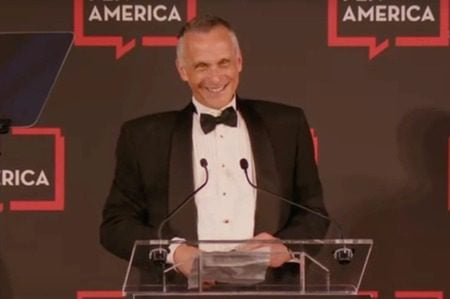
There he is, accepting a “courage award” from the literary free-speech group PEN America “for standing up to government assaults on higher education.”
There he is, giving interviews in which he lambasts “prominent Jewish figures around the country who get comfortable with Trump, it seems to me, because they can say he’s fighting anti-Semitism: ‘He’s good for the Jews.’ It’s pathetic. It’s a travesty of Jewish values, in my view.”
There he is, signing an open letter declaring that anti-Semitism “is being used as a pretext to abrogate students’ rights to free speech, and to deport non-citizen students.”
And there he is, telling JTA that so-called institutional neutrality positions, adopted by a range of universities amid the Israel-Gaza war (and supported by the Jewish campus group Hillel International), are “bogus.”
Roth’s profile has caught the attention of some Jewish families, including that of Mason Weisz of White Plains, NY, who said Roth was one reason that his son is a first-year at Wesleyan now.
Weisz recalled hearing an NPR interview with Roth in April, after admissions decisions were out but before seniors had to pick their schools, as pivotal.
The interview “in which he argues that Trump’s use of anti-Semitism to justify his strong-arming of universities actually is bad for the Jews, encapsulates everything I appreciated about Roth,” Weisz says.
Roth also earns good marks from some Jewish students on campus.
“He does care about Jewish students. He’s someone who does take their concerns seriously. And compared to other university presidents, he’s been better,” said Blake Fox, a Jewish senior at Wesleyan who is pro-Israel and is on the campus Chabad board.
Fox says he had a good experience as a Jew at Wesleyan, in part because the encampments there never felt threatening (he noted the protest movement was much smaller at Wesleyan than it was at other schools). That was due, at least in part, to Roth’s efforts to peacefully negotiate an end to the encampments.
Yet, Fox said, the president — whom he’s met several times — was also deeply concerned for the well-being of Jewish students. In meetings with Fox and other Jews on campus, Roth vowed to take action if any protesters ever threatened a Jewish student by name.
He also appreciated Roth standing up to Trump, particularly on issues of campus speech. “I’m pro-Israel, but I also support the First Amendment,” Fox said. “Even if there are individuals whose speech is bad, targeting them for deportation is a dangerous precedent, I think.”
Though a historically Methodist school, Wesleyan today has no religious affiliation and enrolls around 600 Jewish students — nearly 20% of the student body.
There’s no Hillel, but the school’s Jewish community includes a full-time rabbi, student leadership, dedicated Jewish residential housing, and a sukkah.
There’s also a Chabad outpost, which opened in 2011. Its director, Rabbi Levi Schectman, noted that recent “Mega Shabbat” gathering drew what he said was a record attendance of 175 students.
Roth, the school’s first Jewish president, has held the post since 2007.
He grew up in a Reform household on Long Island and considered himself “only modestly observant” until his father died 25 years ago. After that point, he said, he “began saying Kaddish and subsequently attending Torah study.”
Nowadays Roth makes a point of involving himself in Jewish campus life. He spent Rosh Hashanah with the affiliated Jewish community, and, last year caught a Shabbat service at the pro-Palestinian student encampments.
The latter group wasn’t too thrilled to see him there, he recalled; they’d been targeting him by name, often in insulting language.
But he wanted to learn more about the Jews who were participating in the protests right outside his office.
When one of them, an Israeli, personally apologized to Roth for the aggressive behavior of other encampment participants, Roth invited the student to his office and they had a long chat. “There were so many interesting conversations,” he said.
Roth acknowledges he’s in a better position to speak out than the heads of other universities, where hospitals and major research centers are more reliant on federal funding, and where instances of anti-Semitism had been more prevalent pre-Trump.
Schools like Columbia, Harvard and the University of California have made significant concessions to Trump. Is Roth worried that Trump could turn on Wesleyan next?
“Didn’t I say I was Jewish?” he responded, laughing. “Am I worried? Of course I’m worried. I’m a worrier . . . I would hate to put Wesleyan at risk.” But, he said, that wouldn’t stop him. “I have three grandchildren. I want them to grow up in a country where they don’t have to be brave to speak up.”
As Jews marked the recent two-year anniversary of Oct. 7, Roth was on the road to a literary festival in Lenox, Mass., co-sponsored by the left-wing magazine Jewish Currents, which loudly opposes both Israel and communal American Jewish support for it.
He would be appearing onstage with the journalist M. Gessen, who has compared Israel’s actions in Gaza to Nazi Germany.
Roth says he hadn’t known that Jewish Currents was a co-sponsor when he agreed to take part in the festival. But, he added, it wouldn’t have changed anything about his appearance. He’ll talk to anybody Jewish. A while back he submitted a piece to the magazine that was rejected (“I guess it was insufficiently anti-Israel,” he mused) and wound up running in the Forward instead.
Roth sees his own views on Israel as moderate. While he called for a ceasefire in March, 2024, he refuses to call the Gaza war a genocide and remains adamant he supports “Israel’s right to exist.”
He only blames Israel for what he said were the security failures that led to the Oct. 7 attack, which he had condemned immediately as “sickening.”
He takes Israel’s wartime behavior to task for “paving a path for egregious war crimes and a level of brutality and inhumanity that I never would have associated with the country.” Yet he remains “stunned,” even today, by what he called “the lack of basic sympathy, empathy, for the victims of those horrific murders” of Oct. 7.
“I pride myself on being realistic about the persistence of anti-Semitism,” he said. “Still, the callousness with which some people greeted those horrors was very disturbing.”
Yet when the encampments came for Wesleyan last spring, and some of their participants accused him directly of being complicit in genocide, Roth opted to negotiate with them. He wrote a piece in The New Republic declaring that he would not call the police, even though he knew the protesters to be in violation of some campus policies.
In that piece, he predicted: “My fear is that such protests (especially when they turn violent) in the end will help the reactionary forces of populist authoritarianism.”
Roth didn’t like many of the phrases his own campus protesters used, including “From the river to the sea, Palestine will be free.” Yet he defended their right to say it, angering some Jews on campus as a result.
“I try to have it both ways,” he said, weighing his principled views on both Israel and protest.
This can sometimes lead to very intricate needle-threading. He recalled how, when an address he gave to prospective students was disrupted by pro-Palestinian protesters unfolding a banner, he let them continue and even acknowledged the banner before pressing ahead.
Wesleyan senior Fox does take issue with some of Roth’s stances, including his opposition to institutional neutrality.
“I think he fundamentally misunderstands what institutional neutrality is,” Fox said.
“We don’t need to hear your views on Ukraine. We don’t need to hear your views on Israel.” Having the school president call for a ceasefire, he thought, is “alienating both sides of campus.”
More significantly for his job, Roth has long opposed the movement to boycott and divest from Israel.
This has angered activists at Wesleyan, who, like those at other schools, have made divestment a central demand.
Last spring, in order to peacefully break up his school’s encampment movement, Roth promised protest leaders they could make a case to the board for divestment that fall.
When the board opted not to divest, a small number of protesters became angry and attempted to take over a university building.
“They were not very civil to my staff members,” Roth recalled, describing the protesters as basically daring him to take action.
That time, he did call the cops.


