

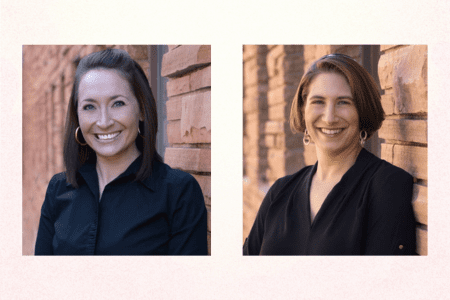
In the wake of the departure of Rabbi Joe Black, Temple Emanuel became the second US Reform congregation in history to elevate two female rabbis as “co-senior rabbis.”
The designation came in 2024. On Nov. 7, Rabbis Emily Hyatt and Elizabeth Sacks will be officially installed in their new roles.
Jewish synagogues sometimes celebrate installations long after a rabbi has achieved a new role in a congregation.
“Often, installations are the start of a relationship,” Rabbi Sacks told the IJN from Jerusalem, where she was attending the World Zionist Congress. She was also a guest on the most recent IJN Cast.
“But this is really a deepening, and a committed partnership that just feels so warm and so mutually beautiful.
“I think that we like to move our installations not from day one, but a little bit into the future in most places, because people should get to know us for a little while before we celebrate so that they have a sense of who we are.”
Regardless of when the official installation occurs, the occasion is very much a lifecycle event for Jewish clergy.
“A hundred percent,” says Rabbi Hyatt. “It is a moment in the lifecycle of the temple, right?
“We have been around for 151 years, and every time you move into a new phase of your story, Judaism says you stop and you acknowledge and you celebrate and you lift up somewhere you came from and where you think you might be going.
“And it’s cool. It’s really cool to be able to do that with the whole community.”
Two senior rabbis (plus another rabbi and two cantors), 2,000 units – how do the two rabbis divide up their countless responsibilities?
“We each have areas that we focus on that we are in charge of, ensuring they are moving beautifully,” says Rabbi Sacks. “For example, I focus and oversee worship and ritual, and Rabbi Hyatt oversees pastoral care and life cycle events. Those are just two examples of major pieces of clergy portfolio.
“That does not mean that Rabbi Hyatt is never on the pulpit, or that I never do pastoral care. What it means that each of us is in charge of shepherding the vision and stewarding that vision with our entire clergy team.”
“We have very many color-coded spreadsheets,” Hyatt laughs. “It allows us to know who is responsible for what at the end of the day.
“Everybody knows on our end whose job is what and exactly who is doing what and who needs to be in charge of, or checking in on which piece of our puzzle.
“Collaborative leadership doesn’t mean nobody’s in charge. That’s not a good model for success or for carrying out any kind of vision.
“Each of us has strengths and interests and each of us has both individual, independent and collective communal vision that we’re working on.
“We think a lot about where are the places where we connect and collaborate to create vision, and then how do we divide and conquer, in order to execute on that vision.
“In a lot of ways, it’s amazing and working so well, and it’s how we’ve been operating already for years between the two of us.
“In some ways we’re still figuring it out. I think that’s hopefully how it always will be, that we never get stagnant in this.”
With that, Temple Emanuel moves into its new era. The strategic mission command comprises of Sacks, Hyatt and executive director Steve Stark.
We are very proud of the model that we’ve created,” says Rabbi Sacks. “We’re one of the only senior rabbi pairs in the country. We are, as far as I know, only the second pair of female senior rabbis who are working together in this way.
“A number of years ago, the board of Temple Emanuel, together with the senior clergy and leadership of the temple, decided to adopt what we call an executive suite model,” says Rabbi Sacks. “What that means is we actually have three CEOs. So, what does that mean?
“We believe in collaborative leadership. We believe in non-hierarchical leadership. For us, this is saying, we are interested in thinking about how we redefine what it means to be synagogue leaders and to be Jewish communal leaders, and to bring the idea of partnership.”
Added Hyatt:
“We’re not looking for sweeping change at the moment. We’re looking to sophisticate where we’re at and get all of our staff and our professionals and our teams and our models working as efficiently as possible so that we are best equipped to hold those things every day.
“The biggest challenge certainly is the world and culture around us,” says Sacks. “And one of the things that I feel the most moved by and proud of as a part of our culture here at temple is that this seems to be a place where people have hard conversations.
“That is that is both the biggest challenge and the biggest blessing, because we don’t walk away from them and we don’t shy away from them.
“People say hard things and engage in hard conversations because that is the only way I think that we navigate through this world.”
Those conversations include the factions of anti-Zionists out there,” says Hyatt.
“The conversations that we have then are really not about anti-anything. They’re about redefining, and understanding in context, what does it mean to be a Zionist.
“We’ve worked really hard to engage people in the conversation of what Zionism is, and to engage people in a space where disagreement doesn’t have to be opposition, and there doesn’t have to be a separation from that.
“We actually have even more of an obligation to disagree with the things about which we feel deeply committed.”
Adds Hyatt:
“I want people to know that they should belong to any community that they belong to. It should be a place where their core values and beliefs are respected and where they’re welcome even if they’re not always agreed with unilaterally, and those are two really different things.
“One of our greatest hopes is that we have two senior rabbis who don’t always agree with each other is the truest model of what it means to know that we can be different from each other and be partners and be in community together and pray together and celebrate together and mourn together.
“If we model that all the time, then people will start to believe it, that we don’t have to find people who are just like us in every belief in order to make a meaningful community.”
For Sacks, the bottom line is this:
“One of the things that we’re excited about is that Temple Emanuel has been growing, and in order to make sure that each and every one of the congregants gets the attention and the care that they deserve, we want to have a clergy team that’s substantial and able to handle that.”
© IJN 2025


