

Ana Levy-Lyons was in her 20s when she found out she was Jewish. During her childhood in Tenafly, NJ, her family never spoke about what her mother would later call her “Jewish heritage.” Classic “nones” (what Pew calls the “religiously unaffiliated”), the family observed no religious rituals other than an Americanized Christmas and Easter.
Nevertheless, Levy-Lyons was drawn to matters of the spirit. After a brief career in tech and music, she enrolled at the University of Chicago Divinity School, eventually training as a Unitarian Universalist minister. She served for 18 years in UU pulpits.
Now 52 and no longer working as a minister, she is enrolled in the Jewish Renewal movement’s ALEPH ordination program to become a rabbi.
Levy-Lyons might have told a “coming home” story, but her new book takes a different direction.
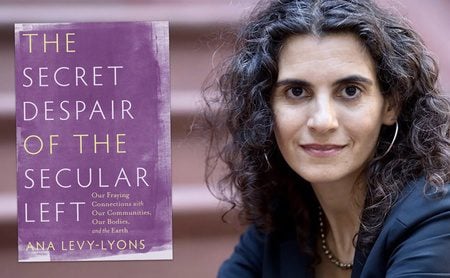
The Secret Despair of the Secular Left is less a celebration of Judaism (although there is that) than a searing critique of modern secularism.
As a church without a creed — UU’s pulpits and pews are open to believers and nonbelievers of any stripe — Unitarian Universalism came to represent to Levy-Lyons a “self-assured nothingness” that she sees among “nones” of all backgrounds.
Without religious and traditional structures, she asserts, community bonds erode, people become detached from the natural world and their souls become alienated from their bodies.
“I have come to believe that this is not just my story but the defining story of our time,” she writes. “It’s the story of disembodiment, disconnection and dislocations. It cuts across class and race.”
She offers religious tradition, especially Jewish traditions, as an antidote to a pervasive sense of grief and longing for deeper connection and meaning. She writes from the left but also against the left, frequently challenging liberal orthodoxies when it comes to feminism, abortion and gender identity.
On her Substack, she writes that the book is neither progressive nor conservative — or rather, both progressive and conservative.
“I’m hoping that this book can help elevate our discourse beyond today’s political polarization and engage our deeper cultural and spiritual struggles,” she writes.
“From my perspective, despite how much the two ‘sides’ hate each other right now, in terms of these struggles we are more similar than different.”
Levy-Lyons, whose previous book was No Other Gods: The Politics of the Ten Commandments, she lives on the Upper West Side of Manhattan with her husband and their 14-year-old twins.
Andrew Silow-Carroll: Your book is about a break with UU and and what drew you to reclaim your Judaism. A big part is a denomination that doesn’t impart any obligations or “shoulds” on its members, compared to mitzvot, which are commandments or obligations. Did I get that right?
Ana Levy-Lyons: Yes, that’s part of it. My first book is about the Ten Commandments, and it’s very much about the liberating power of mitzvot. In the secular-left world, obligations and rules and commandments are seen as oppressive and restricting, and they are in certain ways, but I feel that they actually liberate us from what otherwise is subtly guiding our lives, which is a consumerist culture and the hidden values of secularism, where freedom itself becomes the ultimate good.
You quote a supervisor at a UU congregation in the Midwest: “The most important thing” (referring to your congregants) “is to never make them feel guilty.” Was that the UU ethos?
Yes, freedom and self-determination are much more important than any obligations we might have to somebody else.
This is a story I didn’t tell in the book, but I remember when I was in search for what ended up being my Brooklyn pulpit. I was interviewing at a congregation, I think it was in Rhode Island. They asked me to put together a workshop or a little class for the search committee.
I asked them to imagine that if they were really, really religious Unitarians, what would that look like? What would they eat and not eat? What would they allow their children to do and not do? How would they dress? How would they spend their time?
They just looked at me like I was from outer space. “There’s nothing that we wouldn’t eat, because we’d be good people, we would eat in ways that are healthy, and do things that are aligned with our values.”
I didn’t get that job.
Let’s talk about the title of your book: The Secret Despair of the Secular Left.
The despair comes from the kind of mismatch between all of the crises that we’re having in our world today — war and ecological devastation, everything that is happening now — and the despair that comes about when you realize that your spiritual, religious and communal resources are just not up to the task of giving meaning and strength when you need it, nor providing a structure and a sense of connection to the past and the future.
In the beginning of the book, I talk about it in terms of the economic term “unrealized loss.” We invested all of our energy and freedoms into these fruits of modernity and we find that it’s actually kind of worthless.
We’ve liberalized ourselves out of any possible sort of meaning or foundation that we could have had.
What is an example of an investment the secular left has made that hasn’t paid off?
There are two very easy ones.
One is our use of technology and screens. We have this great new technology, and it seems like it allows us to connect meaningfully with people on the other side of the world, and as a result we don’t need to stay rooted in local communities anymore. We can move anywhere we want to for work.
So this is freedom, right? You don’t have to remain chained to your local community or your family.
But then we are lonely and depressed in direct proportion to how much we use our phones and use this technology. We’re alienated from one another and don’t have real communities.
I think Judaism in particular puts a real value on physical community and roots.
There’s the idea of a minyan. There’s a real emphasis on the kind of connectedness that has been broken in the modern world.
The other example is Shabbat. This is an ancient spiritual technology that people are now free from, in the Christian world, too, where blue laws are a thing of the past.
Secularism freed us from the oppressive rule of having to not work on one particular day of the week.
As a result of that, we all work all the time, and we’re completely exhausted and overwhelmed.
It is difficult to choose not to work one day of the week when everybody else is working.
It’s a secret despair because people, especially on the left, don’t want to admit that it’s the very things that they were so proud of, that felt so liberatory, that felt so empowering, that are actually draining meaning from life and causing alienation.
What does Judaism offer as an alternative to this despair?
Judaism offers a multi-generational story of people’s experiences of the divine and how the divine has acted in our lives, with the Torah as the basis for a huge kind of discourse that spans all these generations.
It offers us a sense that we are part of something much larger, that we’re not reinventing the wheel. We actually have something to build on, and something not only that we had to build on, but that we are accountable to.
It’s almost like scientific advances — you wouldn’t as a scientist just throw out everything that every scientist has ever done in the past, and then just kind of start again.
It doesn’t mean that you can’t revisit some things that you think scientists in the past got wrong.
Judaism gives you not only a starting point, but this huge resource that you can draw on: people who for thousands of years have been struggling with things that are in many ways the same things that we’re still struggling with today.
So along with that comes a sense of obligation to the future, and the sense that we’re a part of this tradition, we are making our own contribution to it, and then passing it on to future generations.
As I’m reading your book, I’m saying, “She’s writing about the middle ground between modernity and tradition, obligation and autonomy. That’s Conservative Judaism.
Yet you are studying toward the rabbinate at ALEPH, part of the Renewal movement. which is very liberal and innovative. I don’t associate it with the rigorous religious obligations and “shoulds” you write about. Am I wrong in terms of the kind of rabbis Renewal is creating.
You’re exactly right about the kind of rabbis that ALEPH is creating. They are all about expanding the traditions and reinterpreting Halacha [Jewish law] and all of that —but there are a number of rabbis who I would say are more traditionalist.
The reason why I ended up at ALEPH was because I was working full time as a minister, and I was writing books and I was raising a family, and so I had to study part time. There was no way I could go full time and [ALEPH] would allow me to study part time. In some ways it’s been a good fit for me because the mystical orientation of Jewish Renewal is something that really resonates with me.
Are you interested in another pulpit?
I’m so done with the pulpit! [laughs] I mean, I’m glad that I had that experience, but it’s so hard.
I’m probably just going to continue doing what I’m doing now. I’m trying to recreate a career for myself doing freelance versions of different components of clergy work. Writing, guest-preaching, one-on-one spiritual work.
What would it be like to help people escape from the oppressiveness of secular modernity, and find the freedom of the religious and communal life?


