

PASSOVER EDITION 5785
SECTION A PAGE 8
Interconnected controversies are roiling Israel — everything from Israel’s courts to its intelligence agencies to suspicions of a Qatari plot.
Police have questioned Prime Minister Netanyahu, two of his aides have been arrested and protests fill the streets.
The editor of the Jerusalem Post was also brought in for questioning.
All this is beside the debates over the Gaza war and the hostages still held by Hamas.
On April 1, the banner headline on one of Israel’s top papers blared, “National Vertigo.”
Why is Netanyahu’s office being investigated over Qatar?
Eli Feldstein was hired after Hamas’ Oct. 7, 2023, attack as a spokesman for Netanyahu. Allegedly, Feldstein was also being paid to represent the Qatari government — a longtime funder of Hamas — and to push Qatari messaging to Israeli journalists.
The man who oversaw Feldstein, longtime Netanyahu adviser Yonatan Urich, faces similar allegations.
Both Feldstein and Urich have been arrested, and the investigation has ensnared Jay Footlik, a former Democratic adviser, who reportedly arranged the Qatari payments to Feldstein.
On April 1, Jerusalem Post editor-in-chief Zvika Klein was also being questioned under caution. Klein visited Qatar one year ago at the country’s invitation and spoke with senior officials there; he wrote that his trip there “reveals a nation striving for a larger purpose on the world stage.”
Israeli media had reported that Feldstein invited Klein to Qatar. Klein denies that. “The Qatari government is the one that contacted us, the Jerusalem Post — because they knew that we’re a balanced and influential publication that is read both among government officials and influential American Jews — as do many other countries, and we have no need for intermediaries.”
One day earlier, Netanyahu himself was questioned. He has denied wrongdoing and says the investigation is politically motivated.
Why is this investigation blowing up?
Netanyahu has been on trial for corruption for years, but the Qatar scandal is different. Qatar has funded Hamas and houses Hamas’ leadership, who continued to use it as a home base. Qatar is also one of the countries mediating negotiations over the Israeli hostages Hamas is holding.
The concern is that if the prime minister’s aides are secretly working for the country that houses Hamas’ leaders, that may not bode well for Israeli security. Another twist: Amit Hadad, the lawyer representing Yonatan Urich, also has another client: Netanyahu.
Will the investigation implicate Netanyahu? What’s he saying?
The prime minister has not been charged in Qatar-gate, but he was brought in for hours of questioning on March 31.
As in his corruption cases, the prime minister denies any wrongdoing — and isn’t holding back. In a video on March 31, he called Eli Feldstein and Urich “hostages” — a loaded term in Israel.
He claimed that the entire investigation is a ploy to take down his government.
“After an hour, they were out of questions,” he said of the police. “I said, ‘Show me materials, show me something.’ They had nothing to show. I was astounded. I knew this was a politically motivated investigation, but I didn’t understand to what extent. And they’re holding Yonatan Urich and Eli Feldstein, simply, as hostages.”
The comment raised eyebrows. “He knows no bottom,” tweeted liberal activist Yaya Fink, one of the prime minister’s longtime critics. “The only hostages are our 59 brothers and sisters who are abandoned in Hamas captivity.”
Does Qatar-gate have anything to do with Netanyahu firing the intelligence chief?
It depends who you ask. “Netanyahu is firing Ronen Bar for only one reason — the ‘Qatar-gate’ investigation,” Israeli opposition leader Yair Lapid says. “For a year-and-a-half, he saw no reason to fire Bar, but only when the investigation into Qatar’s infiltration of Netanyahu’s office and the funds transferred to his closest aides began did he suddenly feel an urgency to fire him immediately.”
Although Bar, who was in his position on Oct. 7, 2023, is unpopular, a poll found that about half of respondents say Netanyahu fired Bar over “Qatar-gate” — not because of his job performance. (About a third said the decision was a result of Oct. 7.)
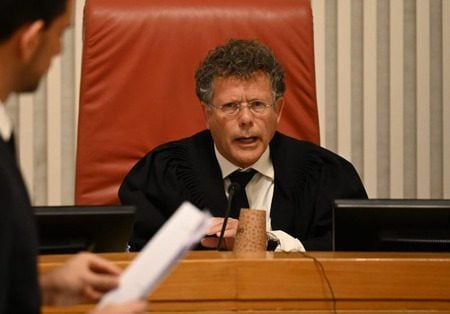
Israel’s Supreme Court was this week holding a hearing to determine whether it was legal.
Israeli law permits the prime minister and government to dismiss the Shin Bet chief without stating a reason, but courts can review if the decision was made lawfully.
There is a legal question of whether the dismissal must first go through the Senior Appointments Advisory Committee. That committee assesses the integrity and suitability of candidates for top civil roles, including the heads of the security and intelligence agencies (Shin Bet and Mossad), the police commissioner, the military’s chief of staff and the Bank of Israel governor.
Netanyahu insists that he has the right to choose his own officials — and he’s forging ahead, with mixed results.
On March 31, he announced that Eli Sharvit, a vice admiral in Israel’s navy, would be the next Shin Bet chief. The appointment earned praise even from some Netanyahu critics, who praised Sharvit’s professionalism.
But then, one day later, Netanyahu flipped, and pulled Sharvit’s nomination. That about-face came after Netanyahu allies protested that Sharvit had opposed another Netanyahu effort — his quest to reform the judiciary.
US Sen. Lindsey Graham also objected to Sharvit because the navy man recently wrote an op-ed, in Hebrew, criticizing President Donald Trump’s climate policy.
“While it is undeniably true that America has no better friend than Israel, the appointment of Eli Sharvit to be the new leader of the Shin Bet is beyond problematic,” Graham wrote.
“There has never been a better supporter for the State of Israel than President Trump. The statements made by Eli Sharvit about President Trump and his policies will create unnecessary stress at a critical time.”
Netanyahu announced April 2 that the Shin Bet’s deputy head would be its interim leader.
What is the target of the protests?
Protesters outside Netanyahu’s Jerusalem residence have highlighted the Qatar controversy and opposed the firing of Bar. They protest Netanyahu’s decision to end the ceasefire in Gaza and resume the war against Hamas.
Netanyahu says the offensive is necessary to depose the terror group from Gaza and pressure Hamas to release the remaining hostages.
Netanyahu says that Israel’s military pressure on Hamas is what caused it to release hostages in November, 2023 and January, 2025.
Protesters say that more war will endanger the hostages — instead of negotiating to bring them home. Negotiations, however, failed with Hamas’ refusal of all options, according to both Israel and the US.
Another issue animated the protesters: a renewed, successful legislative push to enact a piece of Netanyahu’s judicial form, equalizing the number of elected and unelected members of the Supreme Court selection committee.
The protests have been far from calm. The police, who are controlled by National Security Minister Itamar Ben-Gvir, have clashed with protesters. On March 31, two policemen were filmed grabbing left-wing lawmaker Naama Lazimi by the arms and manhandling her at a protest as she screamed.
Despite the demonstrations, Netanyahu’s parliamentary majority looks solid. His government just passed a budget, which enables his government to continue until the next regularly scheduled election in late 2026.
But Netanyahu is not popular: 70% of Israelis want him to resign, either now or after the war ends. Most surveys show he’d lose a close election if one were held today. But his poll numbers have improved since Oct. 7, 2023, and he’s escaped from political peril many times before.
Still, challengers are girding themselves. Former Prime Minister Naftali Bennett, a former ally who was key to unseating Netanyahu in 2021, just announced that he was reentering politics.
TPS contributed to this report.


