

Shavuot 5785
Where do you pray? In shul, in the company of fellow congregants, with the interactive quotient that so many prefer?
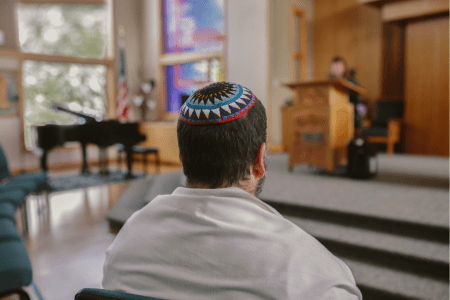
Or, is it your preference to pray in private, at home, in nature, or elsewhere?
Of all of the choices, where — and how — we pray, is so very personal. In many cases, it is rooted simply in family tradition; we do what has been innate since our youth.
That said, tradition doesn’t always prevail.
The Pew Research Center released findings in 2021 that revealed that one in five Jews in the US attend services at a synagogue. Thirty-nine percent of Jews that Pew surveyed said they did not attended services in person, but celebrated Shabbat in a way, the survey said, this was “personally meaningful.”
Pew’s research said that of those who attend services, nine in ten did so because, as the survey said, was “spiritually meaningful.”
So, what category describes your involvement; in-person, or a more private setting?
“Shul. Always,” says Matt Walles, a congregant at Aish.
One local congregant has a conflicted routine.
“I attend High Holidays services at my synagogue,” the congregant told the IJN, “but I really prefer to do my praying by myself, at home.”
That interviewee preferred not to be identified, as it is a very personal topic.
Ask any rabbi, and you’ll likely hear one extolling the virtues of prayer at a synagogue, in person:
“I compare it to the difference between watching the Broncos game on TV or at Mile High,” says Rabbi Adam Morris of Temple Micah.
“I have a great experience at home, get to see all the replays, be warm and have access to food and a bathroom. There’s no worry about transportation or parking or weather.
“And yet,” Morris says, “it’s different being there, in the (synagogue) setting, all focused together on something you care about that’s bigger than you. It is real and genuine and as positive as the experience is of watching the game at home on our own.
“It’s also a very different experience in that communal setting.”
It comes as no surprise that, while they respect the choices of their congregants, rabbis would rather see the seats filled in their sanctuary.
Such advocacy of the in-synagogue experience came as early as the 13th century, from Talmudist Menahem Meiri:
“Whenever a man is able to offer his prayers in the synagogue, he should do so since there proper concentration of the heart can be achieved.”
Chabad makes its case for prayer preference explicit.
“Prayer is referred to as ‘the service of the heart,’ and is one of the many ways that we express love of G-d,” says a statement on Chabad.org.
“Although one may pray in private, praying with a congregation is considered preferable.
“Every effort should be made to join a congregation in prayer, as we are told that the prayers of the congregation are more readily heard on high.”
The word preferable is certainly enough of a nudge to encourage in-synagogue participation.
Of course, any discussion of the “public vs. private” decision, when it comes to Jews, includes an automatic tipping of the scales. After all, a minyan requires 10 adult participants or the service is limited. For Orthodox Jews, the minyan must be comprised of post-Bar Mitzvah males. Liberal denominations typically also include post-Bat Mitzvah females.
“The Shechina — Divine Presence — is more revealed in the presence of a minyan,” Rabbi Yisroel Engel told the IJN.
“Our prayers are answered quicker due to the collective merit of the congregants, similar to group insurance which can’t disqualify any of the individuals within the group.”
(How uniquely Jewish this discussion is, that life insurance is compared to prayer.)
As Meiri said: “The rabbis laid down a great rule: communal prayer has especial value and whenever ten pray in the synagogue the Shechinah [the divine indwelling] is present.”
Judy Blau, who attends both Zera Abraham and EDOS, enthusiastically chooses prayer and the in-synagogue experience.
“I definitely prefer being at shul,” says Blau. “It gets you out of the house and you’re with people.”
Back in the 15th century, Rabbi Yosef Caro offered this compromise for those on the fence in the “public vs. private” debate:
“A person should strive to pray in the synagogue with the community, and if he is not able to come to the synagogue, he should set his heart to pray at the time that the community is praying.”
© IJN 2025


