

By Nathan Stolero, Israel Hayom via JNS
Eurovision week 2025 officially opened on May 11 with the delegation parade on the turquoise carpet — the festive opening ceremony of the competition, in which Israel’s representative Yuval Raphael will participate.
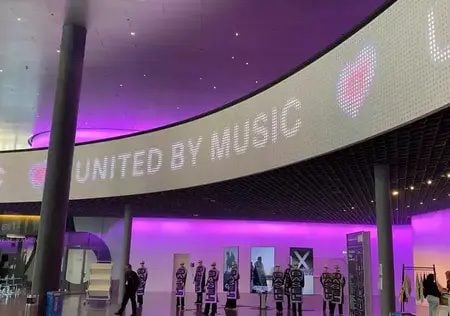
The atmosphere in Basel was already fully present. During the past weekend, the city began embracing Eurovision colors — flags appeared in almost every corner, shop windows were decorated, and squares transformed into pilgrimage sites for competition fans, locals, tourists — everyone.
The general feeling? As if Basel awakened to a world where sequins are a native language, feathers constitute a dress code, and every step on the street comes with an imaginary chorus of “douze points!” (French for 12 points, the maximum awarded).
The magic of Eurovision 2025 doesn’t wait for one to reach downtown; it begins the moment one lands. If you arrive by plane, you’ll encounter colorful signs welcoming you with “Welcome Eurovision Fans” at the baggage carousels of Basel-Mulhouse Airport.
If you choose to arrive by train, from the moment you step onto the main station floor, you’ll understand you’ve entered a city that speaks Eurovision.
Digital signage has transformed into colorful heart displays, direction markers glow in bright pink and almost every column features the competition logo. The station has become an unofficial Eurovision branch — a combination of transportation hub and photo-op station for sequin genre enthusiasts.
Among cups of steaming coffee, locals have embraced the competition spirit. Store after store has wrapped itself in Eurovision colors — “Welcome Home” signs in neon yellow, fuchsia pink hearts.
Shop windows have been modified for the event, featuring microphone-shaped cakes, scarves with “douze points” inscriptions, and shelves stocked with official merchandise.
Digital screens in the station plaza broadcast competition messages and logos on constant rotation. As they change colors and wink at passersby, there’s a sense of a continuous show. Pedestrians pause for photos, children point excitedly, tourists reach for smartphones — as if it’s a semifinal show beginning with a fashionably late five-minute delay.
On Eurovision Street, we met the first group of Eurovision fans from Israel, including Avi Zeikner, a photographer serving as the editor of Euromix.co.il while in Basel.
“We arrived here yesterday afternoon, and since then it’s been really pleasant,” he said. “The atmosphere is quite relaxed. Regarding security, we notice police officers on the streets and hope everything proceeds smoothly. I’m not overly concerned, just trying to limit speaking Hebrew on the street and not carrying an Israeli flag, but overall it feels quite safe.”
Beside him stood Tal Dahan and Shachar Assido — devoted Eurovision fans who have attended every competition for the past three years.
“We haven’t seen anything like this at previous competitions; there are truly wonderful things here. We even met Luxembourg’s representative, and she’s really friendly,” Tal said.
Shachar added, “Very near here was a karaoke party where everyone gathered around us after we sang — nice atmosphere, and it doesn’t feel as tense as last year in Malmö.
“Initially, we thought there wouldn’t be any Israeli flags at all, that perhaps they’d boycott or no presence would be visible,” she said. “But we actually do see them — both here on Eurovision Street and throughout Basel — whenever flags are displayed, the Israeli flag is included. That’s definitely a pleasant surprise.”
This stands in contrast to last year in Malmö, where at this stage of the week, one encountered demonstrations, inscriptions, flags and verbal attacks against Israel. This time, at least so far, the situation appears different — although some anti-Israel graffiti has been spotted and en route to Sunday’s opening ceremony the Israeli delegation was met by an anti-Israel mob, said one delegation member.
“There were moments when we feared for our lives,” Sivan Young told Israel’s Channel 12 News, with some protestors making throat-slitting gestures.
At the end of Eurovision Street, the Eurovision Village spreads. This year, for the first time, it’s established in an enclosed, covered venue, creating the atmosphere of a colorful fair under one roof. The massive structure is branded with distinct Eurovision aesthetics, featuring giant signs, screen displays, flags from every direction and food stalls.
Between these, you’ll find official competition merchandise — scarves, postcards with the “United by Music” slogan — and selfie stations with golden microphones.
On one wall, right at the entrance, appears the Eurovision 2025 slogan in many languages, including Hebrew. But standing casually before this inscription is a tall green plant, apparently placed randomly. It doesn’t entirely obscure it but creates a charming hide-and-reveal effect, as if the Hebrew greeting wants to say hello, but shyly.
It doesn’t appear intentional, certainly not hostile, but this small scene embodies something quintessentially Eurovision, a blend of good intentions, colorful design and foliage that grew beyond control.
The Eurovision 2025 semifinals were scheduled for May 13 and May 15 (with Israel competing), and the grand final on May 17.


