

Beginning with the signing of the Declaration of Independence on July 4, 1776, the United States of America became the first country in modern history to give Jewish men full citizenship.
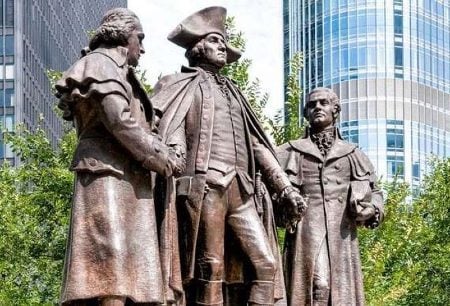
That is only one way that Jews were connected to the fight for independence from British rule.
During the Revolutionary War, the British Army allowed the Jews to fight as mercenaries. But the Continental Army allowed them to become officers. At least two rose to the rank of colonel: Mordecai Sheftall and Isaac Franks, known as George Washington’s right-hand man.
As many as 20 other Jews became officers, according to Rabbi Lance Sussman, who has taught history at Princeton.
David Salisbury Franks, a distant relation to Col. Franks, was Benedict Arnold’s aide de camp and arrested in the traitorous plot.
After being acquitted, he requested an additional court inquiry to completely clear his name. In 1784, he became the first Jew to serve in a US diplomatic post — vice consul in Marseilles, France.
The first Jew to die in the Revolutionary War, Francis Salvador, was born into a prominent Ladino-speaking Sephardic family living in London.
As an adult, Salvador left his wife and children behind to immigrate to Charleston, SC in 1773, hoping to make his fortune as a planter in the American colonies. To do so, he bought 30 slaves; it was their labor that allowed him to become one of the region’s prominent figures and, eventually, to get involved with the American cause.
Despite restrictions preventing Jews from holding office or voting, in 1774 Salvador became the first Jew elected to the South Carolina General Assembly. He was killed by the British on Aug. 1, 1776, during a skirmish on the South Carolina frontier border.
Such a large number of Southern Jews wanted to join the Revolutionary cause that Captain Richard Lushington, a Quaker from Charleston, in 1780 formed “the Jews’ Company,” which included 28 Jews (about half his men).
In 1778, Mordecai Sheftall, a son of Jewish colonialists, was appointed Deputy Commissary General for federal troops in Georgia and South Carolina. Late in the year, as Savannah’s defenses were overrun by British troops, Sheftall and his teenage son, Levi, were captured.
The following year, Philip Minis, also Jewish, and Levi Sheftall were guides to French and American forces in their attempt to recapture Savannah from the British.
A Polish-born Jew who came to New York in 1772 was largely responsible for the colonists beating the Brits.
Haym Salomon acted as a secret agent in British-occupied New York City. After fleeing to Philadelphia in 1778 to escape arrest, his financial skills helped rescue the Continental government.
He acted as supplier to American troops and as paymaster general to French forces assisting the patriots. He helped raise funds for the colonial coffers and loaned money at nominal rates to members of the Continental Congress, among them James Madison.
Salomon was married to Col. Frank’s sister Rachel.
In 1784, he stated in print: “I am a Jew; I do not despair that we shall obtain every privilege we aspire to enjoy along with our fellow citizens.”
When the Constitutional Convention was taking place in Philadelphia, a Jewish merchant, Jonas Phillips, was among those who wrote a letter to the convention on religious liberty. He wanted to ban religious tests for federal officeholders.
“The only letter that the Constitutional Convention got on religious liberty was from a Jew,” said Jonathan Sarna, professor of American Jewish history at Brandeis.
Article VI of the Constitution states that “no religious test shall ever be required as a qualification to any office or public trust under the United States.”
Jews “were part of this grand parade, this grand coalition, that was shaping the new nation,” Sarna said. “You didn’t have to conform to some religious group or standard.”
According to Rabbi Albert Gabbai of Philadelphia’s Cong. Mikveh Israel, many Jews of the day corresponded with the Founding Fathers.
He says that’s why the Constitution resembles the Talmud in some ways; for example, the Fifth Amendment says a person cannot incriminate himself.
“That’s taken straight from the Talmud,” Gabbai says.
In a great parade in Philadelphia in 1788 to honor Pennsylvania’s ratification of the Constitution, the cantor of the synagogue marched arm and arm with two clergymen. At the public feast that accompanied the celebration there was a table with kosher food that, according to one participant, consisted of “soused salmon bread and crackers, almonds, raisins and more.”
When George Washington was elected the first president of the newly formed republic of the United States, his 1789 inauguration was held at Federal Hall on Wall Street in Manhattan. Gershom Mendes Seixas, cantor of New York’s Jewish congregation, was one of 14 religious leaders who attended.
In 1790, newly elected Washington wrote a 340-word letter to the congregants of Touro Synagogue in Newport, RI, the oldest standing synagogue in the US. He promised Jews equal rights and freedom from oppression for their religious beliefs:
“May the children of the stock of Abraham who dwell in this land continue to merit and enjoy the good will of the other inhabitants — while every one shall sit in safety under his own vine and fig tree and there shall be none to make him afraid.”
Ironically, the synagogue’s namesake and first leader, Isaac Touro, was an avowed Loyalist. During the Revolutionary War, he fled the colonies to British-ruled Jamaica, where he lived out the rest of his life.
— Compiled by the IJN from the Jewish Exponent, Aish.com and the Forward


