

IJN Editor and Publisher Rabbi Hillel Goldberg is the author of a new book, God Spoke Once, I Heard Twice: The Torah’s Lens on Fifty-Four Fields of Human Knowledge.
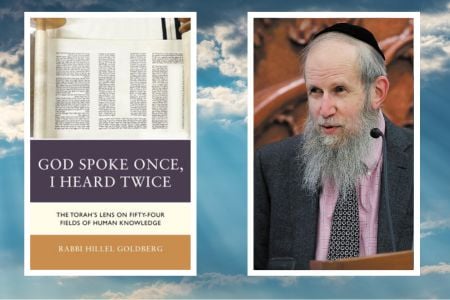
Published this month by Rowman & Littlefield, the book shows how the Torah addresses the arts and sciences, the marketplace and academia – the whole range of human achievement. It is all illuminated by the Torah.
Chapter titles include, for example, “Ecology,” “Psychology,” “Criminology,” “Humor,” “Genesis, Cosmology and Evolutionary Biology,” “Philosophy,” “Culture,” “Ethics,” “Government,” “Anthropology,” “Storytelling,” War” and “Kabbalah.”
Each chapter shows how one of the 54 portions in the Torah illuminates one of the major areas of human knowledge.
The premise of the book is that because the Torah represents the will of the omniscient creator, no field of human knowledge is beyond G-d’s concern.
The introduction to the book opens, “Put aside, for a moment, ‘religion.’ Is there anything in the Hebrew Bible for the journalist, the astronomer, or the calligrapher? For the musician, psychologist, or anthropologist? Can the Hebrew Bible speak to thinkers and professionals on their own terms? . . . The Bible, of course, is a book of religion, but not of religion narrowly defined.”
The key to understanding the Bible — “one of the best-read yet least-understood books in history” — is to read it through its Hebrew lenses. A Hebrew scholar, Goldberg unlocks the deepest teachings of the Torah by careful reference to the original text.
While based on the Hebrew text of the Torah, the book requires no prior knowledge of the language.
God Spoke Once, I Heard Twice opens the Torah to the believer, the historian, the spiritual seeker, the theologian and the student of literature and etymology.
The title of the book is a thematic translation of Psalms 62:2. The Hebrew text of the Torah is both definitive and supple. The Torah provides both eternal teachings, unbound by time and place, and infinite levels of meaning.
Jewish sacred literature is traditionally understood chronologically — verse by verse — or thematically — topic by topic. This book respects both approaches. It follows the Torah in its own order, portion by portion, and derives independent themes from each portion.
To read the Torah sequentially, word-by-word, prevents the reader from manipulating the text for one’s own ends. To read the Torah thematically is empowering, allowing one to see one’s own concerns addressed in the Torah.
Commentary on the Torah is divided into four categories: plain sense, homiletics, allegory, and mysticism. Goldberg’s book employs all four methods.
The Torah is a living document in the sense that it has engendered, and still does engender, discourse between centuries and continents. Commentators did not need to see each other, or even to live within a millennium of each other, to comment on each other. Torah commentary is the cumulative wisdom, the inexhaustible corpus, of countless scholars’ probings — plus the wisdom of each faithful reader of the Torah today.
Goldberg says, “This book is a wide and creative prism yielding perspectives pertinent to the breath of humanity, illustrating the infinite depths and eternal relevance of the Torah.”
God Spoke Once, I Heard Twice is available from major booksellers, or directly from the publisher.
IJN © 2025


