YOM HASHOAH 5785
Little known in the US, Peter Laszlo Lantos is better known in the United Kingdom, where he was awarded a British Empire Medal (a few steps short of knighthood) by Queen Elizabeth and is one of the country’s most prominent Holocaust survivors.

A child survivor of the Holocaust.
A five-year-old Jewish child in southeast Hungary in 1944, he was deported with his family to Bergen-Belsen, where his father died through starvation and forced labor, and a score of other relatives perished.
Lantos, who survived when the concentration camp was liberated by US soldiers and then traveled home with his mother through war-torn Europe, completed his medical studies in Hungary; he moved in 1968 to England for further studies, remained in the UK, and in 2007 published his Holocaust memoir, Parallel Lives (Arcadia).
Then he wrote a version of his life’s story, The Boy Who Didn’t Want to Die (Scholastic), aimed at younger readers. It combines youthful innocence and a sense of adventure with the author’s childhood confrontation with war, hatred, death and torture.
And earlier this year another version of The Boy Who Didn’t Want to Die, again related from a child’s perspective, appeared — this time as a graphic novel.
The newest version, also published by Scholastic and drawn by illustrator Victoria Stebleva, a Ukrainian artist who has specialized in producing images for children’s books, was written as a testimony to the human spirit and resilience.
Its goal is to “teach about what happened in the Holocaust,” and to teach young readers “to be tolerant,” says Lantos, a distinguished now-retired neuroscientist. “I’ve always been a teacher.”
He produced his children’s book as a graphic novel, at his publisher’s suggestion after his standard memoir experienced sales success (it was translated into several European languages), he says in a telephone interview, to reach a younger audience. “Some people prefer to look at images,” rather than at “lots of words.”
Lantos’ latest book is the latest sign of a growing trend in Holocaust education and Holocaust literature: the People of the Book have become the People of the Graphic Novel.
This publishing trend is especially prominent in graphic novels that tell the panoply of Jews’ (and some non-Jews’) experiences in ghettoes and death camps, resistance units and hiding, as well as the post-Holocaust lives of survivors and their descendants.
Once dismissed as comic books for adults, graphic novels — typically sophisticated drawings accompanied by mature text — have evolved into serious, respected literature, and have become an increasingly popular tool for educators and historians who concentrate on the Holocaust.
They have emerged in recent decades as an effective way to reach and teach readers, especially members of younger generations who have grown up in the internet-and-videos-and-social-media era and do not have the attention span to read traditional words-only books. They are also an effective way to reach people with autism, or others who learn better from visual images than from written words.
“Like all literature, some Holocaust graphic novels are better than others, and some are appropriate only for specific age groups. It’s up to teachers — and parents — to select the most suitable ones,” says Rafael Medoff, founding director of the David Wyman Institute for Holocaust Studies. “Once comic books and graphic novels became acceptable in the mainstream culture, they were accepted by educators, so it was natural that nonfiction graphic novels addressing historical topics would start to look at the Holocaust.”
Medoff, a prolific author, wrote a graphic novel, Whistleblowers: Four Who Fought to Expose the Holocaust to America (Dark Horse Books), which was published last year; and another one, Karski’s Mission (Jan Karski Educational Foundation, 2017), about the Polish courier, a Catholic, who risked his life to bring knowledge of the Holocaust to the attention of political leaders in the West.
“As educators, my colleagues and I are always looking for new and effective ways to present historical material,” Medoff says. “That’s why we’ve created short animated films for Disney and educational comic books about the Holocaust . . . Teachers find that this dramatic and graphic approach helps get students engaged in the subject matter.”
He offers some words of caution: “It’s good that the public is open to new ways of learning about sensitive historical issues. But it’s also important to be on guard, because any form of literature can be abused; it’s only a matter of time until somebody creates a graphic novel distorting or denying Oct. 7, 2023, and falsely accusing Israel of genocide in Gaza.”
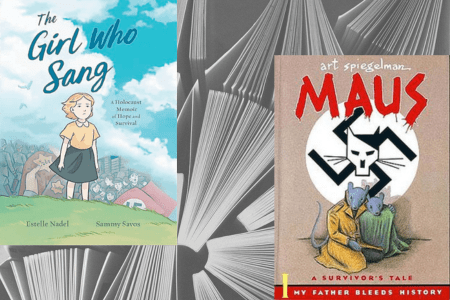
By consensus, the most outstanding graphic novel with a Holocaust theme is Art Spiegelman’s 1986 Maus (about his parents’ Holocaust experience in Poland and their later life in the US), which won the 1992 Pulitzer Prize for literature and opened the door to the dozens of Holocaust-themed graphic novels that have followed, both in the US and abroad.
Maus metaphorically depicted Jews as mice, Nazis as cats, and Poles as pigs.
Though some standard comic books, often penned by Jewish artists, in Western countries during the war, “delved into the grimmest depths of the Nazis’ Final Solution,” according to Smithsonian magazine, graphic novels first gained public acceptance in this country with the 1978 publication of Will Eisner’s Contract With G-d and Other Tenement Stories. In recent decades, some graphic novels have centered around such controversial topics as the US imprisonment of Japanese citizens during WW II, Japan’s wartime exploitation of Korean “comfort women,” the Civil Rights movement in the US and apartheid in South Africa.
And, counter-intuitively, about the Holocaust, a topic traditionally treated with only the greatest deference and reverence. The medium of a graphic novel about the Final Solution was once unthinkable.
Until Maus. Which showed that the topic of history’s worst genocide could be treated respectfully through narrative drawings.
Now, many authors seeking to tell a Holocaust story — theirs or others’ — apparently see a graphic novel as the medium of first resort.
These artistic creations are especially popular among 2G and 3G, the second- and third-generation of Holocaust survivors.
Not all Holocaust graphic novels are alike. Some are closer to memoir, based on the author’s actual recollections and words; though Maus appeared in black and white, recent additions to this category are in full color; some employ a stark, simple sketching style, others, more-developed artwork; many of the books are presented from a child’s point of view, and are written for young readers; some obliquely picture violence and brutality, others hint at it.
Holocaust graphic novels are an instrument of remedial education, used to a growing degree in Holocaust curricula around the country and in individual instructors’ classrooms.
This is especially important, Jewish educators say, as Holocaust survivors are dying, as knowledge about the Holocaust diminishes and skepticism about its historical veracity increases, and as sympathy for Israel and the Jewish community engendered by the massive Jewish losses during WW II decreases.
Graphic novels literally speak the language of the Facebook-internet-TikTok generation, their message conveyed in a medium that young people have embraced.
One advantage of a graphic novel — it can use blank spaces, sans words, to convey emotions and implied-horrors that words cannot.
In this context, silence can speak loudly.
A graphic novel can “take on the new dimension of showing [the indescribable] through its use of images as well as text,” graduate student Madilyn Pflueger wrote in an essay, “Visualizing the Unspeakable: Graphic Novels and the Holocaust,” published in Trinity University’s journal The Expositor. “Graphic novels about the Holocaust utilize both rhetorical and visual devices to address the paradox of explaining the inexplicable.”
Like Lantos’ story, some make the jump from standard memoirs and novels to the graphic novel shelf, while others begin life as graphic novels. (Another recent example: Tova Friedman’s “The Daughter of Auschwitz; The Girl Who Lived to Tell Her Story,” published as a standard memoir by Hanover Square in 2022, was recently issued as a graphic novel by Hachette children’s group.)
The importance of Holocaust graphic novels is very apparent this year, which marks the 80th anniversary of the end of WW II and Hitler’s war against the Jews of Europe. And the attempt of some educators and politicians and civic-minded citizens to keep Maus away from young readers in recent years, on the grounds that Spiegelman’s work was offensive and possibly corruptive, has focused more attention on his graphic novel and on Holocaust graphic novels in general.
Graphic novels about the Holocaust that were published last year include:
• The Girl Who Sang: A Holocaust Memoir of Hope and Survival. By Denverite Estelle Nadel and Sammy Savos. Roaring Brook Press. 265 pps. $17.99; the story of one girl (and her family), who spent part of the Shoah in hiding.
• Heavyweight: A Family Story of the Holocaust, Empire, and Memory. By Solomon Brager; William Morrow. 328 pps. $26.99; the great-grandson of a boxing champion describes how he “can’t stop sparring ghosts.
• Adieu Birkenau: Ginette Kolinka’s Story of Survival. By Ginette Kolinka, Jean-David Morvan and Victor Matet. SelfMadeHero. 112 pps. $24.99; the record of a survivor who, at 95, returns to the site of her wartime internment.
In the early 2025 crop, in addition to Lantos’ “The Boy Who Didn’t Want to Die,” is And Remember Us to Life: A Graphic Novel, by Joanna Rubin Dranger.
In the vein of philosopher Theodor Adorno’s dictum that “There can be no poetry after Auschwitz,” graphic novels that deal with the Nazis’ Final Solution are an extreme example of the type of art that many survivors and intellectuals, typically conflating a not-always-serious medium with a very serious message, at first considered disrespectful, shallow and not serious, says Rosenbaum, the child of Holocaust survivor parents.
One example: Mary Shire, a teacher at the Aiea Intermediate school in Hawaii, who introduced Maus into the curriculum of eighth grade Honors English classes, said “many” of her students called the graphic novel “one of the best things we read that year . . . almost every student agreed that [Maus] was the most effective source in teaching about the Holocaust.”
“When I asked if I should teach it again,” Shire said, “I got a resounding ‘yes!’”
To cite the old question, is this new strain of Holocaust literature good for the Jews? Does it effectively convey what happened to Europe’s Jews in 1933-45 and to the wider Jewish community afterwards, does it succeed in teaching the “Never again” message?
Yes and no, says Michael Berenbaum, Holocaust expert and author in Los Angeles. “Some graphic novels are terrific.” Others, less so. Some graphic novels are effective pedagogic tools, he says. Others, not.
But, he says, you have to realize the limitations of the current generation. “People are not reading anymore — they don’t read books.”
Berenbaum, who writes frequently about the Holocaust and served as project director of the US Holocaust Memorial Museum in Washington, DC, helped design a genocide exhibit, featuring a mini- graphic-novel-style mural that illustrate the Holocaust experiences of several survivors, in the lobby of the Nancy and David Wolf Holocaust & Humanity Center in Cincinnati, located in the city’s Union Terminal.
Are we dumbing down the level of Holocaust education by conveying so much of it in graphic novels?
Are such graphic novels lowering the intellectual level — in other words, dumbing down — the educational value of Holocaust literature?
Again, yes and no. A graphic novel cannot convey the nuance and context of a complex issue that a fleshed-out, text-only book can, he says.
But, Berenbaum adds, citing a Jewish expression about the Torah, graphic novels “speak in the language of bnei adam [human beings],” — i.e. it is necessary to understand the most effective way to communicate with one’s intended audience. “This is a way of reaching them.”
The growing acceptance of Holocaust graphic novels has brought in its wake a limited movement to have some of them banned from public school libraries. In the last few years, controversies have arisen over attempts by conservative activists to keep Maus,”and a few other similar books, off the shelves of public school libraries in Tennessee, South Carolina, Florida and Texas. (Ironically, the move by a Tennessee school district to ban Maus from eighth-grade classrooms in 2022 greatly spurred sales of Spiegelman’s work.)
The critics objected to the books’ use of nudity (apparently naked cartoon mice might offend some impressionable young readers), violence, suicide and realistic rough language — and disrespect that Spiegelman’s rodent-depicted character showed towards his survivor father. In other words, the way the Holocaust and its aftermath was described in these books was too graphic for some people.
Some of the imagery in his graphic novel was disturbing, Spiegelman told The New York Times then. “But you know what? It’s disturbing history.”
“They want to teach the Holocaust,” he told Vulture. “They just want a friendlier Holocaust to teach.”
The path of Lantos’ memoir from standard book to graphic novel may serve as an example for other authors and publishers to take a similar literary path.
“I don’t know what other survivors [with memorable stories] may think,” he says. “I would be quite pleased if other people try to do this. If they want to, why not?”