

By Toby Axelrod
BERLIN — A German court has ruled that an 85-year-old woman and her son who live in a property sold under duress by its Jewish owners in 1939 must give up their home.
The ruling earlier this month capped a decade of legal wrangling over the home, located in Wandlitz, outside Berlin.
For many paying attention to the twists and turns, the fight over the lakeside property came to symbolize the pain and turmoil of nearly a century of history — as well as the ways in which German families tell themselves complicated stories about their role during the Holocaust.
The matter also surfaced lingering resentments, some of them clearly anti-Semitic, about Germany’s efforts to repay Jews for its massive crimes against them.
The Wandlitz estate is likely one of the last property restitution cases to be adjudicated in Germany, as virtually all looted or “Aryanized” property has already gone through the restitution process or been lost to history, with no one left to claim it.
The deadline to file property claims passed decades ago.
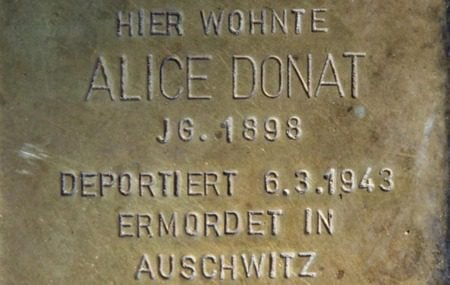
The case centers on an estate, located in a bucolic area about 20 miles from central Berlin, that functioned in the 1930s as a summer retreat for an orphanage operated by two Jewish women, Alice Donat and Helene Lindenbaum. To comply with Nazi laws meant to expropriate Jewish wealth, they sold the land, complete with a structure in poor condition, to Felix Moegelin in 1939 for 21,100 Reichsmarks, nearly a pittance.
Moegelin had to sign the statement “I am Aryan,” while the two women had to sign that they were Jewish according to the Nuremberg Laws of 1935.
The original house was torn down and eventually replaced, and Moegelin and his family settled in on Wegener Street.
Donat and Lindenbaum were deported from Berlin by the Nazis in 1943 and murdered.
The Nazi-looted house is worth $1.6 million
Today, Moegelin’s granddaughter, Gabriele Lieske, 85, still lives in the house with her son, Thomas Lieske, 61. They dug in their heels after a lower court ruled last year that they must give up the property or pay for it.
Located in the suburbs of Berlin, where real estate is hot, the property is worth about $1.6 million today.
Now, the property will be seized by the state and transferred to the Conference of Jewish Material Claims Against Germany, the legal successor to unclaimed Jewish property in the former East Germany.
No living heirs to the murdered owners were ever identified.
“I spent my whole life in the house and looked after my parents,” Gabriele Lieske said after the ruling, according to local media. “We don’t know where to go.”
The case drew national attention earlier this year after it was profiled in the prominent German newsmagazine Der Spiegel just after International Holocaust Remembrance Day.
It vaulted back into public view this month when the Lieskes ran out of legal runway to appeal their case.
In an attempt to seek compensation, the Lieskes’ Munich-based lawyer, Raffael Nath, invoked a legal loophole that allows the German government to provide some payment to current owners who paid for rather than inherited the property from the original buyer who had “Aryanized” the property.
The lawyer argued that Gabriele Lieske actually did not inherit the property from her mother, Luise Moegelin. Instead, he asserted, Lieske purchased it in 1993 through an arrangement in which she would provide care for her aging parent and cover all the upkeep costs. Her mother died in 2012 at the age of 99.
The judge was not persuaded.
A compromise is rejected
Gideon Taylor, the president of the Claims Conference, said media attention to the case was misplaced.
“What the judge did was completely unremarkable,” he said. “This is an established principal in law that has been in place since the end of the war. A forced sale is not valid and that which was taken must be returned.”
Whether and when the Lieskes will move out is not clear. The Claims Conference has offered to let Gabriele Lieske remain as a tenant in her childhood home for the rest of her life.
The Lieskes’ lawyer Nath said in an interview earlier this year that Gabriele Lieske turned down the offer because it would have come with an obligation to pay rent, and her son would not be allowed to live there after her death.
But no terms of a tenancy were negotiated, Taylor said. “We are certainly willing to work out an arrangement with the family,” he said.
Still, he noted that German law is clear about whether looted property can be inherited. “Where, as here, an ‘Aryanizer’ took over Jewish property, it does not get passed to the heirs of the Aryanizer,” he said earlier this year.
Holocaust survivors, their heirs or the Claims Conference have received compensation or restitution for thousands of properties in Germany, starting in the west after the war, and in the east after unification.
A few cases are still pending, 79 years after the end of WW II. But some will never be heard, according to restitution lawyer Olaf Ossmann.
“So many families didn’t even start cases in the post-war period” because the legal hurdles and burdens of proof were so daunting, said Ossmann, who was born in Leipzig, Germany, and now lives in Winterthur, Switzerland, where he is president of the Jewish community.
The task, he said, was “so depressing, in a way, that they stopped.”
In the last 33 years, Ossmann estimates he has handled some 3,000 property cases — some for prominent German Jewish families, but mostly owners of smaller properties.
Ossmann, who today handles mostly looted art cases, still gets calls from people who found documents from their parents or grandparents and can’t make sense of them. “Fair and just” compensation is not really possible, he said. “The proper term I’m using normally is ‘the best you can get for the moment.’”
The tragic end of the two original owners
According to the Stolpersteine (Stumbling Block) memorial project, Alice Donat was born in 1898 in Vienna to Robert and Anna Donat, and had two sisters and a brother. She studied education in Berlin and later ran the private kindergarten and Jewish children’s home with Helene Lindenbaum.
The two women purchased the property in 1932, according to the district court decision handed down in September, 2023.
In his memoir, the late Emanuel Berger, an orphan who resided in the home and who survived the Holocaust, described Donat as loving and strict; she taught the children to sing and dance to her piano accompaniment.
Even less is known about Helene Lindenbaum, other than that she was born in 1888 in Berlin and was married.
When the women sold their property in 1939, about half the payment went to cover their mortgage. It is doubtful that they ever benefited from the rest, as the district court pointed out in its decision last year: A 1938 decree from the Reich and Prussian economics minister stressed the need to “secure Jewish assets” to prevent Jews from fleeing Germany with their money.
According to the Stolpersteine report, Lindenbaum and her husband, who is not named, were to be deported to Theresienstadt in 1943; they volunteered to go on the transport to Auschwitz with the two children from the orphanage, Emanuel Berger and his brother Erwin.
But Alice Donat would not hear of it. Instead, Donat stayed with the two boys; they were deported together to Auschwitz in March, 1943. Alice Donat and Erwin Berger were murdered in the gas chamber; Emanuel was selected for slave labor and survived.
Helene Lindenbaum, and presumably her husband, were deported from Berlin to the Theresienstadt concentration camp in March, 1943, and from there to Auschwitz in October 1944, where Helene was murdered.
Heirs of the ‘Aryanized’ property say their parents sheltered two Jews
In the former East Germany, the process of restitution began after unification in 1990, when a two-year period of claims opened. Where no heirs came forward or were found, the Claims Conference submitted claims as successor at the end of 1992.
In 1998 the Claims Conference finally determined exactly which plot of land belonged to Donat and Lindenbaum, according to Nath, the Lieskes’ lawyer.
That was when the German government could have informed the Lieskes of the claim, and barred them from selling, Nath said. He added, “Why it took another 17 or 18 years for them to inform the family, we don’t know.”
Gabriele Lieske told Der Spiegel she’d rather die than leave the property. Her son felt the same. After all, they said, what happened was not their fault, but a twist of fate — one that ignored the family’s own history of having sheltered Jewish relatives during the war years.
Those relatives were Felix Moegelin’s niece, Margarete, and her daughter Irene, who was born in 1937.
Margarete’s Jewish mother was murdered in the Holocaust, according to the Yad Vashem database.
Irene’s father was deported to Minsk and likely murdered either in a mass shooting or by asphyxiation with motor exhaust fumes.
Gabriele Lieske says that her grandparents sheltered Margarete and Irene in Wandlitz, and that after the war Margarete and Irene moved back to Berlin.
Documents at the Arolsen Archive indicate that Margarete and Irene both emigrated to the United States.
The Lieske family’s character was not relevant to the legal case, according the court’s ruling.
“The fact put forward by the plaintiffs that the buyer hid a Jewish citizen on his property and thus saved her from the Nazis’ attacks has no connection with the purchase contract of February 8, 1939, and is therefore irrelevant here,” the court said.
Who wants to live insomething like that anyway?
Several readers of the Spiegel article saw the legal process as unfair punishment. Another reader said, “If you accept an inheritance, you also accept the debts,” referring to German law, which transfers both assets and liabilities to heirs.
“Of course it’s bad for the current residents of the house, but in the end it doesn’t belong to them,” said another. “It never belonged to them. It was stolen — ripped from people’s cold, dead hands. Who wants to live in something like that anyway?”
Another Wandlitz property burdened by the Holocaust, the opulent former estate of Third Reich propaganda minister Joseph Goebbels, is on the market now. The German government, which owns it, has been unable to find anyone to assume ownership even for free.
Another reader said, “That’s almost 90 years. It has to end at some point.”
The tragic end of the two original owners
Ossmann said the tendency of the German public to portray those who benefitted from the looting as the victims had always been a problem.
The anger and resentment felt by some descendants of “Aryanizers” doesn’t fade, he said. But “if you take the perspective of the [original] victim, you would easily understand that it didn’t make a difference what you lost first or last, if you lost it by sale or confiscation or by whatever means,” he said. “Because at the end you lost everything.”
The Claims Conference uses most proceeds from sales of unclaimed Jewish property to help Holocaust survivors in need with medicine, food and home care.
It recently determined that there were 245,000 survivors still alive around the world.
One German commentator, the columnist Gunnar Schupelius, recently cited them in his assessment of the Wandlitz case.
“The Lieske family feels that the return is an injustice. . . . We who are alive today are not to blame for the genocide of the Jews, but we should take care of the survivors and their descendants. That is only fair.”
Taylor urged an interpretation of the case that is divorced from broader debates about the lengths Germany goes to atone for the Holocaust.
“This is not about compensation from the German government and how much should be given to Holocaust survivors,” he said.
“It’s about a fundamental principle of German law, never mind morality or justice. And nobody has challenged that.”


