

By Mike Wagenheim
Former JEWISHcolorado shlicha Michal Uziyahu has begun her term as mayor of the Eshkol Regional Council, encompassing 32 communities. The council — in the northwestern Negev between Ashkelon and Beersheba — was devastated by the Hamas-led terrorist attacks in southern Israel on Oct. 7, 2023. It now falls on the 47-year-old mother of three to figure out the uncertain path forward.
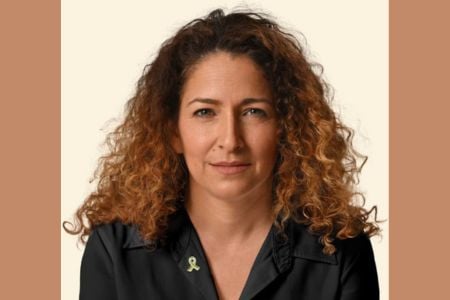
“It’s very intense, and there are many, many things that need to be done, but I feel that people are waiting for change, and I still feel that the spirit is strong,” Uziyahu says.
That is still being tested.
Last week, she escorted former hostage Hannah Katzir on her final journey back to Kibbutz Nir Oz, following her passing at the age of 78. Katzir suffered during her month-and-a-half in captivity, and lost her husband and son to Hamas terrorists.
Her death seems emblematic of the suffering that Uziyahu will need to guide Eshkol out of: The region lost 155 members on Oct. 7. More than half of the hostages hailed from Eshkol.
“I can never get used to it, but it’s part of our life. At the same time, you also see moments of strength and hope,” says Uziyahu, the mother to Shira and twins Ofri and Ron. “It goes together.”
She paraphrases the poem “When I’m Drowning” by Israeli author Tali Versano Eisman, a former officer in the IDF in trying to describe her current perspective.
“You don’t need to describe to me the water but just don’t stop describing to me the land,” Uziyahu says.
“You cannot deal with the water constantly. You have to think for the long run because otherwise you will suffocate. You don’t have a purpose. We have to create a purpose to live for.”
Born in Sinai, Uziyahu’s family moved following the peace treaty between Israel and Egypt in 1979 and started a new community in Eshkol.
“I was always passionate about my community. There was strong local pride,” she says.
She met and later married Amir Uziyahu, whom she described as “a nice kibbutznik.” He was in charge of developing the Negev’s tourism sector at a time when the Israeli government was making huge investments in the region and JNF-USA was turning out its Blueprint Negev to develop new communities.
“I had a purpose. Suddenly, there was a strategic plan,” Uziyahu says.
She received one of her first tastes of American involvement in Israel when Russell Robinson, the longtime JNF-USA CEO, came on one of his frequent visits.
“There was a moment that I was really upset with him,” she recalls.
Robinson had taken funding for a project earmarked for Mitzpe Ramon — a local council in the Negev — and moved it to a project in Beersheba, which at the time was largely underdeveloped. “I said, there is no potential in Beersheba. Obviously, he was right. I was wrong,” she says.
The project was the biblical site Abraham’s Well. It has been turned into a tourist attraction and is one of many JNF projects that helped transform Beersheba’s Old City.
Uziyahu moved to Colorado as an Israeli shlicha, or “emissary,” for Jco. She says she received her biggest gifts from the US.
“The first was my Jewish identity. Suddenly, I realized that I need to choose to be Jewish,” she said of living outside Israel.
She also got an “understanding of the power of the Jewish communities around the world. I realized how much we are not alone — how everything that happens to us in Israel, you live through it here. When we don’t sleep at night, you don’t sleep at night —and not because of the time zone. It’s just because you carry us with you every day.”
When she returned to Israel in 2014, the Eshkol region was going through “Operation Protective Edge” in 2014. Rockets were launched by Hamas in Gaza, raining down on southern Israeli communities. The area wasin a state of emergency during the summer. Uziyahu says she began to work with local leadership to develop a strategy.
She called for Robinson’s help, setting up a meeting between him and the council’s new mayor, Gadi Yarkoni, who was trying to get more people to move to the area, despite the danger.
Robinson, she recounts, presented his Blueprint Negev and asked how Yarkoni, who lost his legs in a mortar barrage just hours before “Protective Edge” ended, wanted to implement it. Uziyahu said the answer was to give subsidies to people who moved.
“And Russell — this very American guy that always wears suits, no matter what — tells this mayor, this farmer, this very native guy, ‘No, you don’t, because if you give subsidies to someone to live in your region, one rocket will fall and they will run back to where they came. I’m here to think with you. How can we improve the quality of life?’”
Robinson again proved prescient. The strategy session led to the development of the Gaza Envelope Task Force, which chose as its first mission to shelter-ize the local resilience center, which supports mental health and emergency preparation.
“There is something healing in renovating and planting and saying, ‘This is my home. I’m not leaving my home.’”
“You would sit in therapy and wouldn’t know if, maybe in a second when you’re in your most vulnerable moment, you need to run to the shelter and someone might see you,” Uziyahu says about the significance of the project.
Other quality-of-life projects followed, such as a gymboree and technology center aimed at children.
Then came Oct. 7 and the resulting large-scale evacuation that took place, again with the help of their American friends.
“I didn’t even have to talk. Russell said, ‘I’m going to write a plan.’ And I said, ‘Russell, I can’t help you right now to write a plan.”
“People were asking us, ‘What do you need?’ And I said, ‘I need you. I don’t know how I need you.’ This is how family goes,” she says.
“When you see your brother or sister, sometimes you know that they need help more than they know, and sometimes you know how to help them more than they can express. This is what happened.”
JNF-USA’s familiarity with the region through its years of work and connections there allowed it to step into the void. It helped carry out the mass evacuation in the days after Oct. 7 and began recruiting some 4,000 volunteers to help rebuild.
Uziyahu insisted that only professionals could do the job. Robinson had other plans.
“I remember the first group of volunteers came to Kibbutz Gvulot. And that community was the first that came back as a whole to Eshkol. There is something healing in renovating and planting and saying, ‘This is my home. I’m not leaving my home.’”
Other communities have continued to return, little by little, and it is giving Uziyahu hope that there are brighter days ahead.
“We are part of a much bigger story,” she said last month as she was lighting her menorah on the first night of Chanukah.
“It’s very dark outside. It’s long dark days. And yet, we light a candle, and another one, and another one, and to put everything in context as part of our big Jewish journey.”
While Uziyahu concedes she has a “huge burden,” she says that she “will continue to insist on choosing the light.”


