

Even as tensions between Israel and Syria increase, a small group of Syrian Jews recently celebrated a milestone that once seemed unthinkable: a return visit to their home country.
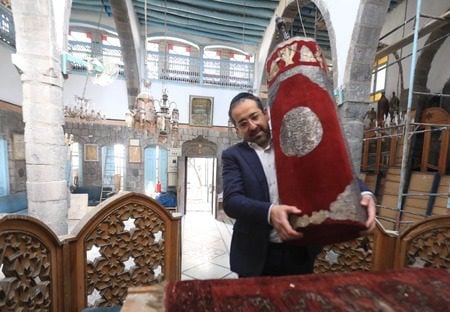
Under the auspices of the new Syrian government, a small delegation toured Jewish heritage sites in and around Damascus last week, two months after the fall of the dictatorial Bashar Assad regime.
The group said it was the first official Jewish delegation to visit Syria, a country that once was home to as many as 100,000 Jews, in over three decades.
Visiting historic synagogues and praying with Torah scrolls that had remained intact through the country’s brutal, 14-year civil war, these Jews celebrated a homecoming.
The visit could allow them and their descendants to imagine a potentially bright future in a place long thought lost to the many Jews who’d once called it home.
Days after the trip, Israel launched military strikes on Syria’s large weapon cache, while its new leader and protesters demanded Israeli troops withdraw from the country’s southwestern region. Israel says it is occupying the area, the Syrian side of the Golan plateau, as a security measure amid instability in Syria.
Spearheading the trip was Rabbi Yusuf Hamra and his son Henry, Jews who left Syria during the final wave of mass Jewish emigration in the early 1990s.
Henry was 15 at the time.
The Hamra family resettled in New York, along with thousands of other Syrian Jews who maintain a vibrant and distinctive community, but retain dreams of returning to the Damascus of their past.
“The whole community was like one family,” Henry Hamra told the Times of Israel about his upbringing in Syria.
“Then you’re changing a whole country. Especially when you go to America, you get lost in the big city.”
“Everyone was so excited,” Rabbi Asher Lopatin, one of the Jewish delegates, who is not a Syrian Jew, said about the heritage tour. “The people are so kind and really, very, very nice.”
After Assad fled in December, 2024 and a new government headed by interim president Ahmad al-Sharaa — who used to belong to groups affiliated with al-Qaida and ISIS — took control, the Hamras saw an opening to return for an official visit.
A relative of theirs had been making unofficial trips to Syria in the intervening decades, including a Damascus “vacation” in 2021.
The Hamras contacted the Syria Emergency Task Force, a US-based organization formed in 2011 to oppose the Assad regime.
“We welcome your visit and your generous initiative,” Moaz Mustafa, the group’s director, wrote to the Hamras in response to their request to tour Damascus, in a letter translated from the Arabic.
Mustafa also assured the group that the Syrian government would provide security detail for the Jewish delegation throughout the four-day trip.
The task force, which aims to lift international sanctions on Syria now that Assad is out of power, would go on to trumpet the trip as “marking a historic step toward reestablishing Jewish life in Damascus.”
For now, though, there is only a tiny trickle of Jews returning to Damascus.
The Hamras were able to round up nine participants for their delegation, not enough for a minyan. Travel into Syria was its own logistical challenge, with much of the group flying in from Qatar, while another small contingent drove in from Lebanon, where Israel has troops stationed in response to the war with Hezbollah that followed Oct. 7.
Lopatin, who works for the Jewish Federation of Ann Arbor, Mich., joined the group at the behest of a Syrian Muslim interfaith coalition partner. The trip was eye-opening.
“I kept on thinking about the Jews returning to Europe, to Poland, after WW II. All over Europe, they were suspicious,” he said. By contrast, “Here, everyone was so excited.”
Local Syrians, Lopatin said, were excited to greet the Jews, who he said were welcomed everywhere they went, even with him openly wearing a kippah.
“For them, the Jews coming back represents a restoration of, I think, civility to Syria, the idea that we are all one,” he said. “That’s what the government is promoting.”
One subject that did not come up much during the Jewish delegation’s trip was Israel. In recent days prior to the Israeli strikes, Syrians had begun demonstrating at the border against Israel’s military presence as Israel has demanded a complete demilitarization of the country’s south.
At a constitutional dialogue in Syria on Feb. 25 attended by the country’s new leader Sharaa, during which the country’s leaders outlined basic freedoms for their people they hope to one day enact, national rulers denounced Israel’s incursion.
Lopatin said the omission of any mention of Israel was an intentional move, and a “smart” one on behalf of the group’s Syrian handlers.
“There’ll be a time to negotiate with Israel and talk about that,” he said. “But for now it was, let’s try to bring Syrians together, let’s try to get rule of law in Syria.
“If this could be a breakthrough for Syria to recognize Israel, that would be something.”
Back in the US, Lopatin said he wants to try to “advocate” for Syria any chance he gets.
“It’s a charming city,” he said of Damascus. “It’s a little scruffy, but it’s a wonderful place and very charming and very nice.”
For more than a century Syria became increasingly inhospitable to its once-thriving Jewish population.
Blood libels and other incidents targeting the country’s Jewish minority persisted from the 1800s through the 20th century.
As in countries across the Arab world, anti-Semitic persecution and Jewish emigration spiked with Israel’s establishment in 1948, when Syria was one of a group of neighboring Arab states who waged war on the nascent Israel, aiming to destroy it.
In 1967, Egypt and Syria again plotted to destroy Israel, but in the Six Day War Israel captured the Golan Heights. In 1982, Syria attempted unsuccessfully to bomb Israel during the First Lebanon War. Syria remains in a state of war with Israel.
Syria’s Jewish population dwindled to a current population estimated at fewer than a dozen. Graves at a historic Jewish cemetery were disinterred to build a highway decades ago. Some non-Jewish locals, by contrast, have guarded ancient Torah scrolls, preventing them from being damaged or lost.
And since the 2011 outbreak of the brutal Syrian civil war — in which Assad launched an assault on citizens and rebel factions trying to oust him from power — synagogues and other Jewish land- marks were destroyed or badly damaged. The death toll is estimated to have topped 600,000 and the Syrian refugee population skyrocketed into the millions.


