

Canadian Prime Minister Justin Trudeau will step down from his post and from his party leadership amid plummeting poll numbers and dissent from his own deputies, he announced Jan. 6.
Trudeau has fostered anti-Israel and anti-Semitic trends in Canada:
• Shortly before Oct. 7, 2023, his party’s House of Commons speaker resigned after praising a Ukrainian-Canadian Nazi collaborator and arranging for him to meet Ukraine’s Jewish president Volodomyr Zelensky.
• Since Oct. 7, Trudeau and his government have been pointed in their criticism of Israel’s handling of its war in Gaza.
• Last February, he made a joint statement with the prime ministers of Australia and New Zealand calling for an “immediate humanitarian ceasefire” in Gaza and urging Israel not to invade the southern city of Rafah, the Israeli offensive that later destroyed Hamas’ last battalions and lead to Israel’s killing of Hamas’ leader, Yahya Sinwar, the architect of the Oct. 7 massacre.
• Last March, Canada restored funding to UNRWA, which several nations had suspended following evidence that some UNRWA staff had participated in the Oct. 7 attacks.
• Last year, Canada’s foreign minister announced a suspension of arms exports to Israel.
• Last year, Canada’s tax regulators revoked the charitable status of two major pro-Israel nonprofits in Canada.
• An appointee for Canadian human rights commissioner resigned before starting his role last summer after the revelation of hispast social media posts comparing Palestinians to Jews in the Warsaw Ghetto.
Left-wing Jewish groups also have gone after Trudeau’s party for not taking what they believe to be a forceful enough stance against Israel’s actions in Gaza.
Trudeau said he will stay on as a caretaker prime minister until his party selects a new leader.
Canadian Parliament will be put on a temporary hold until March to give Trudeau’s Liberal Party time to do so via a grassroots vote shortly before then.
Canada’s next elections must be held sometime before October.
A resurgent Conservative Party has made a play for Canadian Jewish support through outspoken support for Israel and opposition to anti-Semitism.
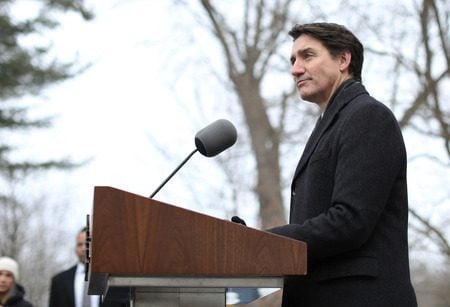
Trudeau said during his press conference outside his residence in Ottawa: “It has become clear to me that if I am having to fight internal battles, I cannot be the best option.”
Trudeau took office in late 2015 and has sought to implement a broad liberal agenda, winning reelection twice. But his approval ratings have cratered in recent months amid concerns about inflation and immigration, with the vast majority of Canadians favoring his resignation.
The recent resignation of his deputy prime minister amid a lack of confidence in his leadership triggered a cascade of unrest within his Liberal party.
That includes indications of declining support among Canada’s approximately 335,000 Jews, who have faced a documented rise in anti-Semitism since the Oct. 7, 2023.
Multiple synagogues and Jewish day schools in the Toronto and Montreal areas have been targeted by gunfire, rock-throwing and fire-bombing since the attacks.
Bomb threats were also sent to major Canadian Jewish groups after the attacks.
Both B’nai Brith Canada and the Centre for Israel and Jewish Affairs have expressed frustration with how Trudeau and his party have approached Israel and anti-Semitism.
“Shame on you Justin Trudeau,” B’nai Brith Canada posted on social media last month, following Canada’s backing of a UN vote critical of Israel, a break from the country’s longstanding policy.
Following a violent pro-Palestinian demonstration in Montreal last fall, CIJA said in a statement:
“Fires were lit, businesses vandalized and Jewish Canadians once again felt unsafe in their own country. Our political leaders need to stop excusing extremism. Police must enforce the law. And all Canadians must take antisemitism seriously — NOW.”
Trudeau condemned that demonstration, as well as other incidents, as anti-Semitic.
In July, 2024 he appointed Jewish lawmaker Anthony Housefather as the government’s advisor to the Jewish community, and in December his government announced a new forum intended to combat anti-Semitism.
A warning sign of a Jewish turn away from Trudeau was a special election in midtown Toronto last summer, in which a typically Liberal stronghold with a sizable Jewish population went for the Con- servative party candidate.
Following the 2018 synagogue shooting in Pittsburgh, Trudeau apologized on behalf of Canada for turning away the MS St. Louis, a ship of more than 900 Jewish refugees from Nazi Germany, in 1939 that was famously denied safe harbor in the US and elsewhere.
In 2021 he pledged more than $5 million to strengthen security at Jewish communal institutions.
That year he also appointed Canada’s first-ever envoy to fight anti-Semitism.
As elections approach, the leader of Canada’s resurgent Conservative Party, Pierre Poilievre, is hoping to take the country’s top post.
Poilievre has courted the country’s Jewish vote in speeches to synagogues and forceful pro-Israel rhetoric since Oct. 7.
On the one-year anniversary of the attacks, at a ceremony Trudeau also spoke at, Poilievre blamed Trudeau’s Liberal Party for a nationwide spike in anti-Semitism, receiving louder applause than the prime minister.
In an April speech at an Orthodox synagogue in the Montreal area, the Calgary-born Poilievre referred to himself as “a simple goy from the Prairies” who’d hitchhiked through Israel in his youth. He also recounted the story of Purim, winning a standing ovation from the crowd.
His deputy leader, Melissa Lantsman, is Jewish and spoke at a pro-Israel rally in Ottawa in December 2023.
In a just-released interview with the conservative Canadian pop psychologist Jordan Peterson, Poilievre said one of his economic models for the future of the country is “Israel after the ’90s, becoming [a] startup nation.”


