

By Pesach Benson
In a dramatic operation, the Mossad recovered and returned to Israel the official Syrian archive of legendary Israeli spy Eli Cohen, nearly six decades after his execution in Damascus. So deeply did Cohen penetrate the ruling circles of Damascus, he was even considered for a senior ministerial role in the Syrian Defense Ministry.
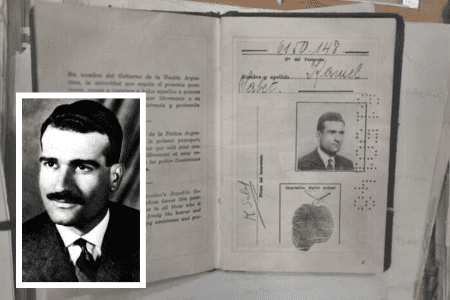
“Eli Cohen was a legend,” Prime Minister Benjamin Netanyahu said on May 18.
“In the test of time, he has been revealed as the greatest intelligence agent in the annals of the state; his heroism and his activity contributed to our historic victory in the Six Day War.”
Cohen’s story was serialized by Netflix with Cohen played by Sacha Baron Cohen (no relation).
At a special meeting on May 18, Netanyahu and Mossad Director David Barnea presented some of the recovered items to Cohen’s widow, Nadia.
The covert mission, carried out in partnership with an undisclosed foreign intelligence agency, brought back approximately 2,500 original documents, photographs and personal items that had been in the hands of the Syrian security services since Cohen’s capture in 1965.
Among them was the original handwritten will Cohen composed just hours before his death, a document previously known only through a copy.
The archive is a trove of historical intelligence, compiled and tightly guarded by Syrian authorities since Cohen’s arrest in January, 1965.
It contains recordings and investigation files, personal correspondence to his family in Israel, covert photographs from his espionage activities and everyday items taken from his Damascus apartment, such as keys, forged passports and diaries.
Some of the most striking findings include documentation of Cohen’s assignments from the Mossad, such as surveillance and intelligence-gathering missions at military bases in Quneitra.
Also recovered was the original court sentence that condemned him to death, as well as a ruling permitting Rabbi Nissim Indibo, head of the Jewish community in Damascus, to provide religious rites before Cohen’s execution.
An especially poignant discovery was a thick orange file labeled “Nadia Cohen.”
It contained records of the Syrian intelligence service’s surveillance of Cohen’s wife, detailing her relentless international campaign to save her husband — letters to world leaders, pleas to then Syrian President Amin al-Hafiz and appeals to humanitarian organizations.
Barnea described the recovery as a moral and strategic milestone.
“Bringing the archive here is an additional step in advancing the investigation to locate the place of burial of our man in Damascus,” he said.
“This important mission stands before us and we are committed to continue and do our utmost to realize it. We will continue to act to locate and return all of our missing, fallen and hostages — the living for rehabilitation and the deceased for eternal rest after a proper Jewish burial.”
Eliyahu “Eli” Cohen was born in 1924 in Alexandria, Egypt, to a Syrian-Jewish family. He was active in Zionist circles in Egypt and was eventually arrested by Egyptian authorities for his activities. After his release, he immigrated to Israel in 1957. Initially, he worked in various civilian roles, including as an accountant, but his linguistic skills, intelligence and background soon drew the attention of Israeli intelligence.
After his recruited into the Mossad, Cohen was sent to live among Syrian expatriates in Buenos Aires in 1961 to establish his cover as a businessman named Kamel Amin Thaabet.
Froom 1961 to 1965, Cohen operated in Syria, cultivating relationships with influential political, military and business figures.
His charisma, fluent Arabic and apparent wealth made him a popular figure, and he gained access to confidential discussions and classified military information.
He suggested to Syrian military officials that they plant trees near their bunkers on the Golan Heights to provide shade for troops — information that Israeli forces later used to target those exact positions in the 1967 Six Day War.
In 1965, on what was supposed to be his last time in Damascus, the Syrians, with Soviet assistance, detected Cohen’s radio transmissions and arrested him. He was publicly hanged in Damascus in 1965.
Israel and Cohen’s widow have been fighting for the return of his body from Syria ever since.
In an encouraging sign for Cohen’s family, the remains of Israeli soldier Sgt. 1st Class Tzvi Feldman, who disappeared during a 1982 battle in Lebanon, were returned to Israel on May 11 after being recovered in Syria.
Feldman, Yehuda Katz and Zachary Baumel disappeared in the Battle of Sultan Yacoub during the First Lebanon War. Twenty-one soldiers were killed and another 30 were injured fighting Syrian army forces in the Bekaa Valley.
Baumel’s body was located by Russian soldiers working in coordination with Syria and returned to Israel in 2019.
Katz’s fate remains unknown.


