

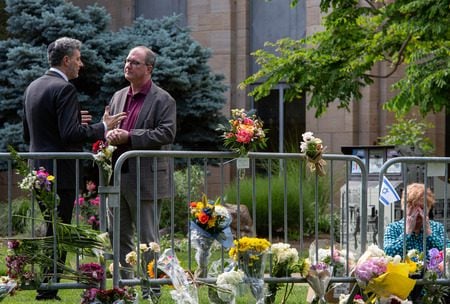
In the wake of Boulder, an essential question facing Jewish communities locally and nationwide is security.
The hardening of Jewish targets really hit full steam following the mass murder in Pittsburgh at the Tree of Life synagogue in October, 2018. For institutions and individuals who weren’t yet on the security wagon, the killings of Sarah Milgrim and Yaron Lischinsky outside of the Capital Jewish Museum in Washington, DC on May 21 was a wake-up call. For those who still didn’t get the memo, the attempted murder of peaceful marchers in Boulder on June 1 made it indisputable that reality has changed for Jews in America.
A joint Dept. of Homeland Security and FBI warning of an elevated threat level against Jews and Israelis put that reality into writing.
For Colorado Jews, a robust system is already in place to support Jewish groups seeking to enhance their safety, though as the Boulder attack showed, nothing is foolproof.
Through JEWISHcolorado, the national Security Community Network (SCN) operates a Colorado division with two full-time staff.
For its director, Kevin Farrington, the new government warning is anything but new. “In our mind,” he says, post-Pittsburgh and post-Oct. 7, “there’s always a standing threat against the Jewish community.”
“The core essence of our job is training,” says Farrington. It’s the only way to try and prepare for an event like the firebombing in Boulder.
“If you’re trying to figure it out during the event or immediately afterwards, it’s probably going to be a steep learning curve,” he says.
SCN offers trainings for facilities, including for their safety teams, but also for individual citizens. While SCN is institution focused, it also offers periodic trainings open to the community at large. More of those are in the works.
The trainings can be scaled up or down, he says, and take into account the needs of a particular group.
Basic situational awareness is always part of it, as is responding to an active threat. But it may also include medical response, or additional training on how to respond if outdoors, which is the setting for Run For Their Lives meetings.
SCN also offers security planning for public events, which includes first inspecting a venue before proposing a security plan.
It also coordinates with local law enforcement, to make them aware of large gatherings or upcoming Jewish holidays, and will also facilitate hiring off-duty police officers.
Farrington is pleased with the number of people SCN has trained, “but we can always train more and we can always go back and retrain or learn new concepts,” he says.
“We’re a one-stop shop for all safety and security training. I’m not saying we have all the answers, but if we don’t, we know who has the answer that we’re looking for and we can connect you with them. But people don’t need to be searching for answers,” he believes, encouraging anyone with concerns to contact SCN.
All of SCN’s services are provided at no cost to Jewish community members. JEWISHcolorado raises the half a million dollars it costs annually to provide those services, says Renée Rockford, president and CEO.
“It is not without a lot of work,” she says. “We go out and raise that money, and then we can offer this program at no cost to the community. It’s resting on the shoulders of many generous donors and a lot of hard work on the part of the fundraising team.”
Those funds cover salaries and fees to SCN for use of its infrastructure, which includes the duty desk and the analysts need to track and understand the information.
Almost immediately after the June 1 terror attack in Boulder, Jco announced the launch of a Boulder Security Fund. According to Rockford, the fund has raised almost half of its $160,000 goal. Those funds are earmarked for immediate needs, including security for Run For Their Lives.
Maintaining accessibility to SCN services is important to Rockford, so even as security needs — and costs — are growing, she wants to make sure SCN remains available to institutions at no cost.
“We don’t want to be in a position of turning away someone who needs our help. So we commit to not only doing the program, but raising the money to make sure it happens,” says Rockford.
The Dept. of Homeland Security offers grants to nonprofits for security that are distributed through FEMA. On June 9, the House Appropriations Subcommittee on Homeland Security announced a proposed budget of $305 million for the Nonprofit Security Grant Program for 2026.
For many, that is woefully low.
According to OU Advocacy, in 2023 the program received 5,257 applications for $679 million in funding, with 42% approved. In 2024, more than 7,500 organizations applied for nearly $1 billion in grants; less than half, $454.5 million, was distributed.
“Every synagogue, school and community center denied funding is left vulnerable,” said OU Advocacy executive director Nathan Diament.
“Thoughts and prayers are not going to protect us. It’s time for Congress to step up with the resources needed to keep our communities safe.”
Information gathering is another key component of SCN’s work. Locally, the regional office collects information from Colorado-based facilities and law enforcement. That may include suspicious activity or suspicious incidents that SCN can investigate through its relationships with law enforcement — local, state and federal — and with SCN’s central desk in Chicago.
“If you’re able to tie [a suspicious activity] to a specific person,” he explains, SCN will start asking the following “Do they have a violent history? What does their social media look like? Are they confrontational? Are they advocating for violence online?”
Those lines of inquiry help SCN, together with groups including the ADL, develop “a threat picture.”
But Farrington warns that it can be very difficult to gain a high level of specificity on threats.
“Unfortunately, when you look at this stuff, anti-Semitism, opposition to Israel, usually for a lot of these guys and ladies, it’s one of many aspects that they’re engaged in.” It can be difficult “to pinpoint what might be their truly top tier hot-button item.”
Bulletins — such as those about last Sunday’s Boulder Jewish Festival, often include a note that there are no known security threats. But what does that mean in a reality where Mohamed Sabry Soliman was planning his Boulder attack for months?
“When we say there is no known threat, it means there is no specific intelligence saying a certain group or individual is targeting a specific event.
“In the case of specific threat information, there might be adjustments to the event or the venue or something to that effect,” he says. “No known threat” doesn’t mean an institution shouldn’t prepare.
SCN’s local team has expanded to two full-time staff, Farrington and Brian Maloney. It meant that when the June 1 firebombing occurred, SCN could continue with its prescheduled work, which included security trainings for summer camps, while also focusing on events in Boulder.
It is a mistake for a Jewish organization not to take some precautions, Farrington says.
“It’s always good to plan for safety issues, particularly now . . . Everything started to change on Oct. 7, and it’s reached a whole new level of intensity about six to eight months ago for whatever reason.
“The people opposed to Israel and opposed to the Jewish religion have gotten far more confrontational.
“If you’re setting up an event and you’re not considering at least sitting down and taking a few minutes to look at some of these events, if you don’t feel comfortable planning on those, I think you’re remiss if you’re not reaching out to SCN,” he says.
Like Rockford, Farrington wants to get as many people trained and connecting with SCN as possible. “We don’t have any quotas. We’ll do 100 trainings in a month, we’ll do 15 in a month. Whatever it is, whatever it takes,” he says.
“The time to train is now, and before an incident.”
© IJN 2025


