

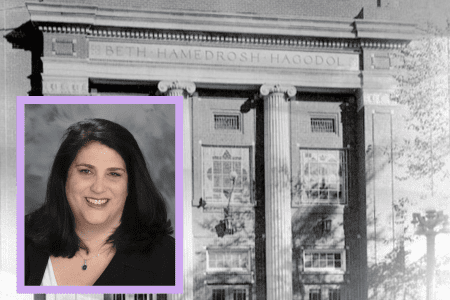
The venerable BMH-BJ, founded in 1897, is at a crossroad.
The synagogue’s seating plan — not a small thing in an Orthodox synagogue — is now different. The sanctuary is now divided by a partition, a mechitza.
In the wake of BMH-BJ’s then-longstanding belief that pews should be mixed, the synagogue withdrew from the Orthodox Union in 2016. This left the synagogue in somewhat of an identity crisis, since it was the last of the “traditional” synagogues that once were a major cohort in the OU.
“We were an oasis in the middle of an ocean and a deserted island in the middle of the ocean,” says board president Jacqui Beckett.
Beckett, whose great-grandfather, Joe Miller, was one of the synagogue’s founders, and whose father, H. Michael Miller, is a longtime leader of the synagogue, became BMH-BJ’s president in 2023, somewhat unexpectedly.
“I was president-elect, and our current president resigned the week before Rosh Hashanah,” Beckett says, “so I took over his presidency.
“I didn’t come in with any preconceived notion. I wanted to figure out what the congregation wanted.”
This, to Beckett, would normally be a familiar process. Trained in corporate governance, she is used to finding input from many directions and coming to a conclusion.
However, one week before Rosh Hashanah in 2023, an accident shattered Beckett’s femur in six places. After three weeks in the hospital, Beckett spent the next six weeks living and sleeping in her kitchen, as she could not climb stairs.
No obstacle to her new BMH-BJ duties, though.
“I started holding coffees where people could come and chat,” says Beckett. “I put all of our young singles together, then put all of our young families together, and I sent out personal invites and I invited people into my home to ask what they loved about the shul.
“Then, I asked, ‘What do you think could be different about the shul?’ and ‘what ideas do you have?’”
The homey atmosphere worked. As the femur started healing, the process of finding consensus began.
“In my law practice,” Beckett says, “I do a lot of governance work and I help companies restructure their governance and the way they operate.
“As we went through the process, it was something I felt very comfortable doing, because I know how to help see the path and find out where we want to go.”
An internal task force was then created, meeting from October, 2024 through March of this year. That group consisted of 10 individuals who were a cross section of the congregation.
They canvassed congregants for input and visited synagogues around the country to witness how successful congregations similar to the BMH-BJ’s status execute best practices.
“We started looking at what others have done, and what other models were out there,” says Beckett. “We talked to over 30 congregations who had had been recommended to us by other rabbis and congregants.
“We looked at everything from traditional Conservative Judaism through very traditional Orthodoxy.
“Everything was fair game. We asked rabbis in traditional Conservative spaces, ‘What’s your recommendation for us?’ Some said, ‘Don’t come here.’
“They said that because they saw where they were sitting as something that isn’t going to last, that it was either going to evolve into some sort of Conservatism, or that liberal side of Orthodoxy.”
“It looked like the more successful synagogues were utilizing a more Orthodox service,” says Debbie Jacobs, who was on that synagogue task force. “This included or reintroduced the use of a mechitza with that prayer practice.”
The conclusion was reached to rebrand BMH-BJ while installing the theme “New Year, New Us,” which was introduced on Rosh Hashanah in 2024, addressing three key areas identified by Beckett:
• Theology
• Dynamic clergy
• Outreach and programming
Task forces were formed in each of those categories.
“We wanted to be a modern outreach-oriented Orthodox congregation,” says Beckett. “From a theological perspective, we really thought about ‘What does that mean?’
“Where do we want to be? We want women to have a valid role in our Orthodoxy. That does not mean necessarily we want women to be called to the Torah. That’s not the objective, but we want them to be able to feel fully a part of the congregation and to engage.”
In May, after rolling out the task force’s recommendations, Beckett and the board of directors created “implementation teams” in various areas, such as programming, outreach, development, rituals, communications and acoustics in sanctuary and chapel. There are 11 implementation teams, and six of those teams are currently active.
While those teams were evaluating those items under review, BMH-BJ was holding dual services.
“We were running two services,’ said Beckett, “one in the chapel [with a mechitza] and one in the sanctuary [without a mechitza], and we were plugging along that way.”
At the heart of BMH-BJ’s withdrawal from the Orthodox Union nine years ago was the congregation’s steadfast practice of mixed seating in the main sanctuary, dating back to at least the 1930s. Beckett said BMH-BJ was the last member of the OU that sat men and women together.
“We were one of hundreds of congregations that belonged to the Orthodox movement that sat their men and women together,” says Beckett. “But as time went on, that was not an acceptable practice within mainstream Orthodoxy, and there was a lot of pressure from the OU to make a transition and make a change.”
Now, a glance inside the sanctuary reveals the new mechitza.
“The exact configuration of the mechitza is completely temporary,” says Beckett. “We started with plants, and people called the sanctuary a jungle. You could see through it. It’s a sheer cloth at the moment.
“When we hire our new rabbi we will put in our order for the new mechitza because we want to make sure that whoever we hire will feel comfortable with what we decide.
“But I can tell you it will be low enough so that people can see past it.”
For Beckett, the issue of the mechitza is extremely personal.
“People really believe strongly that our saving grace and our uniqueness was that we were an Orthodox congregation that sat their men and women together. I grew up sitting next to my father; I learned how to daven from my father.
“I gained my love for the congregation from my father.
“There are people who grew up at BMH-BJ now who have sentiment against the mechitza, who call it segregation.”
One might suspect any pushback would originate from the female side.
“I thought it was going to be,” says Beckett, “but it’s not.
“We had to make a change that did something that wasn’t making us that island in the ocean. So, by last Rosh Hashanah, I knew we had to really evaluate it.
“This was the hardest thing I’ve ever done,” says Beckett, referencing her professional legal role, “and it’s because people are so emotionally attached to the way they daven.
“With some of these things, both sides are equally engrossed and embedded in their own traditions. I completely get it because I’ve been there too. It’s hard to create something new.”
This venerable congregation has seen variation in its long history.
BMH was once a Conservative congregation when Conservative Judaism was considered a stream within Orthodoxy.
When the two became distinct movements, BMH’s Rabbi Charles E. H. Kauvar withdrew BMH from the Conservative movement in 1956 and BMH was welcomed as a member of the Orthodox Union. In 1996, BMH merged with Beth Joseph, which was founded in 1922.
In addition to the rabbinical search and the mechitza, another issue has arisen in BMH-BJ’s current evolution: microphones.
The standard microphone is not allowed by the Orthodox Union, but many in BMH-BJ’s sanctuary have trouble hearing sound emanating from the bimah.
“We don’t have a choice,” says Beckett.
So the synagogue turned to Zomet Institute in Jerusalem, which specializes in finding halachic solutions to technological challenges — including microphones, according to Beckett.
“We’re going to upgrade the sound and move forward to help people who are not able to hear. If you can’t hear, you can’t engage your congregation. If you can’t engage your congregation, there is no way you can survive.”
In the meantime, BMH-BJ has restarted evening minyans, and started focusing on family programming.
“Every other week we’ve been making incremental changes to get us to where we want to be,” says Beckett.
“We have a family service once a month,” says Beckett. “We’re hoping to expand it where kids and parents come together.
“We also do Kabbalat Shabbat with musical instruments right before Shabbos.
“It’s singing and engaging,” says Beckett. “We come together and we do what we want with the instruments.”
There is now a search for a head rabbi, as Rabbi Yaakov Chaitovsky recently became the congregation’s rabbi emeritus.
As the search for a rabbi to replace Rabbi Chaitovsky is underway, Beckett believes that reconciling things like creating additional programming and the sound presentation in the sanctuary — along with the congregational response to the new microphone —- are essential to have in place before hiring a rabbi who will fit BMH-BJ’s new definition of an Orthodox synagogue.
“We are looking for somebody who has the traits and philosophy for us,” says Beckett.
“We are looking at several yeshivas out of Israel, and in many other places. Some of the rabbis who were most attractive to us were trained in Israel. We have full support of the RCA (Rabbinical Council of America) in our search.
“What was very clear to us is that if we’re going to be in this Orthodox space without a mechitza, we were not going to attract a dynamic clergy when Rabbi Chaitovsky retired.”
Claude Brachfeld, who has been a member of BMH-BJ for five years, says: “The overarching change is the arrival to a very old, storied, historic congregation of a solid identity. There have been a number of changes, and I think everybody would acknowledge the most obvious is the mechitza.
“I did see it as having the potential to lead us toward a more indefinable identity within the overall context of different styles of Jewish worship, and that was a very important element for the congregation.
“I would say it has been a success in terms of drawing new people into the congregation. To some degree I have noted an increase in enthusiasm and in participation in services.”
At the moment, the rabbis on staff are Rabbi Shalom Lebowitz, formerly a teacher at DJDS. Rabbi Lebowitz has considerable strength in music and spiritual events and is designated as the congregation’s youth and family rabbi. Rabbi Danny Wolfe directs outreach and supervises the daily minyan.
Rabbi Avi Heller, a Denver native now living in New York, has led the High Holiday services.
BMH-BJ may be looking for more than one clergy member. Cantor Martin Goldstein is now cantor emeritus.
“In June of 2024,” Beckett says, “we held town halls to ask, ‘What would we want in new clergy?’ Cantors, especially in an Orthodox environment, are not easy to come by because there not many cantors today.
“So we started looking at whether we could use a junior rabbi who has a great voice, but we’re still evaluating what we want to do.”
Throughout these meetings, many congregants wondered out loud about a potential path to regain affiliation with the OU.
“Lots of people have asked me about that,” says Beckett, “and it wasn’t even something we were considering. We would entertain the idea, perhaps, but we really never even thought about that.
“But do I think that it deserves to be really looked at and whether we should think about it? Absolutely.”
Size matters, too. The synagogue that now has 350 households of members — down from years past — is embracing change. A facilities team is evaluating how the shul can best use its space, including the ample spaces outside the shul’s sacred spaces.
“Three hundred and fifty households means there are 700 to a thousand different wants and opinions about what we want here,” Beckett says.
“There are people who think this is really difficult for them, and we might not be the right place for everybody who is feeling those things,” says Beckett. “And that’s OK, though it makes me very sad to see people go. I want people to give it a shot and try. We want them to feel comfortable.”
Regarding an interest, by some, of rejoining the Orthodox Union, Brachfeld says: “My perception is that the congregation is able to attract clergy from a much broader pool if we do have a formal affiliation with a movement in Judaism like the Orthodox Union or another entity.”
Most important to Beckett in the BMH-BJ of 2025 and beyond is outreach.
Beckett refers to a study produced by JEWISHcolorado that there are 90,000 Jews in Denver and the Front Range who are unaffiliated.
“What we are trying to do,” says Beckett, “isn’t to take from other synagogues or even attract members from our neighborhood.
“It’s about reaching those people and being a synagogue where all Jews feel welcome and wanted and feel that they can dive in and can pray, but they can also learn and engage socially, where this can be a center as a Jewish hub for Jewish life.”
Beckett said BMH-BJ hired a facilitator to help the congregation work through the process of addressing change.
“We started by imagining what the congregation would look like in the year 2030,” Beckett said. “We started thinking about how we should get there and what would happen to get us there.
“I’m very lucky to have an incredibly supportive board and supportive teams that have come together. Our congregants have truly stepped up and are engaged, and we are always working toward the goal together.
“With all of that in mind, we are really focused on what all of this means to everyone.”
Added Jacobs: “Change means things that can lead to influx. I look at it as an exciting future.”
© IJN 2025


