

By Asaf Elia-Shalev
Australia expelled Iran’s ambassador on Aug. 26 — the first time Australia has taken such a step since WW II.
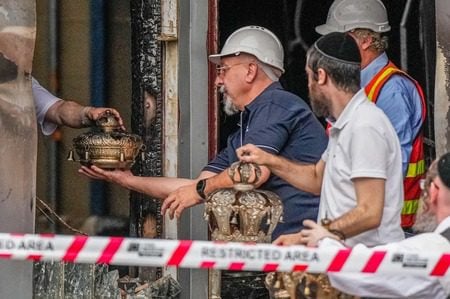
Australia accused Iran of orchestrating anti-Semitic arson attacks on Jewish institutions.
Police in Melbourne announced arrests tied to synagogue fires and vandalism that have rattled the country’s Jewish community.
Prime Minister Anthony Albanese said the Iranian-directed attacks were “extraordinary and dangerous acts of aggression” designed to destabilize Australia.
The government will also designate Iran’s Islamic Revolutionary Guard Corps as a terrorist organization and suspend operations at its embassy in Tehran.
Australia has already moved Australian diplomats to a third country.
“ASIO [Australian Security Intelligence Organization] has now gathered enough credible intelligence to reach a deeply disturbing conclusion,” Albanese said at a press conference Aug. 26.
“The Iranian government directed at least two of these attacks.
“Iran has sought to disguise its involvement, but ASIO assesses it was behind the attacks.
“These were extraordinary and dangerous acts of aggression orchestrated by a foreign nation on Australian soil.
“They were attempts to undermine social cohesion and sow discord in our community. It is totally unacceptable.”
Iran has a long track record of sowing violence against Jewish and Israeli targets abroad. Police in multiple European countries have accused Iran of orchestrating recent attacks on Jewish and Israeli sites.
The Australian response appears to be the most extensive.
Foreign Minister Penny Wong announced the expulsion of Ambassador Ahmad Sadeghi and three other Iranian officials.
“We have made this decision because Iran’s actions are completely unacceptable,” she said.
Authorities said Tehran was behind at least two 2024 incidents:
• the October firebombing of Lewis’ Continental Kitchen, a kosher deli in Sydney, and
• the December arson attack on Melbourne’s Adass Israel Synagogue that destroyed much of the historic house of worship.
ASIO chief Mike Burgess said investigators traced the operations to the IRGC, which used proxies to disguise its role.
“Iran and its proxies, literally and figuratively, lit the matches and fanned the flames,” he said.
The government’s announcement came alongside breakthroughs in the domestic investigation into the wave of anti-Semitic violence that has roiled the country and its sizable Jewish community.
In mid-August, police charged a 20-year-old man from the Melbourne suburb of Meadow Heights with arson, conduct endangering life, and theft of a motor vehicle.
He is the second suspect charged in the case after police arrested a 21-year-old man in July.
“This investigation has been one of the highest priorities for the [Joint Counter Terrorism Team],” Australian Federal Police Acting Assistant Commissioner Nick Read said.
“We remain laser focused on identifying those responsible and holding them to account.”
Jewish leaders called the December firebombing a turning point in the country’s fight against anti-Semitism.
Police also announced on Aug. 25 the arrest of a 37-year-old man accused of repeatedly vandalizing Melbourne Hebrew Congregation in South Yarra.
Authorities said the suspect defaced the synagogue on six occasions between March and August, sometimes riding a scooter and wearing a “Ghostface” mask from the Scream horror film franchise.
He was charged with multiple counts of criminal damage and graffiti, along with driving-related offenses. He was released on bail and is due in court in November.
The arrest followed another July 8 attack in which the entrance to the East Melbourne Hebrew Congregation was set ablaze.
Four people were arrested in that case, including a man charged with arson and endangering life, according to the Jewish Community Council of Victoria.
The arrests highlight what Jewish leaders describe as a worsening security crisis.
The Executive Council of Australian Jewry recorded 2,062 anti-Semitic incidents between October 2023 and September 2024 — a fourfold increase from the previous year.
Recent incidents include synagogue and school firebombings, and threats against Jewish patients by hospital staff.
In January, police discovered a trailer filled with explosives, which investigators later said was part of an elaborate hoax orchestrated by an organized crime boss.
“Our community will perhaps find some solace from this breakthrough in the investigation and in knowing that the skill and devotion of our law enforcement and security agencies is there to protect us,” said Daniel Aghion, president of the executive council.
“Yet there will be great anxiety that we have been targeted in such a callous and calculated way, by a ruthless and violent foreign force, because of who we are.”
Israel’s embassy in Canberra praised the move to blacklist the IRGC, posting to X:
“Iran’s regime is not only a threat to Jews or Israel, it endangers the entire free world, including Australia.”
The announcements come amid strained ties between Israel and Australia.
Israeli Prime Minister Benjamin Netanyahu blasted Albanese on Aug. 11 for his plan to recognize a Palestinian state at the UN, calling him a “weak politician who betrayed Israel.”
Netanyahu also accused the Australian leader of failing to address anti-Semitism, giving him a deadline of next month’s Rosh Hashanah holiday to act.
Albanese brushed off the criticism.


